The post My Search to Find a Carbon Calculator Tool Anyone with a Smartphone Can Use is 50% Accomplished appeared first on Techso Mogro.
]]>Why do I state that in finding SWRM I have accomplished 50% of my goal to find the perfect carbon calculation tool for consumers? Because so far, SWRM, a downloadable application for smartphones is only available on iPhone platforms. In conversation with Gilkes she indicated that an Android version of the application is pending with the only thing holding it up, the company’s newness and lack of resources to have completed both application versions. As an Android smartphone user I cannot download the application as of yet, but I could visit the company’s website and play the online versions that are there, one called the Carbon Footprint Calculator, and the second, a Seasonal Produce Guide for calculating the carbon contribution of fresh fruits and vegetables you buy. On the former’s page there is a link to the App Store where you can get SWRM for free.
I have played around with a number of carbon calculators since I first started assessing tools that the average consumer can use to help mitigate the carbon crisis. I have written about initiatives in Switzerland to have carbon content information included on all consumer packaging so that purchasers can assess the sustainability of one product versus another. To date, I have seen and assessed more than 30 tools and even attempted to create a footprint calculator on my own which I have subjected a number of people to for feedback. I have found the creation of such tools to be a very difficult task indeed.
But having run across SWRM and having talked with Gilkes while at Collision 2019, I, for the first time, see a means by which all of us with smartphones in hand can become engaged in altering our buying behaviour to help sustain the planet.
On the SWRM website it states, “we are passionate about changing the planet. Or to be more accurate, not changing the planet’s climate. Climate science has taught us that we are living above the sustainable limit of our carbon footprint.” But unless we know what that footprint is, unless we have the hard data to make sustainable decisions, it becomes difficult for individuals to make a difference.
The name SWRM honours the honeybee with the beehive being described on the company’s website as “the most efficient system in existence.” Whether the science of this statement is well proven or not, the app the company has created can lead to swarm behaviour, a combined collective activity that all of us can do in our daily lives with the purpose of fostering the planet’s sustainability. The goal in using SWRM is to eventually achieve a personal carbon footprint below the planetary sustainable limit.
If you are an iPhone owner and reader of this blog, I encourage you to try the application. It is quite simple to use. When you go to do comparison shopping, scan the barcode of different products and compare the energy contribution of each, or change the selection to compare carbon contribution. It is an eye-opener.

The post My Search to Find a Carbon Calculator Tool Anyone with a Smartphone Can Use is 50% Accomplished appeared first on Techso Mogro.
]]>The post Gizmos & Gadgets: If you Experience Atrial Fibrillation You May Want This App appeared first on Techso Mogro.
]]>Two large studies done in Hong Kong, one at the Chinese University of Hong Kong including 12,000 participants, and another study at Hong Kong’s Princess Margaret Hospital involving over 10,000 participants, yielded accurate detections of AFib and even detected the condition in those previously undiagnosed. The company is more than ecstatic about the results and not surprisingly describes Kardia as the most clinically validated EKG solution on the market.
How does it work?
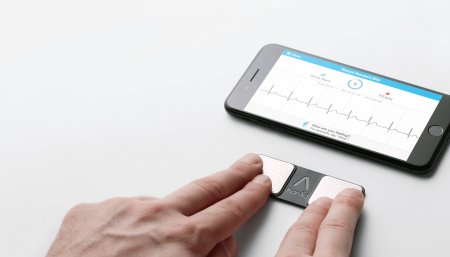
There are two components to Kardia: the app running on an Android or Apple smartphone, and a single-lead rhythm strip that can slip into a pocket or wallet. When a user detects something odd in their heart rhythm they can sit down, take out the strip, open the app, and place two fingers from each hand on the strip keeping them there for 30 seconds.
The mobile app wirelessly picks up the users heart rhythm with the single-lead rhythm strip working like the leads found in standard EKG machines. The information detected is transmitted to the app containing an algorithm that presents 98% accuracy in reading heart rhythm and 97% effectiveness in detecting AFib. The results compare favourably to wearing a Holter monitor or using a portable device for monitoring and recording heart rhythm over several days.
Kardia gives its users the ability to monitor their hearts any time they think something could be wrong. The app keeps a personal heart profile which can be shared with doctors.
The company’s literature contains two user quotes that are worth sharing. States one, “Several times when I was in atrial fibrillation, I was able to talk with my doctor by phone and adjust medication and avoid a trip to the ER.” And another, “I went years without a diagnosis. With Kardia I had the ability to take an EKG whenever I felt anything unusual. After only two readings I had a conclusive diagnosis….Now I use it to track my AFib events and discuss treatment options with my doctor.”
And at $99 U.S., anyone who has experienced or been diagnosed with AFib may want to consider making the investment. You can download the app from the App Store and Google Play. It runs on iPhone models from the 4s to the 7 Plus, and on Samsung Galaxy Note and S3, 4, 5, 6 and 7 models plus the LG Nexus 5, HTC One M7, Jitterbug Touch 3, and Google Pixel and Pixel XL. AliveCor notes that if you do not have one of these devices it cannot guarantee compatibility.
The post Gizmos & Gadgets: If you Experience Atrial Fibrillation You May Want This App appeared first on Techso Mogro.
]]>The post Gizmos & Gadgets: Smartphone App to Detect Asthma, Pneumonia, and Obstructive Respiratory Distress appeared first on Techso Mogro.
]]>In an initial 2013 trial at Sardjito Hospital, Indonesia, which involved 91 patients, the app successfully diagnosed childhood pneumonia with 85% accuracy on cough sounds alone.When presence of fever and other symptoms were noted accuracy in diagnosis increased above 95%. The clinical study also accurately diagnosed asthma although that was not the focus of the initial trial.
Current much larger trials at Wesley Hospital, Brisbane, Joondalup Health and Princess Margaret Hospital, Perth, have so far achieved similar if not better diagnostic results in a group that includes smokers, non-smokers, chronic obstructive respiratory disease (COPD), a disease category that includes emphysema and bronchitis, asthma, pneumonia and upper respiratory tract infections (URTI). The trials include 598 children and 322 adult subjects with more signing up. Preliminary results of these clinical trials have been published with accuracy based on cough sounds alone exceeding 90%.
How does ResApp work?
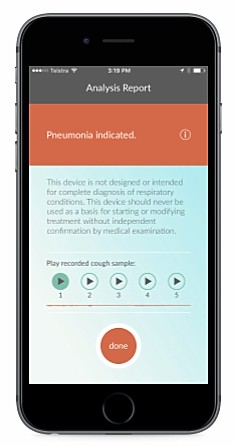
The app acts like a physician listening to breath sounds through a stethoscope. Instead of the stethoscope we have the smartphone microphone which records sound and then matches the results against sound signatures from a database that accurately characterizes respiratory diseases. A patient’s cough has always been the best way for doctors to make diagnoses during a chest examination. That’s because normal breathing sounds are dampened by chest muscles but a cough connects the lungs directly through the bronchi and trachea to the outside making audible sounds produced excellent sources of information. When ResApp hears a cough it compares unique signatures for asthma, COPD, pneumonia, emphysema and URTI with what it records.
Three U.S. hospitals are now using ResApp in clinical trial. This assessment called Smartcough-C involves a multi-centre, double-blind study to see if the app can accurately diagnose childhood pneumonia.
ResApp has the potential to be used not just in clinics, emergency rooms and outpatient facilities, but also as part of a telehealth system for doing remote diagnoses.
Some stats about respiratory diseases:
It would seem that an app like ResApp could be useful in early diagnosis and treatment particularly in those areas of the planet where medical infrastructure and availability of doctors is minimal.

The post Gizmos & Gadgets: Smartphone App to Detect Asthma, Pneumonia, and Obstructive Respiratory Distress appeared first on Techso Mogro.
]]>The post Gizmos & Gadgets: Smartphone App Diagnoses Atrial Fibrillation appeared first on Techso Mogro.
]]>
Atrial fibrillation or A-Fib occurs in 2% of the population and causes seven million strokes globally per year. Pre-emptive diagnosis and treatment could eliminate 70% of these A-Fib-caused strokes.
Other ways to detect A-Fib include a visit to the doctor and being hooked up to an electrocardiogram or ECG. But an A-Fib event may not happen over the short duration of an office visit. Cardiologists today also can use a device called a holter monitor, which is portable and battery-powered. It is worn by the patient and involves attaching electrodes to the chest. Typically the patient uses the device for 24 to 48 hours while it records heart rhythm. There is no guarantee that during the period warn a holter monitor will capture an A-Fib event.
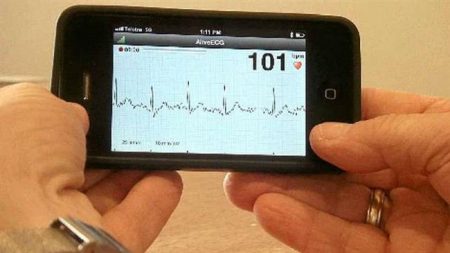
The use of a smartphone and app is a far simpler detection method. If a person is feeling odd and wants to check his or her cardiac status all they do is lie down with the phone placed on the chest. The app will provide a “yes” or “no” result in a matter of a minute.
Tero Koivisto, Vice-Director of the Technology Research Centre at University of Turku, Finland, and a lead author in the publication of the app study, states “this is a low cost, non-invasive way to detect atrial fibrillation that people can do themselves without any help from medical staff. Given the widespread use of smartphones, it has the potential to be used by large populations worldwide. In future, a secure cloud service could be created to store and analyze larger masses of data.”
The post Gizmos & Gadgets: Smartphone App Diagnoses Atrial Fibrillation appeared first on Techso Mogro.
]]>The post Gizmos & Gadgets: Lifestyle GPS Comes to Diabetes Patients with Smartphones appeared first on Techso Mogro.
]]>Between 90 and 95% of diabetics suffer from Type 2 diabetes also known as adult-onset. So of the 422 million diagnosed with the condition 387 million suffer from Type 2. Getting closer to home, in the United States 9.3% of all adults are diabetic. And among seniors (65 or older) that number is 25.9%.
What’s the major cause? Lifestyle. Too much weight and not enough activity. Eating a diet high in sugar and saturated fats. The role obesity plays cannot be underscored enough. From Canadian statistics in 2014, among those 18 years and older categorized as obese, 14.6% had diabetes. For non-obese Canadians in the same category the rate of diabetes was 5.2%.
So if lifestyle is the cause then why not create a lifestyle self-help tool. Enter Suggestic, a California Silicon Valley startup that has developed an application and Internet site focused on personal wellness with the aim to reverse Type 2 diabetes through lifestyle management. Shai Rosen, co-founder and chief marketing officer for the company calls their app a “lifestyle GPS.”

To use it you download the app from the Suggestic site. It prompts you to enter personalized health and genetic data. The site analyzes these entries and creates a first plan recommending diet, nutrition, activities, sleep, stress management, supplements and other suggestions. As you use it and see improvements the app continuously helps you visualize your progress through positive feedback and negative if you stray from the path.
What will you see when you use Suggestic?
The results are only achievable if the data going in is good. Suggestic asks you to submit DNA, blood, saliva and gut microbiome lab results. Why? This gives it a digital presentation of you.
The science behind this is simple. The idea is to inhibit negative gene expression over a lifetime through lifestyle modifications to reverse epigenetic triggers that can turn biological disease switches on. In this way Suggestic can achieve its goal to reverse Type 2 diabetes.
What’s behind the Suggestic app and site?
The AI tool used was first developed by Suggestic’s founders to assist banks in doing causal pattern recognition for fraud detection. In this case they have adapted it to discover causal patterns within individual lifestyles.
The app is expected to be launched this month in the United States. The company hopes to go global in the near future.

The post Gizmos & Gadgets: Lifestyle GPS Comes to Diabetes Patients with Smartphones appeared first on Techso Mogro.
]]>The post How the iPhone 6 and Other Smartphones Will Improve Your Health appeared first on Techso Mogro.
]]>———-
With the iPhone 6 creating a healthy buzz and the potential release of it and the iPhone 7 this year, according to Know Your Mobile, it is clear that smartphones are evolving into reliable medical tools for both professionals and the public. Thanks to the advancement of mobile devices, the power of healing is now within the grasp of every smartphone user.
When you think of soon-to-be physicians and nurses studying for their clinical exams, you probably imagine them hitting the books and putting in hours upon hours of laboratory work. What you probably never thought is how they are using smartphones as part of their training.
Smartphones have become a popular training tool with more than 50 percent of them using smartphone and tablet apps as part of their everyday clinical practice reports the Bulletin of the American College of Surgeons. Students, for example, are using mobile devices to simulate surgical procedures, look up surgical illustrations and access medical data from online libraries. In fact, in the Apple Store you can find over 900 surgery-related apps. There are more than 650 medical apps in the Google Play Store, many of them useful for surgical medical students. Whether Apple or Android, surgical and other medical students can find useful teaching tools and guides. For surgical wannabes there are detailed explanations for numerous surgical procedures that include preop, intraoperative and postoperative care.
Handwritten notes are being replaced by tablets, smartphones, netbooks and other digital, text-friendly devices. Apps such as Evernote and Notability allow medical students to not only take notes, but also to collect documents, file photos and record audio, which they can categorize into a searchable database.
Today’s mobile device users are accustomed to quick information at the tip of their fingers. The iPhone 6 has a new Health app to gather and organize personal health information. Input basic information and view statistics from fitness third parties such as Nike+. Record footsteps, heart rate and sleep activity. Create an emergency calling card in your phone with personal medical information, such as blood type, food allergies, and an emergency contact list.
Beyond the iPhone-exclusive technology, there are a plethora of other health apps available. For example, the app iTriage available on iPhone and Android devices offers information on common symptoms, local doctors and facilities, certain medications and procedures, and the latest news on all the topics for the day. It has been downloaded more than 12 million times since its launch. And it is not alone. There are numerous other apps available to help maintain a healthy lifestyle. Check out these:
Overall, your smartphone is a powerful tool with a lot of potential in the medical field. Whether you are a doctor looking for an article, a student scribbling medical notes or an average consumer trying to find a healthy recipe, your smartphone is now there to help.

The post How the iPhone 6 and Other Smartphones Will Improve Your Health appeared first on Techso Mogro.
]]>The post More on the Future as Predicted by the Consumer Electronics Show appeared first on Techso Mogro.
]]>———-
It has been promised to us in issues of Popular Mechanics since the 1930s. It has been a staple of past World’s Fairs. And we have seen it on television shows like The Jetsons, Batman and Get Smart. It even made an appearance as early as 1922 in Buster Keaton‘s aptly titled movie, The Electric House. It was the home of the future – automated, connected, efficient and smart.
Well based on what was on display at CES 2015, it may finally have arrived. At CES the modern connected home was on display with manufacturers in various fields and industries touting smart, connected products. Everything from Smart devices to wireless chargers to massive 8K televisions dotted the convention center. Unlike in years past, in which many products shown were prototypes rather than commercially available, this year’s CES featured a large number of off-the-shelf items, available for purchase right now.
There were lots of 4K ultra-high definition televisions scattered around the exhibits. The 3,840 x 2,160 pixel screens for home theater are spectacular with unsurpassed picture detail and clarity. And they are huge, some as large as 75 inches and many featuring touch.
But manufacturers like Samsung were showing even more advanced displays at CES. 8K TV sets with image dimensions measuring 7,680 x 4,320 pixels speak to a future when entire walls in homes will become displays. But even more intriguing is the fact that both 4K and 8K televisions are just a part of what is becoming the interconnected smart home.
At CES developers, Samsung included (see image below), showed applications running on mobile smart phones that replace all the remote controls you use on the devices in your home. These smart apps can operate all your electronics from those enormous wall-sized 4K and 8K displays to the washer and dryer. They can program and time your lights, thermostats, and door locks. They can automatically turn on your espresso machine, oven and other kitchen appliances. They can warm the car and start it on a cold winter morning. They have the capacity to learn your preferences and monitor and adjust automatically to your patterns.
Counter-intuitive, we know, but true – after all, what’s simpler than being able to control all of the devices in your home from a single device, today’s smartphone – a magical, all-in-one remote control that has finally arrived. Who would have guessed that it would come in the form of a mobile phone?

The post More on the Future as Predicted by the Consumer Electronics Show appeared first on Techso Mogro.
]]>The post Gizmos & Gadgets: Want to Write Them Then Start With These Tools appeared first on Techso Mogro.
]]>His topic today is a bit of departure from our usual Gizmos & Gadgets content. But I thought you would find it quite interesting.
———-
In these days of instant access and the ability to learn anything at any time, just knowing that something works is no longer good enough. People want to know how it works and then many times they want to take it to the next level and create it themselves. This is no more evident than in the world of programming and coding. The sheer number of apps that have been created is incredible. Apple states that it has 1.2 million apps available in the App Store and Android offers 1.3 million.
Many people start their journey into the world of coding by just having an idea. Creators want to make something or change something that can make their own personal lives better. Then they tell their friends about it, who tell their friends and suddenly you have a high demand app without even trying. But where do you start and what are the best resources available to you if you are a true beginner in the world of programming?
Here’s three of the top online resources to help you get your career rolling or advance your skills to the next level:
Founded in 2011, Codecademy has quickly become one of the biggest and most well-known resources for learning how to code thanks to some great press. With lessons available in many of the most common languages including JavaScript, Python and Ruby, Codecademy sets itself apart by also focusing on teaching how to correctly and effectively use the application programming interface (API) provided by companies to grant access to their data.
Keep in mind that Codecademy is a free training program which is great for beginners but it does not offer training in advanced coding or programming.
This all-you-can-learn program is designed to be an easily accessible training platform that anyone of any skill level can use to view videos and training material on software, programming and beyond. Skillfeed is a popular go-to resource for people who want to learn more about their trade. With a wide variety of courses available and covering a plethora of programs and coding languages like Java, Skillfeed can help users regardless if they are a first time coder looking to create an app, or a seasoned veteran programmer looking to refine and expand their skills.
With well over 5,000 video-based courses and growing, Lynda.com is one of the top resources for quick, reliable information and instruction right when you need it. Lynda.com also boasts an impressive pool of experts and teachers that can help users out along their learning journeys and Lynda.com offers lessons to help users of any skill level. Accounts can also be synced across multiple devices and platforms so users can access their resources no matter where they are.
With smartphone and tablet technology continuing to advance, the ability to adapt and keep up with the programming and coding that goes into running today’s technology will be a key factor in staying competitive and sharp in the industry.

The post Gizmos & Gadgets: Want to Write Them Then Start With These Tools appeared first on Techso Mogro.
]]>The post Learn About PEEK and Maybe Help Prevent Blindness appeared first on Techso Mogro.
]]>

Not designed for you to use in self-diagnosis, it is a field tool for medical professionals to deliver comprehensive eye examinations anywhere in the world. On the project website the developers talk about the 39 million estimated who are blind. But that understates the global problem because according to Dr. Oleg Chestnov, Assistant Director-General, Noncommunicable Diseases and Mental Health, World Health Organization (WHO), the total number of visually impaired based on 2010 global estimates equals 285 million.
Of those suffering from eye impairment 80% are deemed preventable or curable. What’s missing, the provision of effective, accessible eye care services.
Chestnov states in the preface to WHO’s Eye Action Plan 2014-2019, that two-thirds of visually impaired people would recover good eyesight if eye health providers delivered on two issues: accessible eye exams and cataract surgery. With PEEK in the field, the first of these two, accessible eye exams should no longer be an issue. PEEK will make it possible to bring best medical practice to the field running on a wide range of smartphones including popular Apple, Samsung, HTC and Sony models.
In total these apps along with the camera adapter will deliver the equivalent to the best eye examinations one would get from an ophthamologist. The enormous cost saving, portability and accessibility will bring the promise of meeting WHO objectives of delivering universal eye examinations to reality.
With the PEEK retinal camera and apps eye doctors anywhere will be able to diagnose:
PEEK is currently raising funds through pledges on Indiegogo, the crowdfunding site. Its goal is to raise 70,000 British pounds. So far it has achieved 87% of its target with 31 days to go in the fundraising campaign. You can help them get over the top with a pledge of one pound or more. A 60 pound pledge will deliver the PEEK retinal camera and apps to one healthcare worker with Medecins Sans Frontieres or the International Agency for the Prevention of Blindness.
PEEK’s goal is to have first units on the market by October 2015. Right now they are ramping up for production and are seeking certification through regulatory bodies in the U.S., European Union and other national health agencies.

The post Learn About PEEK and Maybe Help Prevent Blindness appeared first on Techso Mogro.
]]>The post Gizmos & Gadgets: Turn a Smartphone into a Virtual Cane for the Blind appeared first on Techso Mogro.
]]>In the myth Ariadne gave Theseus a skein of thread which he laid down as he wandered through the labyrinth in search of the Minotaur. When he finally found the creature and killed it he was able to follow the thread back to the entrance.
It uses augmented perception and not GPS (because it doesn’t work inside a building) to navigate inside a structure. To use it the building must first be mapped out using tape placed on the floor to show routes much like hospitals which have been using colour keyed lines as navigation guides for visitors and patients.
Using the smartphone’s built-in camera, a user points it to the ground and gently waves the phone from side to side. Each time the app encounters a line it signals the phone to vibrate creating a tactile response, thus acting as a virtual cane. The user then follows the line to find how to get to his or her destination within the building.
The lines can be further enhanced with QR codes placed on the ground to provide additional information for the smartphone app user. See the image below to see just how this would work. Important destinations could be labelled making them easy to find for the unsighted user.
The inventors believe future versions can use infrared lines picked up by the built-in detection capability already featured in many smartphone models. Not yet commercially available, the developers, who demonstrated the technology in December at the Boston based, Andrea Bocelli Foundation, state that most of the technology for the app is already available off-the-shelf today.
For more information download the PDF describing the technology at pAth Recognition for Indoor Assisted NavigatioN with Augmented perception.

The post Gizmos & Gadgets: Turn a Smartphone into a Virtual Cane for the Blind appeared first on Techso Mogro.
]]>


