How is it doing it?
A robot dog named Spot (how entirely unoriginal if your as old as I am and had to read “Fun with Dick and Jane” as a child) built by Boston Dynamics, began patroling Bishan-Ang Mo Kio Park last Friday. This is an initial two-week trial in which the four-legged bot wanders through the park and along its many sidewalks to remind park visitors to practice social distancing.
Spot comes with an onboard 360-degree camera and data analytics software that determines the number of people in the park at any time. The initial test is over a three-kilometer stretch during off-peak hours. Spot is accompanied by a human attendant. If the trial is successful, Spot will be deployed regularly during morning and evening peak hours. And other spots will become a part of many of the other parks in the city-state.
Boston Dynamics has been working on advanced mobile robots for a number of years. The company’s early years involved work on robot development for DARPA, the U.S. Defence Advanced Research Agency. For a period of time, Google was a major investor in the company located in Waltham, Massachusetts. More recently the operation was acquired by SoftBank, a Japanese multinational.
Spot is a quadruped robot that can be used both in and outdoors. It walks at a good pace and can manage going up and downstairs as well as all kinds of uneven terrain and obstacles (see picture below). It has wrap-around vision and obstacle detection and avoidance capability. It can operate autonomously and has situational awareness. It also can be operated remotely by a human if needed.

When Boston Dynamics designed the robot it saw it as useful for work in areas that could be deemed dangerous to humans. For example, it could be deployed to inspect hazardous areas at an industrial plant: think nuclear power plants and electrical utility sites. With a human operator, it could be deployed to deal with checking out a suspicious package. Or in a hospital or emergency medical situation could use it in quarantined areas, or have it deliver food and medicine without putting caregivers in harm’s way.
In Singapore, the use of Spot in park patrols means the city-state can stretch out staffing requirements for preventing new COVID-19 hotspots from emerging by enforcing social distancing. And this isn’t the only place where Spot is being deployed in Singapore. A brother to the park robot is being trialed at the Changi Exhibition Centre, a community quarantine facility in the city that his housing people with mild COVID-19 symptoms. That robodog provides a delivery service to the patients including bringing them their medications.
Singapore is figuring out even more tasks for Spot in the future. Meanwhile, it is testing other deployable robots including 30 drones to monitor its parks. Before Spot, the city-state launched a four-wheeled autonomous robot named PUB which was also deployed to one of the parks. But being on wheels doesn’t allow the robot to go off paved paths. Spot can do that.
Singapore seems to have always loved robots. It has the second-highest robot-to-human-worker density in the world, only surpassed by South Korea. Besides the parks, you find robots roaming in food courts, robot greeters in retail stores, and robots providing room service delivery to hotel guests. Robots in the hospital dispense medication. The city’s airport deploys robot cleaners. And there are even robot short-order cooks. More recently an autonomous electric-powered bus was launched with capacity for 80 passengers following a prescribed route. So Spot should fit in quite nicely in the city-state blending in with an increasingly 21stcenturyish environment that embraces new technology like no other.
]]>In recent years the lack of sufficient available freshwater resources to support water requirements of many areas of the planet has grown immensely, so much so that drought risk is on the rise and that nations affected are threatened by significant economic impacts in the coming decades.
Here are some water facts to ponder:
According to the United Nations, “Water scarcity can mean scarcity in availability due to physical shortage, or scarcity in access due to the failure of institutions to ensure a regular supply or due to a lack of adequate infrastructure. Water scarcity already affects every continent. Water use has been growing globally at more than twice the rate of population increase in the last century, and an increasing number of regions are reaching the limit at which water services can be sustainably delivered, especially in arid regions.”
In a number of cities and countries around the world, solutions are being found to tackle scarcity. Some of these are traditional (damming rivers for irrigation), and some are potentially problematic in terms of environmental impact, and others are truly innovative. Here are a few examples:
Miroslav Lajčák, President of the United Nation’s General Assembly, has called for greater international cooperation around the issue of freshwater scarcity. At a recent meeting he stated, “Scarcity of water – exacerbated by climate change or humanitarian disasters – can cause tensions between people, communities, and countries….We will need more than action from governments…Strengthening water infrastructures and systems costs money. And we will need a lot more of it, from different sources. We also need to create environments in which innovation and entrepreneurship can flourish.”

For cities like Toronto, the garbage management process is multifaceted and problematic. Households, apartments, and condos have multi-coloured bins for recyclable plastic, metal, paper (blue), organic recyclables (green), and what is disposable (grey). The city collects from homes with curbside pickup and delivers the blue bin recyclables to warehouses where the stuff is sorted and stashed awaiting buyers who can turn the collected material into new products. The green bin recyclables are collected to turn into compost which the city uses for parks and other green spaces, and gives away to residents at community recycling events. The grey bin garbage goes to landfill sites with one even in neighbouring Michigan. That’s right. Toronto exports garbage to the United States and we pay an American landfill operator to take it. At one point Toronto was considering sending its non-recyclable garbage to an abandoned open-pit iron mine site some 600 kilometers (almost 400 miles) north of the city.
Proposals to incinerate garbage have always been opposed by Toronto politicians on the grounds that pollutants produced from burning impact air quality, add greenhouse gases to the atmosphere, and produce ash waste that can be filled with unknown quantities of toxic metals and chemicals. But in other urban centers where landfill options are limited, incineration is seen as a solution to the garbage problem.
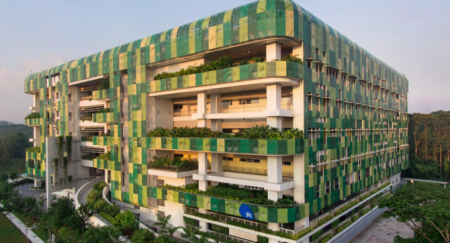
Singapore is the latest city to see garbage in a “waste-to-energy” light. Because the city has very little real estate it can waste on waste, it has opened a new facility, the Innovation Centre for Environmental Technology, where research by a Japanese company, JFE Engineering, is developing direct melting gasification, a technology that burns garbage leaving only slag (which can be put into landfill), metal, and other potentially commercial end products.
Meanwhile in Duiven, The Netherlands, the Dutch waste to energy company, AVR, is building a waste-to-energy plant which includes large-scale carbon capture and utilization (CCUS) capability. After the waste is burned 60,000 tons of carbon dioxide (CO2) will be captured and liquefied for transport to the French company, Air Liquide, who will use the gas in Dutch greenhouse operations where vegetables, fruit, flowers, and other plants are grown. The capacity of the CCUS technology can only manage 15% of the total CO2 emissions produced, but AVR expects to find additional customers with a goal to eventually capture and reuse 800,000 tons annually. Other potential customers include manufacturers of building materials, concrete, plastics, and biofuels. The biofuels produced could even be used to heat the greenhouses through the Dutch winter.
But the ultimate waste-to-energy technology is one that produces zero emissions. Companies and inventors have come and gone claiming to have found the solution for economically turning waste into energy without contaminating byproducts. One such is ZEROS System, a Highlands, Texas-based company just to the east of Houston. Its website describes the Zero-emission Energy Recycling Oxidation System capable of disposing of waste and turning it into energy and useful products while producing no emissions. ZEROS, based on patents first issued in the 1980s, has been used once in remediating an oil field accident. But other than that has yet to have attracted a customer to implement its stackless technology. As you read the content of the website it sounds too good to be true. Finding corroborative evidence to support the site’s claims yields next to nothing. The last report on the technology looks at economic feasibility. It was written in 2011. And then there is a 2013 YouTube video.
The search for the zero or negative-zero emissions holy grail is still on. Maybe the new Singapore initiative or the work being done in The Netherlands will finally produce it. I’ll keep you posted.
]]>nuTonomy, the software company offering its Singapore on demand taxi service uses a mobile app that residents can download. They can then hail a self-driving car, modified Mitsubishi iMievs and Renault Zoes. The cars will be autonomous but the company has an engineer riding shotgun to act as both a monitor and fail safe should something go wrong. Throughout the public trial nuTonomy will be looking at the data it collects to help it improve the service from booking rpocess to passenger experience. For the moment the area of coverage is Singapore’s one-north business district.

The Uber Pittsburgh trial will use its existing mobile app. Passengers will hail a driverless car and experience the trip for free. The vehicles in this test will have a safety driver on board to serve a similar purpose to the one on board nuTonomy’s taxis. The Uberized Volvos will be equipped with a table computer for passenger use. They will be able to follow the car’s progress and receive an explanation of what is happening. In early testing Uber found out that its autonomous vehicle system didn’t like bridges and Pittsburgh has 500 of them. That could be a bit of a challenge.

The vehicles or pods are autonomous and operate in all kinds of weather conditions. The Singapore technology is described as 3rd Generation Group Rapid Transit (GRT). Each pod can carry up to 24 passengers per trip with the goal to handle 8,000 passengers per hour.
For SMRT Services the use of 2Getthere pods represents an integral part of what is a multi-modal transit strategy for Singapore. Fully automated driverless vehicles operate along dedicated networks of roads with high frequency service. The technology uses artificial landmark beacons to manage selected Singapore road networks.
2Getthere has been developing the technology since 1984 and installed its first people movers in 2002 at the Floriade horticultural exposition held in Haarlemmermeer, Netherlands (see image below). Since then the company has moved a 3rd generation of autonomously driven pod technology. A smaller version of the pods to be used in Singapore have been running in Abu Dhabi‘s Masdar City since 2010 over a 1.5 kilometer netowrk with 10 vehicles providing thousands of commutes daily. Unlike Floriade, the Masdar City installation is the first urban public GRT.

Although the GRTs implemented to date run on exclusive rights-of-way, the Singapore technology will operate in a network configuration providing both scheduled and on-demand options. Colin Lim, Managing Director for SMRT Services describes the 2Getthere technology as meeting first and last-mile connectivity in Singapore.
]]>Singapore is a small island but home to over 5.5 million. As you can imagine traffic congestion is fierce. The government offers free travel on city trains during peak hours and even provides free breakfast vouchers. To discourage drivers for every automobile you must pay a certificate of entitlement, equal to the purchase price of the vehicle. Yet despite the push for public transit use and the onerous cost of ownership, vehicle congestion remains high.
Singapore has been experimenting with autonomous vehicles for a number of years. They have been running a driverless shuttle bus called Navia in two locations in 2014. The National University campus features driverless vehicles as well. And in the Jurong Lake District’s Japanese and Chinese gardens this fall, Singapore deployed driverless cars with an online booking system and vehicle-to-vehicle communication for several weekends.
In simulations driverless vehicles appear to be far more efficient than human-operated cars and trucks. They can operate with double the density and with far less congestion. With autonomous vehicles traffic lights can be eliminated. And with little in the way of bottlenecks, they reduce greenhouse gas emissions.
The Singapore test, to be done in one of its most congested neighborhoods, will study the impact on pedestrians and bicycles.
Impediments remain. The GPS maps upon which autonomous vehicles rely for navigation need to be three-dimensional with positional accuracy tolerances of 20 centimeters (about 8 inches).
If the deployment succeeds Singapore intends to roll out autonomous vehicles across the entire island state. They will be the first country to do this but certainly not the last. The United Kingdom, Sweden and a number of American states are deploying autonomous vehicles bringing the technology closer to within a decade becoming ubiquitous globally.

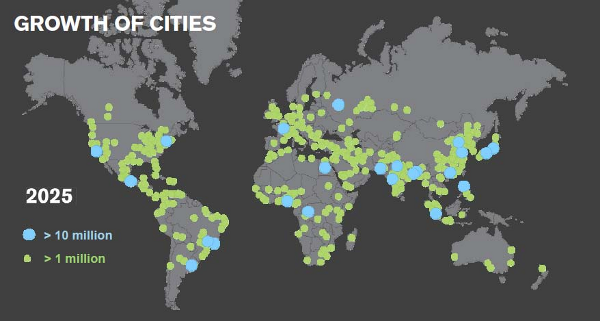
What struck me about the speech was the following quote: “By 2025, which is tomorrow morning in geologic time, and at the scale in which we invest in mining, 630 million people, or 14 per cent of the world’s urban population, and 8 per cent of all the people walking on this planet, will live in 37 megacities…..As you build those cities, not only are you wildly consumptive of copper and steel and iron and molybdenum, but look at the air. If you want to clean that air, the environmental metals are copper, platinum and palladium.” In other words, being in mining in the 21st century is a good thing because of the overwhelming demand for urban infrastructure and the technology to keep city environments livable.
The Urban Revolution is Here and it Looks Ugly
Friedland’s perceptions reflect current statistical trends. The year 2008 was the first time in human recorded history that more than half of us lived in towns and cities. And forecasters are predicting that by 2040, two-thirds of us will be urban dwellers. I’m not sure if Friedland recognizes that the growing cities of the future are not the mature ones of the Developed World, but are in fact those in Asia, South America and Africa where rural to urban migration has exploded. For a list of the fastest growing megacities of the Developing World, check out my former posting on the subject.
Based on forecasts our urban population by 2040 will be 5.6 billion. The cities holding the most of us will be like Lagos, Nigeria, Africa’s largest urban centre a city of 20 million and already bursting at the seams. Presenting a dichotomy of glittering glass towers and fetid, overcrowded shantytowns, cities like Lagos are the ones that need new infrastructure but don’t necessarily have the economics running in their favor to make the investment. Instead Lagos and others like it could implode becoming dysfunctional environments where inhabitants fight over insufficient food, water and energy. Add to this the potential destructiveness of global warming and you have a recipe for urban nightmares where extreme weather events and heatwaves create frightful scenarios.

Developed World Urban Planners Have a Different Perspective
So much of urban planning tends to focus on the issues cities in the Developed World are facing – urban transit, recycling and waste management, attracting new industries and jobs. These urban planners talk about sustainable, planned cities rather than those facing unprecedented human migration pressures. These urban planners are planning for New York, London, Berlin, Moscow, Paris and Tokyo, not the cities of India, Pakistan, Bangladesh, Indonesia, South and Central America and Africa. It was interesting to hear yesterday that my city, Toronto, is now the 4th largest city in North America, having surpassed Chicago in population. And what are they debating in my city? Urban transit, waste management and recycling, attracting new industry albeit a casino complex, and what type of food vendors can operate on city streets. This debate is not too dissimilar to ones going on in the two immediate cities in North America larger than Toronto – Los Angeles and New York. But for North America’s largest megacity, Mexico City, the issues are far more fundamental. That’s because Mexico City has more in common with the cities of the Developing World as rural to urban migration swells its ranks.
Planners for Developed World cities talk about reducing urban sprawl through intensification and the building of vertical urban environments. Sometimes they talk about the urban poor and public housing but more often the subject of the poor is spoken of in the context of mass transit, job growth, and basic social services.
Developing World Urban Planners Deal with Malthus’ Hierarchy of Needs
Addressing the Developing World cities requires much more fundamental thinking. The issues are food, shelter and other basic necessities of life. These urban planners describe a Malthusian nightmare of informal settlements, massive slums lacking proper sanitation, drinking water, housing, energy, transportation access and other fundamental city services.
Rather than being the economic engines of their countries, Developing World cities are a drag on meeting national goals. They suck the lifeblood out of the state, or they are simply ignored. Many Developing World urban planners advise governments to discourage rural to urban migration, particularly if it is directed at existing cities. They would rather build new smaller, efficient cities designed in partnership with industry, ensuring adequate employment for urban immigrants. In a recently published article The Problem with Megacities, the author, Joel Kotkin, talks about new ideas coming from Developing World urban planners.
Garden Cities and the Developing World
One of these is an Indian urban planner, Ashok R. Datar, Chairman of the Mumbai Environmental Social Network. Datar believes that Asian megacities need to look at a different model than the cities of the West. “We are copying the Western experience in our own stupid and silly way,” states Datar and suggests that smaller “garden cities” would be preferable. In rejecting the Developed World megacity model the Developing World should look to cities like Singapore, and emulate it. Singapore since the 1960s has been a planned environment balancing urban development with a green garden mentality, making it one of the most sustainable cities on the planet.
In the two images below you can see just how faithful Singapore urban planners have been to fulfilling the concept of an urban garden. The map on the left shows vegetation cover in 1986. The blue areas have no forest canopy or parkland. The map on the right shows the vegetation cover as of 2007.

Singapore is not a small urban centre but it represents a way forward for the Developing World as it addresses its growing population of urban dwellers. I’m not sure where Friedland’s predictions fit within a Developing World model based on garden cities that are smaller and healthier. But I’m sure even these urban centres will need the copper, steel, molybdenum, platinum and palladium that mines will continue to produce. Just probably less of all of these primary metals because garden cities will reuse and recycle so much of what they need to create a sustainable future.
]]>This is our past and present. What about our future? What will our global community look like in 2100? How will we organize? How will we govern? How will we oppose? I would argue that today we already have the tools in place to disrupt what has been. Let’s look at what may very well be our world in 2100.
The tools to invent this altered world exist today so it is not too much of a stretch to imagine that many if not all of these predictions will come true. Over the next few weeks I will be exploring each of these topics in greater detail. So let’s begin.
1. The Rise of City Over Nation State
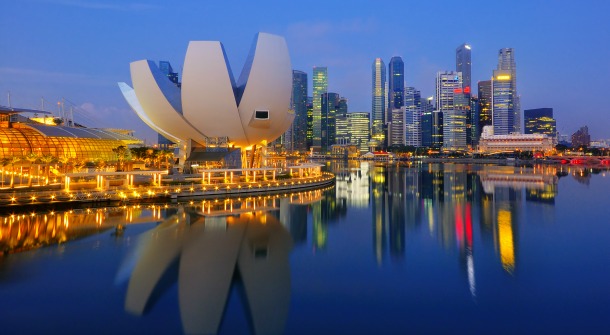
Is Singapore the model for governance in the 21st century? Its 5 million people live on an island a mere 697 square kilometers. Born out of a colonial past, Singapore first gained independence as part of Malaya in 1961 but four years later separated to become a republic in the form of a city state. Today there is no equivalent to it on the planet but will other cities emulate Singapore sometime in the 21st century?

When you think about it, city states in the Internet Age may make more sense than any other form of government. And if Singapore is the example to follow it is hard to argue with a city state model that has produced:
Singapore punches well above its weight regionally and globally proving that a progressive city state works for the 21st century. Unfettered from a hinterland, unrestricted by state and federal ties, able to respond to the immediate needs of its citizens, can you imagine New York City, Chicago, London, Barcelona, or Toronto moving in the direction of the Singapore model. Will cities facing the challenges of the 21st century declare themselves independent? For those of us who have grown up in federations or nation states the idea seems fanciful but is it? Are our federal institutions or even state, provincial or regional governments better able to address local needs? In the United States where the federal government increasingly seems unworkable, would an Atlanta, Miami or New York be better off on their own?
In Part 2 we will continue to look in our crystal ball and speculate on how the Internet and social media will alter democratic processes in the 21st century. I invite you to come along for the ride.
]]>
Singapore First to Open Vertical Urban Farm
Sky Greens has opened the first 3.65-hectare (9 acre) farm on the island of Singapore providing fresh vegetables to local consumers. The farm consists of 120 vertical towers with plans to expand to 300 by next year. Today Singapore can only produce about 7% of its total food requirements because of scarce agricultural land on the island. As a result much of the food consumed by Singaporeans comes from neighbouring Malaysia. Sky Greens uses a system it calls A-Go-Gro. Each vertical system is 9 meters (approximately 30 feet) in height. Currently the farm is growing Chinese Cabbage, Spinach, Lettuce, Xiao Bai Cai, Bayam, Kang Kong, Cai Xin , Gai Lan and Nai Bai. Sky Greens hopes to increase Singapore production by almost 50% to allow the island nation to grow 10% of its total food requirement.

Bananas May be the New Potatoes of a Warming World
For many in the Developing World potatoes may not be an accessible food staple as temperatures rise according to United Nations experts looking at the future of food security. In a report on food security and climate change, the scientists predicted a decline in corn, rice, wheat and potato production. Already many of these crops are stressed in warmer climates so growing them will become even more difficult as temperatures rise. Instead bananas, cassava and cowpeas (also known as black0eyed peas) may become the staple food source for much of the planet. Bananas will migrate to more northerly climes where they will be a good substitute for potatoes. Wheat will disappear from semi-tropical and tropical farms. Rice and soybeans which have enjoyed rapid growth in places like Sub-Saharan Africa may disappear as well to be replaced by cassava (currently grown in many African countries) and cowpeas (seen below).

Drop in Arctic Snow and Implications for the Permafrost
In June this year according to a study appearing in Geophysical Research Letters, the snow cover in the Arctic continued to drop. Since 1980 that snow blanket that remains after spring melt has fallen from 9 million square kilometers to 3 million (from 3.5 million to 1.15 million square miles). In the polar region of the Northern Hemisphere the drop in snow cover has exceeded the drop in sea ice over the same period. What does this mean? Snow radiates sunlight to cool the atmosphere above it. The lack of snow means sunlight energy is absorbed into the ground and consequently the air above gets warmer. It also means that permafrost gets warmed. Warming permafrost (seen crumbling below) means the release of greenhouse gases (mainly methane) from the previously frozen tundra.

The Internet Changes How We Respond in a Crisis
Hurricane Sandy gave Google.org, the non-profit arm of Google, an opportunity to test a new service it calls public alerts. Using Google Maps to pinpoint crises by location, people looking for information were able to receive emergency alerts, find evacuation routes, and shelters to ride out the hurricane. Anyone with an Android phone could receive these alerts in response to searches on Google.com or Google Maps. Google provided a New York City map, webcams and detailed information from NYC Open Data, the city’s web site for software developers. Information from the Red Cross, the National Hurricane Center, NOAA, weather.gov, Storyful and the Naval Research Laboratory appeared in near real-time on Google Maps.

News About New Heavy Launch Rockets from the Public and Private Sector
In the last week news appeared about NASA’s SLS (Space Launch System). The United States is creeping closer to being able to launch large payloads into Earth orbit and beyond in the post-Shuttle era. There are two candidates in the running, one privately operated for profit and the other government sponsored. SpaceX is building the Falcon Heavy, capable of putting 60 ton payloads into orbit). The Falcon Heavy should be ready to fly in late 2013 or early 2014. The SLS has even larger payload capacity capable of placing 77 tons into low-Earth orbit with first launch planned for 2017. The SLS plans an upper stage to increase payload delivery capability to 143 tons by 2022. Unique to the SLS will be a nose-cone fairing with a diameter of 10 meters (30+ feet) creating payload volumes of 1,100 cubic meters (38,846 cubic feet). With large payload volume the united States will be able to put spacecraft capable of inter-planetary travel into orbit.

A Postscript
Once again I thank the thousands of you who continue to drop by each month. It encourages me to write more. If you have a topic that fits within the themes of this blog, and a flare for good writing, then let me know. Guest articles are welcome!
– Len Rosen
]]>That is the future of medical implants powered by fuel cells that use glucose (sugar). No external or internal battery pack to replace. Just do what you normally do to fuel yourself and you will keep all the medical devices inside you running.
That’s because fuel cell technology has the potential to use fuel like glucose and a team of engineers at Massachusetts Institute of Technology (MIT) have exploited this in designing one that mimics the way cells process glucose as fuel. Built of silicon with a platinum catalyst, the cell uses the catalyst to strip electrons from glucose molecules creating an electric current. It currently can generate hundreds of micro-watts, enough to power an implanted device. The focus of the team is neural implants. With no requirement for an external power source, these fuel cells can run as long as you keep feeding yourself. So an apple a day sounds like a plan!

Energy Update: Print or Paint on Solar Cells
Sounds like an ideal way to maximize surface areas for power generation. No longer science fiction, University of Southern California researchers recently announced a liquid printable solar cell using solar nanocrystals that are so small you can fit 250 billion of them on the head of a pin. The work at USC follows a December 2011 announcement of a similar nature made by scientists at University of Notre Dame who have developed a solar paint.
The downside to the current technology is poor conversion efficiency compared to traditional photovoltaic technology. The upside is the nanocrystals can be applied to plastic as well as glass. Plastic panels can be flexible and shaped to fit anywhere.
The current nanocrystals use cadmium which is toxic but scientists believe they can work with other materials to perfect this technology and improve power yield efficiency for commercial production.

Space Update: 100 Goldilocks Planets within 30 Light-Years of Earth
A Goldilocks planet is one that has the potential to support life on Earth. That means it’s not too hot, not too cold, just right for liquid water to exist on its surface.
Since astronomers developed the technology to find planets circling neighbouring stars they have been stunned by the sheer numbers. Currently they estimate tens of billions which is why astronomers think there are 100 Goldilocks planets in close proximity to us. By close we mean within 30 light years. Based on our current propulsion systems no one will be going to visit these planets for awhile.
Research at the La Silla Observatory in Chile conducted over 6 years surveyed 102 red dwarfs, the most common stars found in the galaxy. The astronomers identified 9 super-Earths, that is planets between one and ten times the size of our Earth. The methodology detected only a fraction of the total planets around red dwarfs but using the discovery astronomers were able to calculate an estimate that 40% of all red dwarf stars have Goldilocks planets orbiting around them. There are 160 billion red dwarf stars in our galaxy. So you can do the math.
If we within the century (see my predictions in a previous blog) develop propulsion technologies that reach between 10 and 50% sub-light speed it is feasible that robotic spacecraft can journey to these systems. And where robots first go, humans will follow.

Transportation Update: Wireless Recharge for Battery-Powered Vehicles
If electric-powered vehicles are to replace internal combustion engine technology then making recharging accessible anytime a vehicle is parked makes sense. With that in mind the United States Department of Energy is rewarding grants to companies who develop static wireless charging systems for electric cars similar to the Powermat used to charge portable electronics.
Nissan has announced that the Leaf 2013 model will include a wireless charging option transferring power from a ground transmission unit to a receiver on the vehicle using electromagnetic induction. But Nissan’s solution is specific only to its automobiles.
What the Department of Energy seeks is high-efficiency wireless charging technology that works with any vehicle and that can be installed in parking lots and garages. The system would employ electronic payment. Delphi, the automotive parts supplier is working with MIT to develop such a system.
A wireless charging system would include:

Urban Landscapes Update: Singapore Creates City Garden with First Mechanical Forest
The project is called Gardens by the Bay. It features a 101 hectare (250-acre) garden that includes a massive climate-controlled conservatory and the first mechanical forest. The garden opens June 29, 2012. Visitors can experience indoor themed gardens representing flora from around the world, a flower dome, a cloud forest, an exhibit called The World of Plants, and two indoor lakes.
Dominating the landscape are 18 supertrees, varying in height from 25 to 50-meters (80 to 164 feet), made from concrete and steel. Each tree is a vertical garden with the canopy designed to collect rainwater, absorb heat and provide shade for the plants in the gardens below. The trees are also outfitted with photovoltaic cells to generate electricity for lighting and other uses in the gardens. The trees serve an additional purpose as ventilators for the neighbouring conservatory. Each supertree will house over 226,000 plants representing 200 different species.

]]>


