What’s this technology all about?
A New Type of Sail
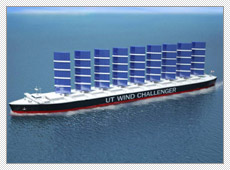
Ships will be outfitted with multiple 20-meter wide (65.6 feet), 50-meter high (164 feet) telescoping sails made from aluminum or fibre-reinforced curved plastic. The material of each sail is hollow in the centre to expand and contract as weather and wind conditions change.
A computer control system will position each sail to take advantage of maximum wind force. In simulation and wind tunnel experiments on models, the sails work effectively even in heavy cross winds. When in port the sails will collapse. At sea the sails can be partially to fully deployed based on prevailing wind and weather conditions.
Weather and Wind Tracking Technology
The control system will use weather forecasting live feeds, networked maritime navigation information from other ships at sea, on-board wind measurement including both direction and speed to optimize sail usage. Individual sail wind analysis will be combined with wind-flow analysis for the multiple sail array to ensure that all sails gain optimum value from prevailing winds.
Navigation Routes Redefined by Wind and Weather
Currently ships at sea seek the shortest distance routes to get from one port to another. Wind is not a factor in defining these routes. But that would change if merchant and cruise vessels were outfitted with these high-tech sails. Each sail equipped ship would be equipped with ocean wind forecasting technology for plotting an optimal course.
Measurable Benefits
Current model tests are built to scale to a size suitable for large merchant ships. The next step is to build a half-scale model for testing at sea before full-scale manufacturing and first sea trials on a 180,000-ton bulk carrier outfitted with 9 sails as early as 2016. Wind Challenger is a project headed up by researchers at University of Tokyo along with a number of ship builders and vessel and fleet operators.
]]>The world became a lot smaller place as transportation technology evolved faster ways to get from one place to another. Human settlement patterns altered from being predominantly rural in the 19th century to urban in the 20th. By the mid-20th century cities spread out spawning underground and above-ground railway networks and road infrastructure that created the urban daily commute from home to work and back.
The automobile became a personal freedom machine for those who could afford it. And increasingly in North America and Europe, automobiles were economically feasible for much of the population. This expansion was supported by a network of energy suppliers providing a fuel infrastructure for gasoline and diesel.
By the end of the 20th century in North America the era of relatively cheap gasoline and diesel was coming to an end. In Europe gasoline and diesel was already prohibitively expensive in the last 20 years of the century but that didn’t stop Europeans from buying and driving cars.
In the last decade of the century developing world automobiles and the infrastructure to support them started to take off with China and India representing the fastest growing car markets. This increased demand for gasoline and diesel to fuel these new automobile consumers.
Western governments, in trying to reduce fossil fuel consumption, began legislating fuel efficiency standards for automobiles. In 1997 Toyota, Japan’s largest automobile producer launched the first hybrid vehicle using a combination of electric-battery-driven motors along with a gasoline internal combustion engine. Honda soon followed in 1999 with its own hybrid, the Insight. This combination of electric motor and gasoline internal combustion engine provided manufacturers with a way to improve fuel efficiency. For a short period, one manufacturer, General Motors, designed and delivered to a limited market an all-electric car. But this experiment was soon squashed.
But automobiles represented only one type of transport. At the beginning of the 20th century land transportation for industry relied on rail and marine shipping to acquire raw materials and deliver finished products to market. But by the end of the century rail played a smaller part for these same industries as trucks became predominant. Ships went through dramatic redesign as well growing ever larger, whether moving bulk raw materials or container systems largely spawned by the rise of the trucking industry.
Even more significant was the development of heavier-than-air flight capability. The airplane and the infrastructure to support it became one of the great achievements of the 20th century. Air travel contributed to a rising global view of the planet, reducing the amount of time required for travel dramatically.
For a short time in the 20th century balloons vied with airplanes but became novelties by the end while jet-engines became predominant with propeller-driven aircraft relegated to specialized markets from the mid-century to its end. As airframes increased in size, global distribution of goods through the air grew rapidly in volume supplanting rail and marine shipping. Air passenger transportation briefly went supersonic with the launch of the Concorde and TU-144. By 1978 the latter was no longer in service and the Concorde’s last flight occurred in the first decade of the 21st century.
In the 20th century humans travelled in to Earth orbit and to the moon using rocket technology first pioneered in the United States, perfected as a weapon of war in Germany, and then enhanced further after World War II as the Americans and Soviet Union developed the technology further for military and scientific pursuits. Rocketry remained the purview of national governments with the cost of the technology far exceeding the ability of most private enterprise.
What will make the 21st century different? The planet has grown very small in the 20th century and will be even smaller still in the 21st. Our concepts of transportation will take on three perspectives. At the urban level we will need to enhance and invent new means of mass transit. At the planet-wide level, globalization will drive innovation on land, sea and air. And in space, extra-planetary transportation will alter our frame of reference as a species and representative of all the life on Earth.
In subsequent blogs on transportation we will explore the following:
1. Urbanization and Population Growth and its Impact
Urban concentration of human population will change our transportation models. Toronto, Canada, where I live, provides a great example. Between 2001 and 2006, growing traffic congestion increased the average commute time by 16%. While Toronto increased road lanes by 56% between 1986 and 2006, public transit grew by only 18%. Almost one-third of Toronto workers commuted more than 15 kilometers each way to do their jobs in 2006. In the Greater Toronto area and suburbs average daily commutes were longer. Toronto is one of the worst examples of unplanned urban transportation impacting on quality of life. But Toronto is not unique as a North American city. So we will look at this subject in greater depth.
2. Energy Conservation as a Transportation Challenge
In other sections of this blog we have talked about energy and the significant challenge that energy consumption has for our technical society. Governments are legislating industry to innovate to reduce the amount of energy needed for transporting people and goods. Reliance on fossil fuels is increasingly impacting health and the environment. Reconciling our need for energy and modes of transportation is something that 21st century technology needs to address.
3. Environmental Pollution, Climate Change and Transportation
Humanity by necessity is being forced to reduce its carbon footprint. We have talked about geo-engineering the planet in another section of this blog. But in this coverage we will specifically look at the technologies we currently use to move materials, goods and people and their impact on the environment and climate. How will we continue to do business globally using transportation technology to move raw materials, agricultural produce, and manufactured goods half way across the planet while dealing with CO2 and other pollutants?
4. Employment Patterns
We are changing the way we work today. The Internet, software-as-a-service (what techies call the cloud), virtual business presence, the disassembling of our bricks and mortar ideas about what is a business, have undergone dramatic change in the first decade of the 21st century. How will that accelerate through the rest of the century. What will the impact of the electronic commute be on the automobile industry and other forms of personal transportation? What will it mean for logistics and supply management when companies go virtual?
5. Alternative Fuels
Electric cars, biofuels, hydrogen, solar power, ion propulsion, micro-nuclear, what will be the fuels that drive our transportation technology in the 21st century? Will we wean ourselves completely from fossil fuels?
6. Technical Innovation
Electronic roadways, chained automobiles, smart vehicle technology, robotics, high-speed maglev and pneumatic rail systems, radical new ship designs, hypersonic aircraft, ion propulsion, solar sails, space elevators….these are concepts on the drawing boards and in the labs and R&D centres of innovators and entrepreneurs today. What is promising and realizable in the 21st century? What will remain a dream?
Enjoy the journey with me and please remember to ask questions and comment. I always respond.
]]>