Since I was a young boy, I have been drawn to science and history. These have been two of my passions. As a young teen, I was drawn to the science fiction novels and short stories of authors like H. G. Wells, Ray Bradbury, Aldous Huxley, George Orwell, Isaac Asimov, Arthur C. Clarke, John Wyndham and others. Their writing was about alternate histories, dystopian worlds and the future.
After graduating with a history degree and a goal to teach high school, I could not fulfill that dream. Instead, I found a job in educational publishing calling on post-secondary schools, selling textbooks, and looking for future authors.
A book I was offering to schools was co-authored by Don Fabun and Niels Sundermeyer, called “The Dynamics of Change.” Published in 1968 it described what to watch for within the next twenty years and what our world would be like by the late 1980s.
Another book I had to offer was Douglas Hofstadter’s, “Gödel, Escher, Bach,” which described mathematics, the emergence of human consciousness from biological constructs and how computers in the future would attain similar intelligence and self-awareness.
After reading books like the aforementioned two and science fiction I became hooked on the future. More than a half-century later, I continue to seek what lies ahead, researching the changing world, humanity, and our place in the Universe.
I want to thank the tens of thousands of steadfast readers from more than 40 countries who visit this blog site and inspire me to continue its pursuit at age 75. I hope to write and host postings here as long as my wits remain.
It was Isaac Asimov who aspired to write until the day he died. I would wish for the same. So please continue to visit and use the Search window to look at subjects that interest you already written about.
You may find today’s post a bit of a departure from what is typically published here. It is more about history and less about science and technology. I hope you find the subject as interesting as I have found it all because a morning read of the newspaper brought back a memory of the past.
On September 30, 2024, Canada’s federal government acknowledged the National Day of Truth and Reconciliation, a solemn day that acknowledges the injustices done to First Nations from the country’s colonial past to the present.
The picture that accompanies this posting is of a place called Shingwauk Hall. It is located in Sault Ste. Marie, Ontario, where the three largest Great Lakes converge. Shingwauk is home to Algoma University, a school I regularly visited when I was selling textbooks for a living.
Shingwauk Hall is also the site of what was once a residential school. For American readers, Canada’s residential schools were equivalent to U.S. Indian Boarding Schools. These were institutions established by federal and provincial governments, run by Christian religious organizations, and designed to “take the Indian out of the Indian.”
Canada closed its last residential school in 1996. There are still hundreds of Indian Boarding Schools in operation in the United States. These institutions were born to assimilate Native North Americans without ever providing equal footing with the “civilized” European world that encroached upon them beginning in the 15th century with Christopher Columbus’s “discovery” of a land that never needed to be discovered.
The subsequent arrival of Europeans in the Americas wiped out 90% of the Indigenous population within the century that followed the year 1492. The survivors lost their homelands through disease, war and broken treaties. Their children were forced into “schools,” sometimes even kidnapped by legal authorities. These schools whether residential in Canada or Indian in the U.S. were overcrowded, underfunded, disease-ridden and many were run by racist abusers. Children died by the thousands. Many were buried in unmarked graves.
One of those mass unmarked grave sites was discovered by an anthropologist in 2021 at a former residential school in Kamloops, British Columbia. The graves contained 215 children buried by the Catholic Church which operated the school from 1890 to 1969.
On my job when I first visited Shingwauk Hall, my historical curiosity led me to ask about the building’s name. I was told it was an Indigenous one because the building had been donated to the University by the Hurons, a First Nations tribe who had a past chief named Shingwaukonse. This wasn’t exactly true.
Shingwauk Hall is located in the traditional homeland of the Anishinaabe and Métis. The Hall is a replacement building for a former residential school called the Shingwaulk Industrial Home. Chief Shingwuakonse hoped the industrial home would build a bridge between his people and European settlers through the sharing of culture and job skills training for the modern world for First Nations. The institution opened in 1873. The Industrial Home operated until 1970. On its grounds are 109 known burials that include 72 students who died between 1875 and 1956.
Today, Shingwauk Hall is the home of the Shingwauk Kinoomaage Gamig and Algoma University. The former is a post-secondary institution that offers undergraduate degrees in the Anishinaabemowin language and Anishinaabe studies. The latter is a traditional arts and science undergraduate university.
What made me think about Shingwauk Hall on September 30th? It was seeing it in a picture and reading about it in The Globe and Mail newspaper. It also got me thinking about the way forward in reconciling our North American colonial past with the continent’s First Nations. What is the way forward in the 21st century?
The word reconciliation is used to mean reversing historical injustices like the residential and Indian boarding schools. It means ending the colonial constructs of Canada’s Indian Act and that of the U.S. Department of the Interior over Indigenous communities. It means creating economic opportunities, capacity-building, and nation-to-nation relationships between First Nations and Canada’s other government entities.
It means First Nations get better schools, high-speed Internet access, preservation of their languages and cultures, job training, trade opportunities for Indigenous enterprises, clean drinking water in their communities, improved healthcare services, enhanced food security, and more.
Whether First Nations lie north or south of the 49th parallel in North America, the problems are largely the same and the solution is as well, a level playing field for all, not to erase the past, but to provide a sustainable future for Indigenous people. The Shingwauk Kinoomaage Gamig program could be emulated across the Americas to bring a degree of closure to colonialism and give new meaning to the federalist projects in both Canada and the United States this century.
]]>I sold post-secondary textbooks to schools, liaising with university professors and community college instructors. My territory took me as far away from Toronto to Sault Ste. Marie, the place where three of the Great Lakes meet. The Sault had two post-secondary institutions, Sault College and Algoma University. I would spend two days on each visit talking to instructors, the bookstore staff, and administrators.
Yesterday, Canada observed its National Day for Truth and Reconciliation, an annual event to remember the victimization of Indigenous people by Canada’s many governments. As I read the September 30th edition of The Globe and Mail, an article described how Canada set up residential schools for Indigenous children. One of those was on the site of Algoma University. It is called Shingwauk Hall. During my visits to the university, I had heard about a historical connection between the school and local First Nation peoples but I didn’t know the history. The Globe and subsequent research enlightened me.
Algoma University’s main campus building sits on the site of what was once a residential school that was established in the latter half of the 19th century to turn First Nations’ children from Indian to White. The goal was to “take the Indian out of the Indian,” to make them forget their culture, languages and traditions. It didn’t create equality for these children who continued to face discrimination in mainstream Canadian society.
The Canada-wide 19th-century residential school program enforced cultural assimilation without equality. Schools separated children from families making them live in crowded residences like the one depicted below. Christian religious organizations largely ran the schools.
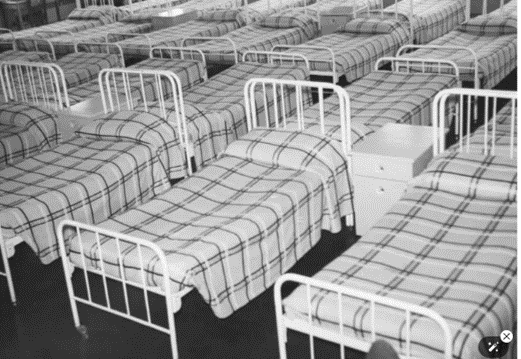
Shingwauk Hall, the main building of Algoma University, was built in the 1930s to replace the original Shingwauk Residential School erected on the traditional lands of the Anishinaabe First Nation and Métis. The Métis were descendants of intermarriage between French voyageurs and Native North Americans, a common occurrence in the fur trade.
The Shingwauk name is associated with Shingwaukonse, an Anishinaabe Chief who believed that a residential school would give his tribe European-based knowledge and skills to enable them to thrive in the new Canadian nation. The school was run by the Anglican Church, the second-largest administrator of residential schools in the country. The vast majority of residential schools were run by the Catholic Church.
I first called on Shingwauk Hall in 1973. Other than the name there was no trace of its residential school past or acknowledgement that the prior purpose of the place was to “take the Indian out of the Indian.” Today, however, Shingwauk Hall although still a working university, is making an effort to acknowledge its residential school past.
The United States has had its version of residential schools. It parallels that which Canada imposed on its natives in their dispossession of North America. Canada acquired its western lands through the purchase of the Hudson Bay Company’s Rupert’s Land, a British Crown monopoly that stretched from the U.S. border to the Rocky Mountains, Hudson’s Bay and the Arctic Ocean. No Indigenous people were consulted during this massive acquisition. Where treaties existed between the British Crown and native tribes, most were soon disregarded.
The U.S. acquired its western territories through the Louisiana Purchase from France, a war with Mexico and later a land purchase, through an agreement to divide the Pacific Northwest with the British, and by purchasing Alaska from Russia two years after the end of the Civil War.
In both countries, reservations confined Indigenous people to marginal lands, ejecting them from their traditional territories. The assimilation experiment followed.
The original Thirteen Colonies involved conversion to Christianity with Christian church organizations administering assimilation experiments that began in the 17th century. The reality, however, produced abusive conditions that inflicted all kinds of indignities on native residents including kidnapping children from homes, corporal punishment, malnutrition and disease.
When unmarked graves were found at a residential school in Kamloops, British Columbia, it lit a fire that led to the beginning of Canada’s national reconciliation effort with a growing acknowledgement of the injustices committed to Indigenous peoples. The Kamloops discovery resonated in the United States with both federal and state governments beginning to reflect on their treatment of Native North Americans. Thousands died in Canada’s residential schools with the last one closing in 1996.
In the United States, however, as of 2023, based on Department of the Interior records, 523 Indian boarding schools have been identified. Some are closed but many remain. In Oklahoma alone, 80 of these schools were established.
The nature of these American schools has changed recently since the passing of the Indian Self-Determination and Education Assistance Act of 1975. Assimilation is no longer their purpose.
Shingwauk Hall in the Sault is no longer a residential school. Today Algoma University features the Shingwauk Kinoomaage Gamig, an accredited Anishinaabe post-secondary institution that since 2008 has been offering programs geared specifically to Indigenous students reconnecting them with their language, traditions and native skills. It is one of nine Indigenous institutes of higher learning that have opened in Ontario.
The main hall at Shingwauk includes an exhibit highlighting the history of the residential school program. Institutions like this and others remembering the European incursion into the Americas are similar to Yad Vashem and other Holocaust memorials and museums that today can be found around the globe. The Nazis and collaborators murdered almost 50% of the world’s Jews from 1937 to 1945.
The European arrival in the Americas led to the death of almost 90% of the native population from communicable diseases in a half-century. For the Indigenous population of the Americas, memorials and museums are needed to remind all humanity of what happened, and of the subsequent subjugation of the survivors. It isn’t enough to celebrate a single day of remembrance without redressing the remaining institutional racism and the continuing underserved Indigenous communities in North America.
For Indigenous people living in Canada and the United States reservations still have to live with boil water advisories, substandard existing homes and a lack of new builds, few basic amenities and overcrowding. The Indigenous population still suffers from environmental exposure to asbestos, lead and mercury pollution. Diabetes runs 2.5 times higher than the average in Indigenous populations. Poverty rates are twice the national average in both countries. Teenagers continue to drop out of school at higher rates than the national average. Alcoholism and substance abuse are common substitutes for gainful employment.
Reconciliation in correcting the legacy of colonialism is just a first step for Canada and the United States. Self-determination for Indigenous communities with public and private capital investments in capacity building is needed. Infrastructure and service gaps have to be addressed. All of this has to happen with Indigenous groups in partnership with national, state, provincial, county and municipal governments.
]]>