The post Japan Needs Construction Workers and is Turning to Robots appeared first on Techso Mogro.
]]>According to an article by Pavel Alpeyev, appearing in Bloomberg Technology this week, Japan will face a shortage of one million construction workers in the next decade as people retire. The construction industry is not where robots are seen en masse these days. You find them on factory assembly lines, or in warehousing operations. If you do see them associated with the construction the robots serve as packers, pickers, and trackers of building materials.
One of the challenges facing the development of robots in construction is the need for mobility. Whereas a robot in an assembly line remains stationary, and a warehouse automated machine operates in a stable navigable environment, a robot designed to erect a building needs all the dexterity of the former, and navigability that is far more flexible than the latter because of the constant changes at the site throughout construction.
One Japanese construction contractor, Shimizu Corporation, is currently in a race to develop the first autonomous construction robots. It has been running a series of trials at the Robot Laboratory, Shimizu’s Institute of Technology, in Tokyo.
What roles is Shimizu looking to have robots play in construction?
The robots are controlled using a tablet with human operators sending instructions to the machines designed to operate autonomously.
Robo-Carrier picks, lifts, puts down and navigates loads of up to one ton of plasterboards in a constantly changing work environment. It features collision prevention and can detect any human that gets near it while operating. Situational awareness is obtained using laser sensors which help the robot to see the environment three-dimensionally.
Robo-Welder uses its robotic arm equipped with laser shape measurement to determine the contours of a groove, or channel, on a steel column to be welded. It determines all the steps needed for creating a clean weld. The arm can move along six different axes to perform welds. Two Robo-Welders can work together on any one column.
Robo-Buddy comes with two robotic arms that also move along six different axes. Sensors recognize the position of the ceiling grid and insert ceiling suspension bolts with one arm while lifting ceiling boards into the correct position with the second.
In terms of all the tasks needed to build a high-rise, this first triad of robotic workers will do a mere 1% of the various construction work requirements. Machines to construct floors and walls may follow.
Masahiro Indo, a general manager at Shimizu’s construction technology division, believes that automating construction sites to the point where 10% of the labour will come from robots remains a challenge since so much of the detail work comes once the building’s frame and major components are up. There are no robots currently designed to do the kind of work needed in doing interior infrastructure and finishes.

The post Japan Needs Construction Workers and is Turning to Robots appeared first on Techso Mogro.
]]>The post Japanese Company Proposes Solar Power Project for the Moon appeared first on Techso Mogro.
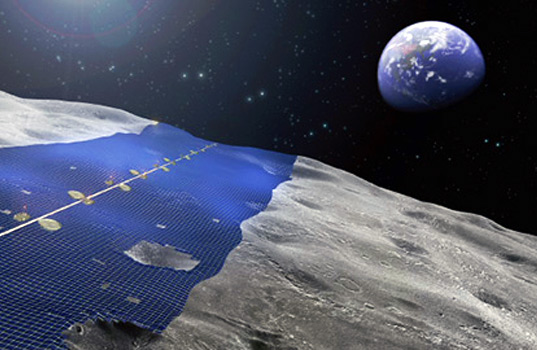
]]>Called the Luna Ring it would extend the entire length of the Moon’s equator, 11,000 kilometers (6,835 miles). At first it would be a few kilometers in width but overtime as it was built out it would eventually reach its full 400 kilometer (250 mile) span.
Laced with electric power cables to transfer power to a Earth-facing 20 kilometer (12 miles) wide transmission facility, the energy would be converted to microwaves and following a radio guidance beacon be beamed to a receiving station on Earth.
Most if not all of the material for construction of the Luna Ring would come from the Moon’s surface. Power for the equipment to build the Ring would be generated from sections of the ring as each is built.
Space-based solar power has been a dream of scientists and engineers for some time. But this is the first project of its type to be so well documented. Can the Japanese company that conceived it pull it off? It should be stated that this is just one of eight futuristic proposals made by the company. These include floating green island cities that would be deployed in the Pacific Ocean, truss-designed cities that would almost float on air, enclosed, self-sustaining urban spaces capable of operating autonomously for a century, underground cities, space hotels, lunar bases, and the transformation of the world’s deserts by lacing them with artificial lakes and waterways to make them bloom.
For those who believe the Moon should be preserved in the same way we treat Antarctica today, such a project would be considered a massive assault on nature. But the absence of life on the Moon with only the presence of a few Apollo artifacts makes the idea conceivable and less a violation of nature than let’s say building a tourist attraction on Greenland or Antarctica’s glaciers.
Nowhere does Shimizu tell us how much the Luna Ring would cost? But as the company has described it once the first robots arrived on the Moon they would replicate themselves as well as construct the Ring from lunar material with little human involvement. So we are really talking about investing in start up costs and then letting the Ring build itself.
The post Japanese Company Proposes Solar Power Project for the Moon appeared first on Techso Mogro.
]]>
