
In so many science fiction novels, for some reason, Saturn is always portrayed as the intermediate station from which humanity moves out into deeper space to find habitable planets circling remote stars. But what we never realized was that around Saturn there could be life. Titan, with its liquid methane rain, rivers and lakes gave us evidence of amino acids present in its atmosphere. The geysers of Enceladus contained water, salts, ammonia, and molecules we associate with the presence of primitive life.
Before Cassini we had no idea that the Saturnian system could produce things so familiar. Titan’s atmosphere contained mostly nitrogen just like Earth’s atmosphere. Its rivers and lakes and rain may not have been water, but the landscapes seen from Cassini’s images and the Huygens lander seemed so familiar. On Titan water formed much of the land mass. The rivers of Titan flowed through them carving out channels like here on Earth. It is likely that the lakes and seas these rivers flow into contain the building blocks of life as we know it, or life as we don’t know it based on different chemistry. Cassini has whet our appetite to go back and sail on those methane seas and roam through its desert dunes and icy cliffs.
Cassini found three new moons to add to the 59 known ones. It discovered hydrocarbons on Hyperion, a moon that looks like a sponge or lava rock suspended in space. On Dione, a small moon, Cassini detected the presence of oxygen in its atmosphere. How did oxygen form in a dead world?
The mystery of the rings and why they are so much larger than any other planet in the Solar System remains unknown. But we understand the ring system much better having detected shepherd moons that keep the rings in place, and grooves that make the rings look like a vinyl long-playing record. We also found new rings previously undetected and a moon being formed between two rings as it accumulated ring particles.
Cassini showed us auroras and giant hurricanes on the planet itself. We found a hexagon-like atmospheric pattern at Saturn’s north pole. We followed Saturn through half of its year watching seasonal changes in its almost 30-year circuit around the Sun.
And then in one priceless shot Cassini showed us Earth through a gap in the rings, a pale blue orb, seen against the backdrop of space. When we blew the image up we could even faintly make out Earth’s companion moon.
We will miss Cassini. It was quite a ride.

Cassini was launched in 1997 and reached Saturn in 2004. The spacecraft is almost out of its maneuvering fuel and as a grand finale NASA has it flying between the rings of Saturn in a once a week orbit. In less than 22 weeks from now, on September 15th of this year, Cassini will rendezvous with Saturn and crash into the atmosphere ending its 20-year mission.
We often talk about how expensive these planetary missions are and the amount of money that goes into the robotic spacecraft, landers and rovers that NASA sends into the Solar System and beyond. But how many machines do we build that can survive a 20-year mission into the extreme environment of space while flawlessly executing instructions and delivering data over a distance of billions of kilometers.
Cassini is just one of these incredible robotic space explorers that have given back to scientists and the world tenfold more than expected. Think of another, Opportunity, one of the pair of rovers sent to Mars which just turned 13 years old. The original mission for the rover was 90 days. And now NASA scientists have sent the Martian rover on a new journey to explore another feature of the planet.
What Cassini has revealed to us in its 20 years is amazing details about the Saturnian system, a mini-Solar System of its own. Here are just some of things we have observed and learned from this robot:
And we are far from done yet because Cassini will continue to study the planet and the rings close up over the next few months until it finally says goodbye to 20 years of incredible scientific discovery.
What has been the cost of all of this?
That works out to $20 million per year for Cassini and just under $38 million for tracking and operations over two decades. Even the throwaway one-time cost of the rocket works out when amortized over the life of the mission to $21 million annually. That’s a lot of science for $79 million per year.
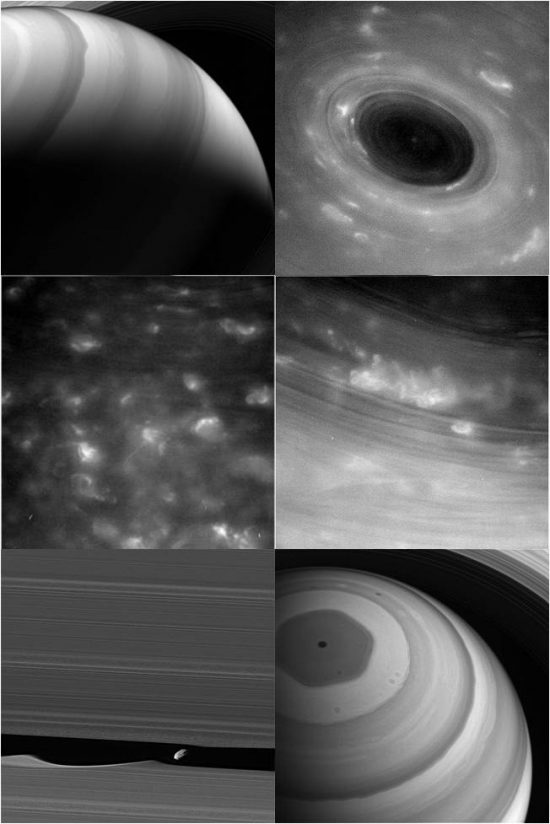
For whatever the reason the voyage of the joint mission of Cassini and its companion Titan probe, Huygens, continues to amaze us with imagery and telemetry on the Saturnian system. NASA, the European Space Agency and the Italian Space Agency developed the technology that was launched in October of 1997. Seven years later the spacecraft arrived at Saturn entering into orbit around the planet. In 2005 the Huygens probe landed on Titan’s surface. Huygens transmitted images and data from the surface for a short period before falling silent. In its descent and landing we gained a great deal of knowledge about Titan.
Today Cassini continues to operate its cameras, spectrometers, magnetometers and analyzers as it swings around the planet visiting the moons and giving us spectacular images of the entire system including Saturn’s amazing rings.
The Challenge of Getting to Saturn
The technique deployed by Cassini to get to Saturn involved gravity assisted acceleration. In the diagram below you can see the indirect route taken. It involved a Venus flyby in 1998 and then Venus, a second time, followed by Earth in 1999. Next was a close encounter with Jupiter in 2000 and from there it travelled to Saturn arriving in 2004. Each planetary flyby provided a gravity assist to Cassini gaining speed with each pass. Total flight distance equalled 3.5 billion kilometers. This method allowed Cassini to save fuel and made it possible to keep its launch weight under six metric tons. Without gravity assist the spacecraft would have required a much larger compliment of fuel.

Designing a Spacecraft for Long Distance Communication and Survival
Cassini had to be designed to operate with a high degree of autonomy. On average it takes one hour and 24 minutes for a transmission from Earth to reach it. That means a 3-hour round trip between Earth and Saturn. The images Cassini transmits back to Earth give scientists a visual means of understanding the orientation of the spacecraft and its location within the Saturnian system. Instructions are then sent from Earth to orient the spacecraft’s instruments for whatever the planned objective whether a moon, the rings or the planet itself.
With the Cassini mission planned to continue for another five years until 2017, power and fuel consumption are paramount concerns. Cassini relies on three plutonium fuelled RTGs for power and heat in the extreme cold near Saturn. As the plutonium decays Cassini slowly loses power. But it has sufficient capacity to keeps its instrumentation in operation for the foreseeable future.
Propellants are another matter. Cassini is fuelled with two types of propellants, a mono-propellant and a bi-propellant. The mono-propellant, hydrazine, is used to do small maneuvers such as positioning and alignment. The bi-propellant, a mono-methyl hydrazine with nitrogen tetroxide has been used for course correction and other large maneuvers. When Cassini started out it had 132 kilograms of hydrazine, 1,131 kilograms of mono-methyl hydrazine and 1,869 kilograms of nitrogen tetroxide on board. Much of the fuel was spent getting to Saturn and for orbital insertion. The remainder is seldom used and as a result the spacecraft even with less than 10% of its original bi-propellant remaining can continue to fly.
What We Have Learned So Far About Saturn and its Moons
How do you sum up what we have learned from Cassini? The science and discoveries have been incredible. Here are some highlights:
With Cassini, we are not done yet but once the mission is over expect a return to Saturn’s neighbourhood with missions that will land and explore Titan and Enceladus.

In the late 20th century NASA conceived of a different Grand Tour. A wonderful confluence of planetary alignment became the motivator to develop technology and a plan to rendezvous with Jupiter, Saturn, Uranus and Neptune. This Solar System confluence occurs every 176 years and was going to happen in 1977. So NASA began planning in the 1960s to meet the objective of doing a Grand Tour of the outer planets of the Solar System. To do this NASA needed to work some things out.
Before launching its Grand Tour NASA had to test the technology it was developing. It did this through an interim mission involving two spacecraft, Pioneer-10 and Pioneer-11. Both were highly successful in reaching Jupiter and Saturn.
Getting to Jupiter and Saturn
A space mission to Jupiter bears little resemblance to one going to Mars. Mars is 227 million kilometers from the Sun. Earth is 150 million as a comparison. We use the distance of the Earth from the Sun as a measure we call an Astronomical Unit or AU. So Mars is 1.5 AU from the Sun. Jupiter on the other hand is 5.2 AU from the Sun.
To go from Earth to Jupiter you have to calculate where Jupiter is in its orbit related to Earth. That distance can be as close as 628 million kilometers or as far away as 928 million. Pioneer-10 launched on March 2, 1972. It was atop a three-stage Atlas-Centaur rocket with the third stage providing added thrust to achieve an escape speed of 52,000 kilometers (32,400 miles) per hour making it the fastest human-built object of its time. It passed the Moon in 11 hours and crossed the orbit of Mars in 12 weeks. A month later on April 6 Pioneer-11 followed.
NASA built both spacecraft using aluminum with boron-epoxy tubes. The instrument payloads included attitude controllers using radio beacons to maintain direction, television cameras for taking pictures of the planets, magnetometers, plasma analyzers, charged particle. ionizing and micro-meteoroid detectors, photometers, radiometers, photopolarimeter and transmission equipment to send telemetry and photographs to an Earth-based Deep Space Network of communication stations located in California, Spain and Australia. Both craft used hydrazine propulsion thrusters, silver-cadmium batteries and a Radioisotope Thermoelectric Generator (RTG). The RTG used thermocouples to convert heat to electricity from the radioactive decay of plutonium.
Neither spacecraft were large weighing approximately 260 kilograms (570 pounds). Both spacecraft carried a gold plaque on which information was inscribed about their origin.

Pioneer-10 was first to traverse the Asteroid Belt between Mars and Jupiter. With that success Pioneer-11 was instructed to fire its thrusters to increase velocity and change its aiming point so that Jupiter’s gravity would assist it in going on to Saturn.
Although Pioneer-10 was first to be launched it arrived at Jupiter, the first week of December 1974, a day after Pioneer-11. Both spacecraft relayed data and images about the Jovian system, its moons, magnetic field, and the presence of the solar wind. Pioneer-10 came within 130,000 kilometers (81,000 miles) of the planet’s cloud top. Pioneer-11 was even closer, just 43,000 kilometers (26,725 miles) above Jupiter’s clouds. That close approach increased the spacecraft’s speed to 173,000 kilometers (108,000 miles) per hour taking it the next 2.4 billion kilometers (1.5 billion miles) to rendezvous with Saturn.

Pioneer-11 reached Saturn on September 1, 1979 passing within 20,800 kilometers (13,000 miles) of the planet and sending back remarkable pictures that included the rings. Pioneer-11 discovered two Saturnine moons and an additional ring while studying the planet’s magnetosphere.
Both spacecraft continued to operate well beyond the completion of their primary missions with Pioneer-11 studying interplanetary space until the mid-1990s, and Pioneer-10 transmitting past the year 2000. In these two robotic spacecraft NASA had proven it could build reliable technology for the Grand Tour that soon was to follow.
The Grand Tour
For the Grand Tour NASA built two of the most complex unmanned spacecraft ever designed. Dubbed Voyager-1 and 2, the latter was launched first on August 20, 1977 aboard a Titan-Centaur rocket. Voyager-1 followed on September 5 but it was launched on a faster, shorter trajectory to have it arrive at Jupiter first.

Like their predecessors reliability over a long-duration flight meant the spacecraft would need to detect and react to internal problems without human intervention. This required the development of on-board artificial intelligence. Instrumentation included high-gain antennas, detectors of all kinds to conduct 10 different experiments, and television cameras. Both spacecraft used RTGs similar to those on Pioneer-10 and 11. They each weighed about 800 kilograms (1, 760 pounds).
Voyager-1 arrived at Jupiter on March 5, 1979. Voyager-2 followed on July 9. Voyager-1 reached Saturn on November 12, 1980 followed by Voyager-2 on August 25, 1981. The trajectory of Voyager-1 took it close to Saturn’s largest moon, Titan. The trajectory made it impossible for the spacecraft to rendezvous with Uranus and Neptune. But Voyager-2’s trajectory positioned it well for a flight to the two remaining gas giants beyond arriving at Uranus in January of 1986, and Neptune in August of 1989.
What did the two spacecraft discover? The list of firsts is amazing:

Together the two spacecraft visited more worlds than any previous spacecraft. And to this day they continue to operate, an incredible technological design achievement. As of February 2012, 35 years after launch, Voyager-1 continues to transmit data to Earth from a distance of 17.9 billion kilometers (11.1 billion miles) from the Sun, the farthest a human-made object has ever travelled. On a different trajectory Voyager-2 in February reached 14.6 billion kilometers ( 9.05 billion miles).
No voyage of human discovery has ever equalled the two Voyager missions.
]]>


