Recently researchers at the Sandia National Laboratory Kirtland Air Force Base in the United States demonstrated a closed-loop Brayton Cycle engine technology as it delivered power to the electrical grid continuously. Sandia has been working with the Brayton Cycle technology for power generation for some time now because it is seen as having significant energy conversion advantages over conventional steam turbines by as much as 50%.
George Brayton, a 19th-century American inventor experimented with internal combustion engines. The Brayton Cycle Engine is his invention dating back to 1878. The engine worked by heating compressed air in a closed space before releasing it to power a rotating shaft. Substitute a turbine for a rotating shaft and you get the picture. States Darryn Fleming, at the US Department of Energy (DOE) Supercritical Transformational Electric Power Program, the Brayton Cycle is “basically a jet engine running in a closed loop with supercritical CO2 as the working fluid.”
Sandia’s use of supercritical CO2 (the gas under very high pressure) is more than just happenstance. Supercritical CO2 is chemically stable, non-flammable, non-toxic, and should increasingly be available as carbon capture projects increased promoted by incentives and subsidy programs contained within the recently US-passed Inflation Reduction Act.

A diagram showing the Brayton Cycle can be seen above. The gas is heated to temperatures much greater than steam at water’s boiling point, 100 Celsius (212 Fahrenheit). In fact, heated CO2 can reach temperatures seven times greater (700 Celsius or 1,290 Fahrenheit). That’s what makes the energy conversion 50% more efficient than using steam which loses as much as a third of its energy potential as it converts back to water during the process.
This past April, a Sandia team heated CO2 to 315 Celsius (600 Fahrenheit), a little less than half the optimal temperature. Their Brayton Cycle engine was able to send continuous power to the grid for 50 minutes. Although only 10 Kilowatt-hours, less than a third of what the average American home consumes in a day, it was the first demonstration of the technology as a reliable energy streaming source for the electrical grid. The test included three controlled shutdowns and restarts and the technology aced it.
Scaling up from 10 Kilowatts to 1 Megawatt appears to be doable by 2024 based on the Sandia Labs team. They plan to double the temperature of the supercritical CO2 in the next iteration of the Brayton Cycle engine. It requires upgrading materials and parts to withstand these changes in heat and pressure. A 1-Megawatt demonstration technology will be enough to power up to 1,000 homes or could be used to replace diesel generators in remote locations such as communities in Alaska or Northern Canada.
The Sandia Labs team goal along with industry partners is to increase the capacity of their Brayton Cycle system to generate up to 5 Megawatt-hours continuously to the electrical grid. They see that as being a technology that grid operators will be more willing to allow. That’s because those operating and maintaining the grid don’t take kindly to anyone disrupting it in any way. For utilities, the work being done at the Sandia Labs could prove to be a game changer in what is a power industry moving away from its heavy reliance on fossil-fuel thermal energy production.
]]>
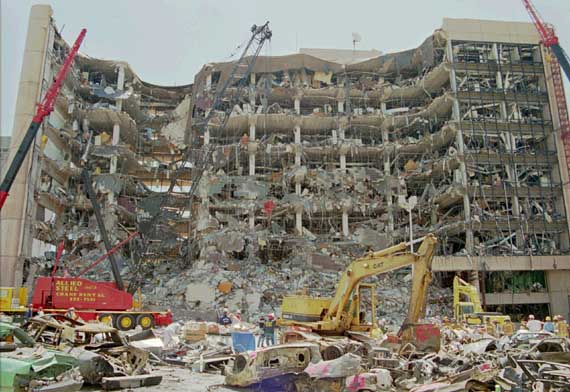
Well it turns out that folks at Sandia National Laboratories in Albuquerque, New Mexico, have come up with a revised formula for a fertilizer that works well with plants but fizzles as a bomb ingredient. Sandia has no intentions of applying for a patent on their new formula and plans to make it widely available to manufacturers.
Although ammonium nitrate is outlawed in theaters of war like Afghanistan because of its bomb making properties, it does get smuggled into the country from neighbouring Pakistan. As a result, in 2012 approximately 1,900 American troops were wounded or killed by improvised explosive devices like the one being detonated in the picture below.
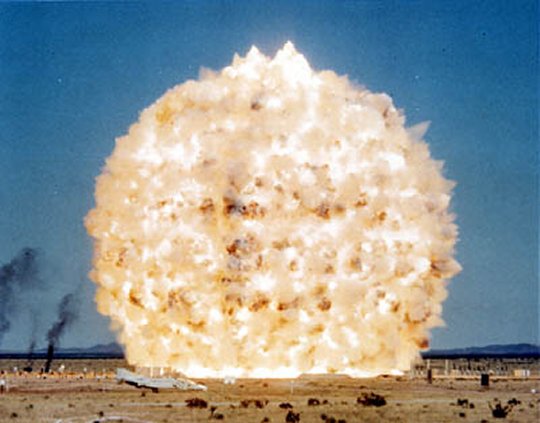
So the motivation to find a new formula for chemical fertilizer is there. What the researchers did is add a compound to the ammonium nitrate to change it at the molecular level. The compound that works best is iron sulfate. The iron ion grabs the nitrate and the ammonia is attracted to the sulfate. The result is ammonium sulfate and iron nitrate. Both even when mixed with a fuel like gasoline or diesel will not blow up.
And the iron sulfate is good for the soil as well, particularly alkaline soils like those found in dry climate zones. The iron also gets taken up by the plants and infuses them with iron which improves the health of those who consume the crops.
The new formula is no more expensive to produce than the old one. Current producers of ammonium nitrate fertilizer can switch over to the new formula. If they do then fewer will die from fertilizer bombs, and more will live because an improved formula will increase crop yields.
Hard to argue with the potential of these results.
Postscript
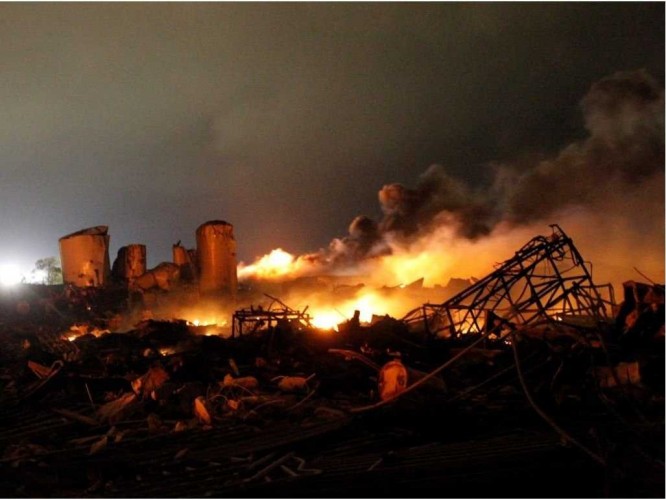
Imagine how many lives would have been saved in West, the town in Texas that experienced the fertilizer factory explosion on April 17 which left a crater 30 meters (93 feet) wide and 3 meters (10 feet) deep, if the ammonium nitrate had been treated with iron sulfate. With more than 250,000 kilograms (540,000 pounds) of ammonium nitrate on site, investigators are speculating that the existence of another chemical at the facility, anhydrous ammonia, could have contributed to the explosion.
]]>
If you think of the most recent disasters that made headlines in 2010 and 11 you can begin to envision how robots can play a part in prolonging life in emergencies. From the earthquakes in Haiti and South Island, New Zealand, to trapped miners in Chile, the tsunami in Japan, and most recently the foundering of the cruise ship, Costa Concordia, engineers get inspired to come up with new ways of supplementing human intervention and rescue efforts using robotic systems. In some of these recent tragedies robotic devices were deployed. But that is not the only use for robots in emergency medicine.
The Robot Will See You Now
Robots are used in emergency medicine in many ways. One is as patient screening tools, marrying robotics with computing science. Hospital emergency rooms represent bottlenecks with patients spending long hours waiting for a doctor or nurse. Shortening the wait times using a triage robot has inspired engineers at Vanderbilt University to develop TriageBot,

A smart kiosk, TriageBot takes a medical history, measures vital signs and detects problems. The robot prioritizes patients based on severity of symptoms and history and can connect to on site staff even outside the emergency department should they be needed. The form of TriageBot is still under development. It could look like the fanciful and friendly robot displayed above or resemble an airport check-in terminal, or it could be built into a hospital waiting room chair. Designed to continuously monitor the patient before being seen by a member of the medical team, TriageBot represents an innovative use of robots in hospital settings.
But not all emergencies happen in the waiting room of hospitals. TriageBot systems when hooked up to a telecommunications network can provide both screening as well as monitoring of patients in remote areas. As the software evolves this type of emergency medical robot should prove invaluable.
The Japanese have a way with robotic systems and not to be outdone, Kyushu University has been experimenting with a robot prototype mobile monitoring system. (Click on the hyperlink in the last sentence to watch the movie. Although the narrative is in Japanese, you quickly get an understanding of how this apparatus works.)
Built for AICHI Expo 2005 this mobile chair features remote control driving done by emergency medical staff off site, vital signs monitoring, emergency first aid and even a defibrillator. The remote operator can talk and see the patient, communicate with bystanders and give them information on how they can help a person having a seizure, fainting or heart attack.
The Robot Will Find You Now
CRASAR is the Center for Robot-Assisted Search and Rescue at Texas A&M University. On its website it lists participation in using rescue robots going back to the collapse of the World Trade Center buildings in 2001. One area of development focuses on using robots as human proxies to provide communication with a trapped person that cannot be reached immediately after a disaster.
Survivor Buddy can work with medical staff to interact with a survivor during the period when help is not yet able to extricate the person. The robot includes a monitor that displays non-verbal human attributes by rotating and moving in a human-like way.
Sandia National Laboratories have been working on robots that can deliver food, water, oxygen and medical supplies to trapped miners underground while encountering environments that could prove lethal to human rescue workers. Designed to withstand flooded areas and explosions from pockets of methane gas the Gemini-Scout Mine Rescue Robot comes equipped with a range of sensors as well as pan-and-tilt, and thermal cameras that elevate to see over obstacles. It travels on flexible treads that climb over obstacles. Using a game controller, Gemini-Scout is designed to work with first responders and can be outfitted for earthquakes, fire and other disaster scenarios.

The Snakebot employs biomimicry to do search and rescue for trapped victims of disaster. An active scope camera that slithers, this robot was used to find trapped people under the wreckage of the 2011 earthquake and tsunami that struck Japan.
But snakebots can even go beyond search and rescue. Carnegie Mellon University roboticist, Howie Choset, has designed a snakelike camera device that with 102 joints is capable of imaging and mapping internal organs such as the heart muscle. Although not a search and rescue application, these types of robot designs demonstrate flexibility with capability to serve multiple biomedical applications.
Nowhere have emergency medical robots been studied more than in the military where they are seen as extraction and evacuation tools that reduce collateral casualties. The United States military increasingly uses robots in all of its field operations including drone aircraft as surveillance and strategic strike weapons, as well as robotic land vehicles. With the goal of having 1/3 of its land vehicle fleet unmanned by 2015, robotic medical evacuation will become a common feature. The American army is testing both robotic evacuation and extraction vehicle technology to move patients from fire zones to hospitals. This includes using humanoid robot designs like the one pictured below.

Using robots capable of picking up an injured soldier on a battlefield represents a way of reducing deaths associated with casualty recovery operations.
The military is also testing unmanned aerial systems that can land and working with casualty extraction robots, remove wounded soldiers from environments where radiation or toxic gas would make it impossible for human intervention. Unmanned aircraft are also being tested to provide surveillance and medical response. To provide the human touch, robot extraction systems include telepresence so that a soldier remains connected to a medical support person even though they are not physically on site.
In our next blog we look at the emerging field of robot exoskeleton technology and its biomedical uses.
]]>Humanity discovered how to control fire hundreds of thousands of years ago with wood and dung our primary fuel sources. Tens of thousands of years ago our ancestors discovered that wood could be converted to charcoal. Peat fires to this day are still a principle heating source in parts of the world. And animal dung provides humans living in desert regions with an alternative to wood.
Humanity has also grown crops and converted them to fuel. Olive oil lit the lamps of Greek and Roman antiquity.
The age of whaling provided whale oil for lamps burning in the homes of European and North America well into the 19th century.
I found this Henry Ford quote that goes back to 1925.
“There is enough alcohol in one year’s yield of a hectare of potatoes to drive the machinery necessary to cultivate the field for a hundred years.”
In World War II, Germany took Henry Ford’s advice and partly fueled their transportation and industry using alcohol derived from potatoes.
In that same war Great Britain experimented with grain-derived alcohol as a fuel for its war industries.
To this day 9-10% of human energy consumption comes from the burning of biomass for heating and cooking. And the two primary sources remain animal dung and wood.
The Biofuel Dilemma Today

Creating biofuels today Brazil, the United States, and other countries are using soybeans, corn, sugarcane, sugar beets and other crops instead of potatoes and grain (Germany and Britain’s experiment) to create ethanol, an alcohol-based fuel. The harvesting of these crops for fuel is changing the mix of what farmers in the Western World grow today and will be growing in greater quantities for the forseeable future. That’s because in a world where population growth is driving the need for greater food production, and energy demand is driving biofuel development, farmers are finding themselves asking the following question.
“Should I grow more food, feed or biofuel crops?”
The argument for food is obvious. The Developing World lacks the capacity to deliver enough domestically grown food to meet population demand. China, India, most of Africa, Southwest Asia and Russia are net importers of food.
The argument for feed seems obvious as well. The increasing demand for meat and dairy products in the Developing World and the continuing demand in the Developed World represents a thriving export and domestic opportunity for countries such as the United States, Canada, Australia, Argentina and those in Western Europe.
The argument for biofuel is more about geopolitics and security. In the United States and Europe, biofuel production means less dependence on imported oil for energy use. For the United States, corn represents the primary biofuel source. Corn usage for ethanol has increased annually for a number of years at a rate greater than the total national corn yield.
The second largest North American source for biofuel is vegetable oils. One-third of all the Canola grown in Europe and North America is used for industrial lubricants or biodiesel. Soybeans, largely grown for domestic and foreign food consumption, are being converted to oil for industrial use.
In the Farm Foundation Issue Report – What’s Driving food Prices in 2011? it reports on changes in agricultural land use from 2005-2006 to 2010-2011. Most significantly, the top three crops are those being grown for ethanol, biodiesel and industry.
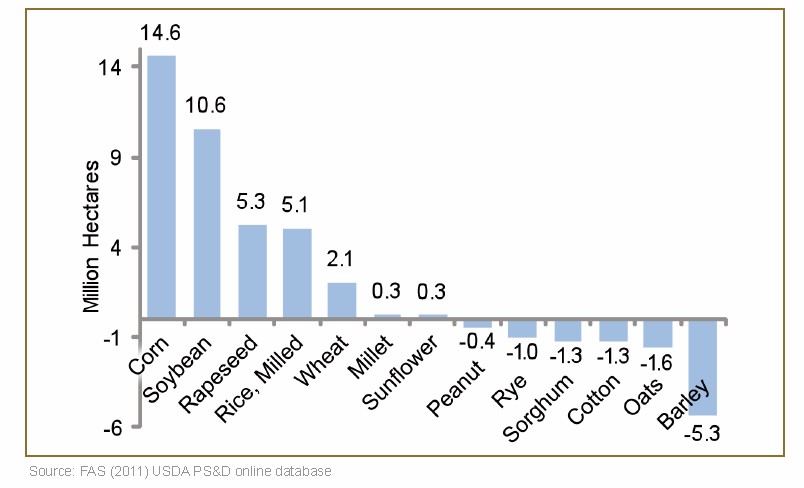
American energy policy contributes dramatically to the growth in demand for biofuels. In 2010 corn-based ethanol production in the United States reached 13 billion gallons. The corn-based ethanol target for 2015 is 15 billion gallons. The U.S. government has set a target of 36 billion gallons by 2022.
A 2009 feasibility study by the Sandia National Laboratories in Livermore, California, looks at achieving a target of 90 billion gallons of ethanol by 2030, of which 75 billion gallons would come from non-food crops and 15 billion from corn, soybean and other food or feed crops. Farm-based biofuel sources included agricultural residue such as corn stover and wheat straw. Farms could also harvest switchgrass and short-rotation woody crops such as poplar and willow.
Biofuel’s Near Future – the Next 20 Years
Cellulosic Ethanol
The Sandia study sees almost all of the capacity for biofuel growth coming from cellulose. Cellulosic ethanol can be derived from low-value residue of industrial processes such as sawdust and scrap wood. Add to this the byproduct residue of farming and the harvesting of woody shrubs and grasses from land not under cultivation. In deriving ethanol from “waste” sources the competitive dilemma for farmers to choose among food, feed and biofuel crop production is mitigated. The pressure to plant more traditional crops on marginal land goes away.
Cellulosic ethanol production has its challenges. Producers need to find an economical way to break down the woody fibres, called lignin, to get to the cellulose to convert it to sugars and ultimately ethanol. By studying the digestive processes of herbivores such as cattle, or studying the way termites break down wood fibre, scientists are developing better conversion processes. The first large-scale cellulosic ethanol plants in North America are expected to come on stream in 2013 able to pump out several million gallons. Getting to 75 billion gallons from this source requires continuous investment.
Algenol
Creating ethanol from algae, called algenol, represents another biofuel option that takes the farm out of the energy production equation. The process involves growing algae in waste water, seawater and brackish water near existing manufacturing or fossil-fuel power plants where CO2 is a byproduct. Capturing and pumping the CO2 into the water along with exposure to sunlight generates algae growth with ethanol the byproduct. Called photobioreactors, these facilities can be located anywhere human activity is generating sufficient CO2 output to justify putting an algae-to-ethanol generator in place. One company in the forefront of commercializing algae-t0-ethanol is aptly named Algenol. Their goal is 20 billion gallons per year of ethanol by 2030.
Biodiesel
Biodiesel is another biofuel that can be produced from soybeans and other agricultural products. But biodiesel can also be produced in very novel ways, from the left over vegetable oil in a deep fryer, from kitchen grease, from rendered animal fats, and what typically is seen generally as waste oil.
Biodiesel has several advantages over other biofuels. It is biodegradable. It helps take care of waste oils that normally get dumped into domestic water supplies or landfill as garbage. It is less toxic and provides fewer emissions than conventional diesel fuel.
Germany and the United States are the world leaders in the production of biodiesel. In 2005 the United States produced 75 million gallons. Comparably Germany in 2006 reported sales figures of 600 million gallons. American output was forecast to reach 1-2 billion gallons by 2010.
Worldwide Biofuel Growth
In 2010 global biofuel production equaled 54.6 million gallons per day. This number is expected to more than double to 113.4 million gallons per day by 2030. Biofuels will generate 8.5% of global energy by 2030, up from 7.7% in 2005.
]]>