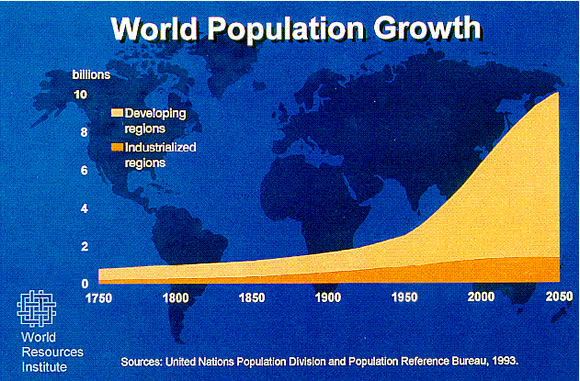
Note the graph below. Where will we see the bulk of future population growth? Certainly not in the Developed World where we have agricultural surpluses, but in the Developing World where there are far more agricultural challenges and a burgeoning population.
What is in our arsenal tools to make food affordable and accessible for all on this planet? In a paper appearing in the May 2013 issue of Nature scientists talk about creating specialized plant membrane transporters to enhance crop yields. The goal will be to expand the amount of land available for growing food through re-engineering of plants to tolerate salinity, toxicity and aridity. The key is in identifying genes in plants that control absorption and transportation of food and nutrients and that heighten the plant’s natural defenses to combat environmental insults.
The authors of the paper located specific genes responsible for the proteins that regulate the pathways from root to leaf tip. In identifying these genes and understanding the regulatory process, they believe they can introduce through genetic modification and in some cases selective breeding, desirable characteristics to improve crop yields.
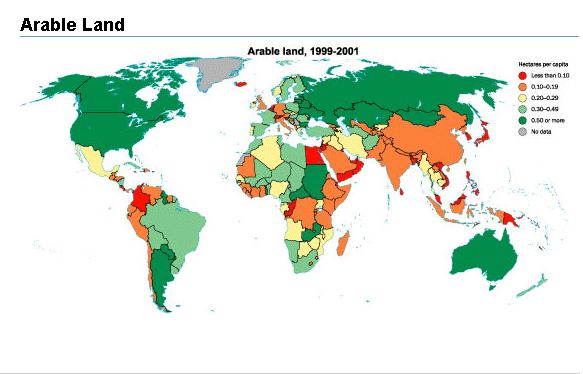
It is the finite amount of land suitable for agriculture, (see map above) about 36% of our total global land mass, that is the single most limiting factor for agriculture in addressing a future with 9.5 billion mouths to feed. So much of our planet’s soil, up to a third, is too acidic, too saline, or so filled with aluminum, sodium and other toxic minerals that we cannot grow food in it. And on the arable land we do have, poor farming practices have depleted minerals and nutrients from the soil in many areas making agriculture no longer productive beyond a subsistence level. That’s why breeding new strains of staple crops that tolerate depleted or currently unsuitable soils is critical for human sustainability.
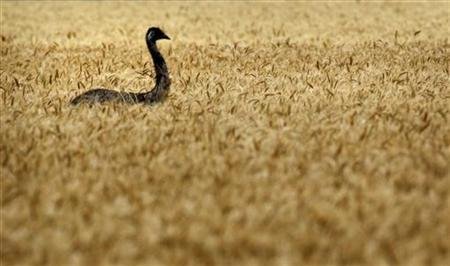
Not all the news is bad. Recent examples of successes include the development of new commercial wheat variety that incorporates salt-tolerance from wild wheat species. This new wheat variety is now being grown in an area of Australia (see image below) that was deemed unsuitable for agriculture in the past because of high levels of soil salinity. The second example is a new variety of sorghum that is acid-soil tolerant, making it suitable for growing in tropical and sub-tropical soils.
For those whose strong beliefs put them in opposition to genetically modifying plants, it is important to understand that we can only do so much in selective and cross-breeding to increase agricultural yields for staples like wheat, rice, corn, and sorghum. Genetic modification is and will be the key to meet 9.5 billion mouths to feed. Why?
The anti-frankenfood movement comes from so many of us who are already well-fed, not from those who are barely surviving. It is also a reaction to the predatory licensing practices of the chemical and agri-biotech companies that today dominate the field of genetically modified foods. And, of course, there is the organic farming movement and its premium prices for food, a luxury that we in the Developed World can afford, but simply beyond the means of most in the Developing World.
That’s why gene manipulation both within species or inter-species (what is referred to as transgenic) is likely our best solution to ensuring 9.5 billion bellies will be filled every day in the year 2050.
]]>