
Right now the technology is in demonstration mode with a test boat (seen in the two images below) running the same routes as the diesel-powered San Francisco Bay ferries, from San Francisco to Sausalito, Alameda, Treasure Island, Richmond and back.
The sail resembles an upright airplane wing guided by a solar-powered on board computer. The boat also has a diesel engine but in operations is relying very little on it cutting fuel use by as much as 40%. The sail cost about $250,000 U.S. and should pay for itself in the annual fuel savings which should amount to over $400,000. Traditional diesel-powered Bay ferries use as much as $1.2 million in fuel each year.
The added benefit of adopting these carbon-fiber sails for use in ferry services on the Bay will be a net reduction in overall carbon emissions.
Can this technology translate to other coastal cities? If the wind conditions are right, and San Francisco Bay has its share of wind, then the “age of sail” may return to prominence in the 21st century.

]]>
What’s this technology all about?
A New Type of Sail
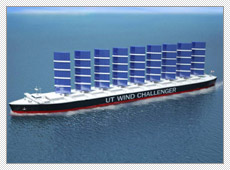
Ships will be outfitted with multiple 20-meter wide (65.6 feet), 50-meter high (164 feet) telescoping sails made from aluminum or fibre-reinforced curved plastic. The material of each sail is hollow in the centre to expand and contract as weather and wind conditions change.
A computer control system will position each sail to take advantage of maximum wind force. In simulation and wind tunnel experiments on models, the sails work effectively even in heavy cross winds. When in port the sails will collapse. At sea the sails can be partially to fully deployed based on prevailing wind and weather conditions.
Weather and Wind Tracking Technology
The control system will use weather forecasting live feeds, networked maritime navigation information from other ships at sea, on-board wind measurement including both direction and speed to optimize sail usage. Individual sail wind analysis will be combined with wind-flow analysis for the multiple sail array to ensure that all sails gain optimum value from prevailing winds.
Navigation Routes Redefined by Wind and Weather
Currently ships at sea seek the shortest distance routes to get from one port to another. Wind is not a factor in defining these routes. But that would change if merchant and cruise vessels were outfitted with these high-tech sails. Each sail equipped ship would be equipped with ocean wind forecasting technology for plotting an optimal course.
Measurable Benefits
Current model tests are built to scale to a size suitable for large merchant ships. The next step is to build a half-scale model for testing at sea before full-scale manufacturing and first sea trials on a 180,000-ton bulk carrier outfitted with 9 sails as early as 2016. Wind Challenger is a project headed up by researchers at University of Tokyo along with a number of ship builders and vessel and fleet operators.
]]>