Nazi Germany’s claim of representing all Germans led to the Sudetenland Crisis of 1938. Adolf Hitler proclaimed that he was protecting the German-speaking peoples living in the border areas of Czechoslovakia from genocide at the hands of the Czechs. Vladimir Putin is doing the same in the Donbas provinces (Donetsk and Luhansk) in Ukraine where the majority of people are Russian-speaking. In both cases, the actions of the bullies have been predicated by claims that those they represented were being subjected to persecution.
Hitler’s Wehrmacht was the most powerful military in Europe by the fall of 1938. Hitler used this as an overhanging threat throughout the Munich conference that led to the dismemberment of Czechoslovakia. Putin’s Russia has amassed an overwhelming military force in proximity to the Ukrainian border and despite diplomatic efforts by European heads of government, and those in the United States and Japan, and despite the threat from all of these to apply broad economic sanctions, he has made his first geopolitical strategic moves to peel off Eastern Ukraine and move peacekeeping forces across an internationally recognized border. It is a move that is just short of war, one that would be a battle of unequals, similar to the move perpetrated by Germany in September 1939 on Poland. Unlike Hitler, Putin is making his move in the guise of peacekeeping.
The other big difference between Germany in 1938 and 39 and Russia in 2022 is the latter’s massive nuclear arsenal. Putin has made it quite clear in a recent speech that the descent to nuclear war could be inevitable if his demands are not met.
As a student of history, it is hard not to notice the obvious parallels in what is playing out once again on the eastern edge of the European continent. It was Jorge Agustín Nicolás Ruiz de Santayana y Borrás (George Santayana as he was known in the United States and Great Britain) a Spanish-born philosopher and historian, who is credited with being the first to say, “Those who do not learn from history are doomed to repeat it.” I’m not sure this is true because one can find similar statements dating all the way back to the Peolopynesian Wars fought among rival Greek city-states and alliances back in the fifth century BCE.
Adolf Hitler is probably the most well-known example of someone who didn’t learn from history when he launched a second front assault on the Soviet Union in 1941 before defeating the United Kingdom. He repeated the same behaviours as Napoleon Bonaparte who, unable to conquer the British turned his Grande Armée on Russia instead. Inevitably, the German leader followed Bonaparte to defeat.
Ignorance of history can be found all around us. Just look at recent headlines. The so-called “Freedom Convoy” that occupied the centre of Ottawa, Canada’s capital for four weeks, and that inspired similar acts at key border entry points between the United States and Canada, bore a resemblance to the January 6, 2021 insurrection displayed in Washington, DC. Both chose similar symbology: Confederate flags, swastikas, and yellow Jewish stars. In proclaiming personal freedom they used symbology that was quite the opposite.
I am a great advocate of Santayana’s statement. Although I never got the opportunity to teach history after graduating from university, I remain an attentive student of it. My approach to describing scientific achievements and technological innovation always is seen through a historical lens. The same is true when I prognosticate about what lies ahead in the future.
Russia’s playbook in Ukraine is history repeating itself in the most obvious ways. It hardly varies from similar acts in 2008 and 2014.
Both cases have led to diplomatic censure and economic sanctions from members of the international community. The sanctions have done nothing to reverse the outcome of Russia’s acts, and today, the country is well on its way to establishing a greater Russian state that bears a striking resemblance to the former Soviet Union.
In the Europe of the 1930s, Nazi Germany played the same game.
And now we face nuclear-armed Russia led by a leader who continues to display the same pattern of deception and bullying that by now should be obvious to the rest of the nations of Europe and the world.
History repeats. What have we learned?
]]>Little known in the West, Kalashnikov builds more than guns. In the latest display of Russian military prowess at the Army 2018 fair held at Patriot Park, Moscow, the company displayed a range of new assault rifle models, armored utility vehicles, and a bipedal walker that looks like it was designed for a Hollywood science fiction adventure.
Called Igorek, this “Avatar-style” monstrosity has to be a joke or a prop to get the media’s attention. The impracticality of its design makes it more than unlikely that it will ever appear on a battlefield.
In the two images below you can compare Igorek to the bipedal walker that appears in the movie “Avatar.”

Surprisingly, a number of iterations of bipedal human-controlled robotic walkers show up when you type the term “military bipedal walker” into a Google search. Robot designers seem to get a kick out of building prototypes. Watch this YouTube video of Method-01, a Korean invention that supposedly will appear one day on future battlefields.
But Igorek, standing 4 meters (13 feet) tall has been described in Popular Mechanics as a “giant egg on legs.” Igorek’s features include:
In Popular Mechanics reveal of the Kalashnikov’s Igorek it notes that combat walkers are entirely impractical on battlefields. Besides the leg vulnerability issue, these walkers require balancing systems to keep the cockpit from constantly rocking. And then there is the height issue. On a battlefield, a weapon with such a high profile would be an easy target.
]]>The use of technology in the wars of the first two decades of this century is not considered the paradigm for anticipated future conflicts. That’s because these have been wars largely fought on the ground and in the air in response to international interventions, quelling of intranational uprisings and civil wars, and land grabs.
We are talking about the continuing Afghanistan conflict now some 17 years old, the Iraq war of 2003 and the post-war fallout leading to the rise of ISIS and its African offshoots, the continuing Israel-Palestine neverendum, Russia’s incursions into Crimea and Ukraine, as well as Georgia, and the ongoing instability in Korea. All of these are extensions of 20th-century conflicts fought largely with 20th-century technologies.
The rise of cyber warfare fought from desks in offices and back rooms is a phenomenon engendered by a global-wide communications revolution of the late 20th century, the Internet. Today this is defined as a war of electrons and AI with algorithms battling for strategic advantage while ensuring no breaches occur in military or domestic infrastructure and operations including politics and elections.
And then there is the insertion of the military into the fields of biomedical engineering and biomedicine with improvements to prosthetic limbs (a development fueled by battlefield ground war injuries to thousands of soldiers in Afghanistan and Iraq), development of exoskeletons to enhance soldier capability on the battlefield, brain implants connected to augmented reality, and DNA-altering technologies in pursuit of creating super-soldiers.
Back in March of last year, I wrote a posting entitled “The Battlefields of the Future: Robot Armies vs. Enhanced Humans.” I described the Mad Scientist Initiative, an alliance of the military, academics, and business, focused on future wars. Among Mad Scientist’s current key areas of interest are these three:
But the reach of the military into scientific discovery and technological invention is not limited to these areas. Consider the following:
And none of these military technological advancements are about missiles and nuclear weapons which remain deterrent weapons with delivery and destructive force capable of wiping out civilization and life over much of the planet. Even in these areas, a rethink is underway to make nuclear weapons smaller with lower yields to make them more battlefield friendly to deliver precision blows to small sites rather than wipe out an entire city. And successors to today’s cruise missiles are in the works as well with hypersonic replacements capable of traveling up to Mach 5 (five times the speed of sound). Russia recently announced a hypersonic cruise missile that could evade any state-of-the-art weapon detection systems.
Finally, there is the militarizing outer space. The Soviet Union and its successor Russia, China, and the United States have all been sending aloft military payloads to spy on each other’s ground, sea and air forces. But the most recent call by the President of the United States to create a separate military branch called the Space Force is something entirely new. Donald Trump in his space policy announcement directed the Department of Defense to ensure “American dominance in space.” In a recent interview on CNN, U.S. Congressman Mike Rogers stated, “the future of war will be fought in space.”
Russia, China, and the United States haven’t been shy about developing kinetic, laser, radio jamming and robotic weapons designed to target Earth-orbiting satellites. China even demonstrated a kinetic weapon on one of their own satellites in the last few years. If all that gets developed are counter-space capabilities to knock out enemy observation and infrastructure satellites, this will not amount to a space war. The idea of a Space Force where human or AI-operated gunships could fire from space on satellite and Earth targets would be a major escalation. Let’s hope this is not the direction that spacefaring countries like Russia, China, and the United States today choose to go.

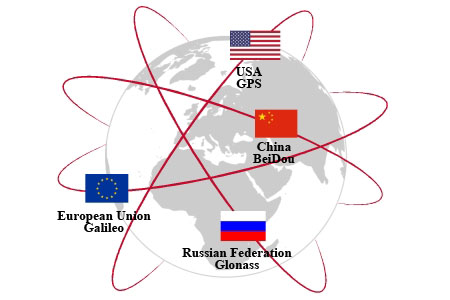
Since then the European Union (EU) and China have both launched their own GPS networks. The former goes by the name Galileo and currently has 22 satellites in orbit with plans for 30 in total. The latter, BeiDou, which came into operation in 2000, has 22 operational satellites with plans to complete the network by adding 13 more by the year 2020.
And not to be left out, both Japan and India are developing regional GPS navigation satellites. Japan’s system, called the Quasi-Zenith Satellite System (QZSS) will have 7 satellites when fully operation by year-end. Currently, there are 4 satellites already in orbit. India’s Regional Navigation Satellite System (IRNSS) with 7 satellites is designed to cover the subcontinent and a region up to 1,500 kilometers around it.
The latest Russia-Chinese initiative appears to be a merger according to Izvestia with GLONASS and BeiDou becoming one system capable of sharing navigational data. It is hoped that in combining their GPS it will improve accuracy for both systems. Talks are scheduled for May of this year to complete planning for the new combined system. It will be interesting to see if the combined GPS will offer civilians and commercial operators the equivalent convenience that the American GPS network does today.
GPS has been revolutionary since the first satellites were deployed. The technology has become ubiquitous as GPS receivers have seen their form factor shrink to a point where they can be incorporated into almost any device from mobile phones, to farm machinery, laptop computers, airplanes, all kinds of transit vehicles, cars and trucks.
The U.S. military-grade version is accurate within a few centimeters. The civilian and commercial version is less precise but certainly more than acceptable. When my family drove to Cleveland last summer, and Atlanta, in the fall, the GPS in our Toyota Rav4 served us well. As I write this posting, my mobile phone is sitting beside me here on the desk and when I check location is pinpoints my whereabouts on Google Maps to be across the street from where I am, a deviation no more than 10 meters. That may not be good enough for engineering measurements, but for general navigation purposes, it appears to be more than sufficient.
So how did GPS come about? The idea was first conceived by a researcher who was an MIT graduate working at Raytheon Corporation. As early as 1951 the company proposed to the U.S. Defense Department, a three-dimensional, time-difference-of-arrival position-finding system. With the launch of Sputnik by the Soviet Union in 1957, the technology was finally in place to turn the Raytheon proposal into a reality.
And now we have six different technologies deployed and next-generation refinements coming out that will make these systems more robust, more pinpoint accurate, and cyber secure.
In a recent article appearing in Bloomberg Technology, Chris Strohm writes that the incursions by Russian hackers also used social media to influence the election outcome. He writes, “Material stolen by Russia’s intelligence services was feverishly promoted by online personas and numerous fake accounts through links to leaked material and misleading narratives.”
The evidence of this comes from FireEye, a company that tracks Russian and Chinese hackers making attempts to break into U.S. computer systems. Strohm quotes David DeWalt, Chairman of FireEye who states, “The dawning of Russia as a cyber power is at a whole other level than it ever was before…..We’ve seen what I believe is the most historical event maybe in American democracy history in terms of the Russian campaign.” The Russians not only hacked the Democratic Party’s email servers and then gave the contents to whistle blowers to put on the web, but also created fake news largely denigrating to Hillary Clinton, which was then spread through the Facebook and Twitter universe using artificial intelligence bots to do postings. FireEye mapped the Russian campaign identifying six key false “hactivist” personas including Guccifer 2.0, DC Leaks, Anonymous Poland and Fancy Bears’ Hack Team. Bots automatically spread the misinformation through fake social media accounts to generate a significant volume of lies and deception. More legitimate whistle blowers like Gawker and Smoking Gun were sent material which they then spread not knowing its legitimacy or illegitimacy. Even legitimate journalists were offered stolen and false information from false email accounts. And FireEye states that the activity post-election continues.
Chairman of the House Homeland Security Committee, Michael McCaul, Republican, from Texas referred to the hacking as a “wake-up call.” John McCain, Republican Senator from Arizona has also called for hearings on Russian cyber activity.
Worldwide the problem is just as severe. Back in September the German government and industry described 20 daily hacks of sensitive networks. Volkswagen reported 6,000 attacks per day and one in five German companies noted attempted or successful hacks of internal networks. Yesterday, Germany’s head of federal security, Hans-Georg Maassen, warned of Russian tampering with the upcoming 2017 election with the goal to “weaken or destabilize the Federal Republic of Germany.” As in the United States the Germans claim that Russia is financing misinformation campaigns using state actors to launch cyberattacks. To underscore the level of exposure, this week German steelmaker, ThyssenKrupp, reported a massive cyber attack that started in February and ran through April. Project data from the company’s engineering division was stolen.
A report on the extent of the Russian hacks will be useful to help the U.S. government, others nations and businesses to better understand how to shore up defences. But what other actions can be taken? Is this the first round in what will become a cyberwar between nations and businesses?
In a recent IBM study it was found that 66% of organizations fail to recover from cyberattacks. Those companies participating in the study reported:
IBM reported that 2016 was one of the worst for cyberattacks with denial of service causing major web outages such as the October 21, 2016 attack that disrupted Paypal, Spotify, and Twitter. The attackers targeted Dyn, an Internet hub by using Internet-connected devices with embedded malicious code. The outage began in the Eastern United States and then spread to the rest of the country, Canada and Europe. The attack took down CNN, the New York Times, the Wall Street Journal and some Amazon-hosted business sites. Bruce Schneier, a security guru, believes that a country is behind the October 21st attack and that it was a test of the resilience of the system to overcome the security breach.
Russia, not wanting to be left out of being a potential cyber victim, stated in the last week that it too was being targeted by “foreign spy agencies” out to create chaos in its banking system. The attack was supposed to begin on December 5th originating from servers in the Netherlands. The Russians, however, claim that they parried the threat and that the “situation is under control.” At the time of the alleged attack Vice President of the United States, Joe Biden, had indicated to Russia that any cyberattack by them would be met with a proportional American response.
The United States currently has a lack of qualified information security people on board to fight back despite Vice President Biden’s “proportional response” remark. The industry is short about 200,000 to meet the current job listings. The U.S. federal government has called for 3,500 new hires by the end of 2016. Worldwide the shortage amounts to 1 million.
An answer to this decided lack of human security expertise is to bring artificial intelligence into the mix. This involves, states Amir Husain, CEO of SparkCognition, an artificial intelligence start up, “a diminished role for humans.” It’s not such a stretch when you consider every PC includes a firewall and antivirus software, pattern recogniton algorithms that help protect our home and office computer systems. Husain is just talking about upping the level of surveillance through more sophisticated software capable of responding to cyberattacks. DARPA, the Defense Advanced Research Projects Agency of the U.S. Department of Defense, recently organized a hacking competition which Mike Walker, DARPA program manager, describes as a way “to build autonomous systems that can arrive at their own insights, do their own analysis, make their own risk equity decisions of when to patch and how to manage that process.” IBM has also turned Watson, its cognitive technology, to the task of detecting cyberattacks and computer crimes by having it absorb everything in print on the subject.
States Husain, “Insofar as machines can sense and monitor the world in ways that go beyond our biological abilities, they will have greater insight – higher quality insight with more depth.”

In Russia, its representative on the World Wildlife Fund called the reduction targets far too conservative noting that the country is home to the largest land-based carbon sink in the world, its boreal forest zone. It is observed that the boreal forest could contribute 24% of the 30% alone as a natural sink. Getting the additional 6%, therefore, seems utterly unambitious.
Still waiting to be heard from of those countries that are significant emitters:


War today is asymmetric. Victories are had with deft insertions involving a few rather than putting millions in the field. Armed to the teeth with technology and intelligence, soldiers drop from the sky and eliminate enemy targets in a matter of minutes. Even better, robot do the job guided to targets by human operators sitting thousands of kilometers away.
The latest war, Russia’s invasion into Crimea, although more conventional in some respects, is a good example of asymmetric warfare. The confrontations hasn’t involved cannonades or fleets of bombers dropping death from the skies. Instead the war has been surgical in its precision, minimalist, and effective.
So how does one develop a strategy to defeat the asymmetric wars we are seeing in the 21st century? By a combination of tactics and technology.
If we were to deploy the old ways of war we would do one of two things:
The new way of asymmetric warfare appears today to not involve soldiers and firepower at all. Instead it takes advantage of our global interdependency derived from a highly technology-connected world. It employs economic weapons of mass destruction. An interdependent world has created asymmetric nations that no longer manufacture much of what they consume and instead have become dependents of others for the goods they consume. An interdependent world has resource generating countries dependent on consuming nations to buy what they pull and pump out of the ground.
Interdependency goes beyond goods and services. It takes in the telecommunications cloud that envelops our globe. The evolution of the Internet is the bridge that connects all humanity. And in that it is a perfect weapon for 21st century warfare.
It can disseminate information to counter government messages and policies. It can influence whole populations through the instruments of social media and smart phone technology. It is the technology of the Arab Spring. It is difficult to jam despite herculean efforts by national security organizations to try and do just that. Hackers and cyber warfarers find ways around blockages. Cyber warriors can insert viruses, trojan warriors and worms into the nation’s industrial heart leading to massive operational disruptions. It can drain a nation’s reserves. It can shut down banking systems. It can turn off taps. It is this cyber warfare capability that may prove to be the greatest danger to any nation choosing aggression over conflict resolution in the 21st century.
And finally, one cannot talk about 21st century warfare without mentioning the legacy of nuclear weapons. What humanity has feared most since the dawn of the Atomic Age in 1945 is nuclear holocaust, war between nuclear-powered adversaries that rains destruction on a global scale. In developing nuclear weapons, however, it appears humanity has created the single, greatest deterrent to the conventional war of battlefronts like those we witnessed in the 19th and 20th century. Since the United States dropped two atomic bombs on Japanese cities in August 1945, no nuclear weapons have ever been used in battle. The Armageddon scenario, nuclear winter, has virtually made atomic warfare a non-starter.

If you have been reading the news in the last two weeks our government received recommendations on its Arctic sovereignty claims which were rejected by the Prime Minister and sent back for a rewrite. Canada’s government wanted to make sure that the underlying geography of the Arctic Ocean floor indicated that the continental shelf ran clear up to the North Pole, an area hotly disputed by Canada and Russia as lying within their territorial boundaries.
Why does Canada want a big piece of the Arctic Ocean floor? Because, the rationale goes, we can then exploit the “tremendous resources that are to be found in Canada’s far north.” So states Canada’s Foreign Affairs Minister, John Baird.
The Arctic Ocean seabed overlays gas and oil deposits. There are potential ore deposits, hydrates and mineral-rich tungsten nodules scattered about that Canada can harvest in the decades to come.
The area in dispute between Russia and Canada is the Lomsonov Ridge (seen in the centre of the image below), an underwater structure that runs for 1,800 kilometers (approximately 1,100 miles) across the seafloor connecting islands off the Siberian coast with Ellesmere, Canada’s most northerly island. The ridge is a shallow part of the Arctic Ocean and is considered prime seabed real estate for both countries.
What neither country has considered is just how foolish these claims will turn out to be in light of the inhospitable and inaccessible conditions in which the resources lie. Even if the Arctic sea ice completely disappears by the end of the 21st century the Arctic Ocean will never be a benign place in which to do mining for oil or any other resource. One accident at an oil rig platform, similar to the one Russia recently experienced in the Sea of Okhotsk or a repeat of a blowout such as occurred on the BP Deepwater rig in the Gulf of Mexico, and you would have an environmental nightmare on your hands that no amount of dispersant could rectify.
Add to this the fact that in the near future all governments including both Canada and Russia will begin to tax carbon and reduce the burning of fossil fuels. What will be the point of exploring for oil under the Arctic seabed in a future world where oil will no longer prime the economic pump?
But that’s not stopping Canada from flexing its muscular claims to the Arctic Ocean seabed including the area around the North Pole. What would Santa say?

But this story isn’t about the assassination but rather reports a story that purportedly appeared recently in the Voice of Russia stating that Sergey Antonenko, head of the Khrunichev State Space Research and Production Center, (the builders of the Proton rocket and the Zarya module that was the first piece of the International Space Station) believes that colonizing asteroids, hitching a ride on them, and using them as closed ecosystems for human habitation may be the smartest way for us to become a space faring species.
In his comments he argues that there are at least 10,000 near-Earth asteroids (NEOs) and over 2 million in the Asteroid Belt. The total mass of all of these space rocks equals more than three Earths so that means lots of material to exploit. And many of the NEOs follow long elliptical orbits that take them outward to the proximity of Mars and Jupiter which means we can ride them to other places in the Solar System.
Antonenko believes we can inhabit some of these space rocks and build closed-cycle ecosystems where humans could live quite comfortably. Today the United States, Russia and China are attempting to develop closed-cycle environments that are self sustaining, a necessary step for any successful long-term habitation of Deep Space, the Moon and Mars. Antonenko sees asteroids as the most suitable candidates for our long-term colonization of space beyond Earth orbit.
There has been lots of talk about mining asteroids and using the materials to support space habitations. But less has been said about inhabitin one of these rocks to make it a home in space. The idea has lots of merit when you consider the challenge of cosmic radiation and how an asteroid could effectively provide the type of shielding needed for our long-term space survival.
Of course NASA has an asteroid capture mission on the drawing boards but the goal there is to study and test mining technologies to see if we can use these rocks to build space infrastructure. What Antonenko has in mind goes much further.

Here are some interesting facts about Russia’s oil record.
Gazprom is one of two Russian companies with drilling rights in the Arctic Ocean. This company in 2012 reported 2,626 oil pipeline leaks. That was down from 2011 when they reported 3,257. The year 2011 also saw the company lose the Kolskaya maritime oil rig off the Siberian coast in the Sea of Okhotsk. Two weeks ago the company announced that it was “on track” to start producing oil from the Prirazlomnoye Arctic oil project before year end. It was this drilling platform that Greenpeace protestors commandeered. The protestors who were arrested have been charged with piracy. The company on the other hand continues to disregard what most other oil companies would consider standard safety practices. In fact its oil exploration rigs in the Arctic still appear to be vulnerable in the event of an emergency with the closest response vessels as much as three days away should an oil spill occur.
Rosneft is described as Russia’s leading petroleum company. State controlled, to date, Rosneft has the worst record for oil spills of any Russian producer. For example the company was responsible for 75% (2,727) of all oil spills in just one producing region, the Khanty-Mansiisk autonomous district, in 2011. Since then the company has achieved a 20% reduction in the number of spills, hardly a stellar record for managing its drilling and pipeline infrastructure.
Russia continues to lead the world in oil pipeline breaks. Why? Because the country has an aging oil infrastructure and lax regulation of the industry. Back in June of this year Russia’s President, Vladimir Putin, pledged to invest $43 billion U.S. to improve Russian infrastructure. This included investments in roads and railways but said little about pipelines. But see for yourself from the image below. This is a picture of a pipeline crossing permafrost being subjected to the stresses of changing climate. It seems accelerating permafrost thaws are wreaking havoc with Siberian-laid pipelines. Now apply what you see here to Russia’s current activity in the Arctic Ocean and we can truly say, “Moscow, you have a problem!”


