
So you can guess what his focus is on. Right….robots, where they are and where they are going.
Diamandis describes the setting for what is becoming a significant technological disruptive force here in the second decade of the 21st century. The combination of advances in artificial intelligence (AI), sensors, actuators and network communication is making the robots of science fiction a reality. Today robots are evident in our daily lives. The Roomba is just one. Google’s self-driving autonomous vehicle is another. Robotic drones come in all kinds of sizes and shapes. Humanoid robots are starting to be used as healthcare aides for the elderly. We are in the middle of the robot revolution and about to be assailed by even more of them. As Diamandis states, “the societal and cultural implications…..will be staggering.”
Here are Rodney Brooks’ shared observations and predictions.
———-
Top 5 Recent Robotic Breakthroughs: 2013 to 2015

1. Consumer cars have started to become robots.
Brooks points out that today’s partial or fully autonomous cars are really “robots.” As we humans interact with autonomous vehicles, we’ll have to rethink the interfaces, rules and behaviors we exhibit around these technologies as they become more commonplace in our lives.
2. 3D gaming sensors are readily available.
We humans are really messy, and historically it’s been really hard for a robot to understand our clutter. Brooks explains, “But recently, 3D gaming sensors, driven by consumer electronics, are becoming good enough for a robot to begin to navigate more effectively.”
3. Robotic Navigation is now cheap and available on smartphones and vacuum cleaners.
The new technology is called VSLAM (Visual Simultaneous Localization and Mapping) and it is making it easier for robots to map their environment and understand how to navigate through it. Brooks explains, “Thousands of researchers worked on this problem during the 90’s. It has now gotten so cheap that the latest Roomba has a camera that builds 3D maps of the world as it wanders around.”
4. Drone control systems have reached a tipping point.
States Brooks, “A few years ago autonomous control of a model helicopter was really, really hard. Then drones came along, paired with mobile phone technology and now drone control systems are intrinsically easier and almost anyone who can write code can now write code that flies drones.”
5. GoPro cameras gave drones something to do.
Brooks sees GoPro cameras as a game breaker. He states, “GoPro cameras ‘just work.’ They capture great images, and are small, durable, and adaptable. They have made drones much more useful and fun to use.” GroPros and similar cameras have given users something to do with their drones and have become a useful way to collect data. You now see a proliferation of drone footage being used in a wide variety of entertainment and business applications.
So what’s in store for the near future?

Top 5 Anticipated Robotics Breakthroughs: 2016 to 2018
1. Smartphone modules becoming embedded supercomputers for robots.
While we may not realize it, the smartphones we use every day are really tiny supercomputers, and the same components powering these smartphones are now powering robotics as well. The first Roombas had 512 bytes of RAM, and this was seen as groundbreaking. Today, the Roomba has a tiny supercomputer utilizing VSLAM to navigate autonomously, and at a cost of about $300 U.S. In the next few years, these capabilities will grow exponentially with profound impacts on robotic capability.
2. Shared learning in the cloud for robots.
When robots are connected to the cloud, they share data about their experiences, and in doing so, dramatically accelerate how quickly they “learn” in the real world. The most profound example of this is autonomous vehicles. These cars constantly upload driving data from their sensors to the cloud so that the whole system can learn from every individual vehicle on the road. For example, if one car avoids a new obstacle in the road, immediately all other cars know what that obstacle looks like and how to avoid it. Watch for a lot more of this in the next few years.
3. Widespread availability and uptake of collaborative robots.
Collaborative robots are showing up in the workplace. Designed to safely assist and augment humans in executing specific tasks, robots like Rethink Robotic’s Baxter and Sawyer represent great examples of where this technology is heading for industrial and commercial use. Baxter can be “trained” by physically moving its limbs correctly to do a series of tasks. Once learned the robots can manage repetitive, physical work side-by-side with humans in almost any setting.
4. Neurally controlled prostheses.
In the next few years expect brain-controlled prosthetics to begin to make us superhuman. Brooks explains, “We’re already making ourselves better, and that is going to accelerate. Cochlear implants are a great example, though they’ve been around for a while. There are big DARPA programs now on neurally controlled robotic devices. We’ll become superhuman.” Prosthetic extensions of us will change the way we interact with the world, giving humans abilities we couldn’t have dreamed of decades ago. “We could become super rock climbers at age 70… there’s going to be an entire industry around people making themselves better by putting this stuff in their bodies.”
5. Physical assist robots for the elderly.
There’s an incredible demographic inversion about to happen. In Japan we’re soon going to have 30% of the population over the age of 65. The same will be true in China by 2050, And the U.S. and the rest of North America, as well as Europe are not far behind. As we extend the human lifespan, Brooks forecasts, “We’ll see a scenario where the elderly will have to look after the really elderly.” This is a hundreds of billions of dollars opportunity for robotics manufacturers. “We are seeing many early trials of robots that help the elderly get into bed, get out of bed, get their groceries up the stairs, the sorts of things that we’ll need to keep our independence. Even the self-driving car is another type of elder care robot because it lets us drive longer, lets us have our independence longer.”
]]>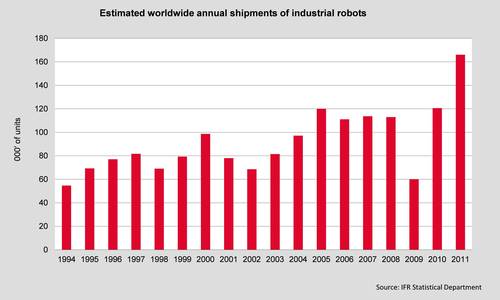
The industrial robots in these statistics cost six figures. But a Boston manufacturer, Rethink Robotics, has introduced a robot capable of performing a wide variety of common, repetitive tasks in the workplace at a fraction of the cost of previous manufacturers. Weighing 75 kilograms (165 pounds), standing 1.8 meters (6 feet), and known as Baxter, this is the first of a new generation of industrial robots that exhibits adaptive skills. Baxter, in a couple of minutes, can be programmed by almost anyone to accomplish new tasks. And unlike other industrial robots Baxter is very affordable at $22,000 U.S.
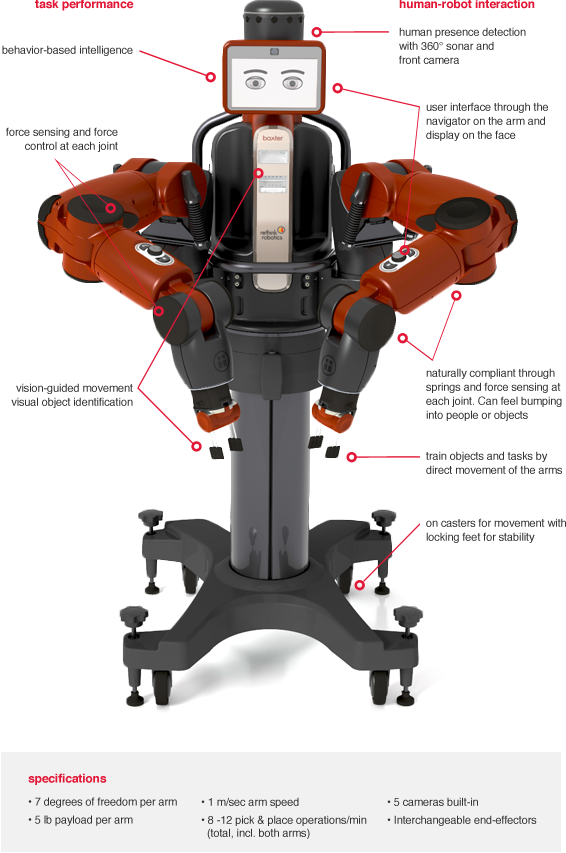
This is truly disruptive technology. Baxter is designed to do small-scale repetitive applications. Baxter can work beside humans in a facility without extra safeguards. Baxter interacts with humans through its LCD display which features eyes and eyebrows that express emotion. That same graphical display serves as an interactive console for human coworkers to reprogram Baxter. By showing Baxter what to do through manipulating his arms, a human worker can train it to do a new task. No software engineers need apply.
Out-of-the-box Baxter is pre-programmed to perform a wide range of manufacturing jobs including operating machines, materials handling, production line loading, unloading, assembly, finishing, inspecting, testing and sorting. In less than an hour Baxter can be on the job. And Baxter automatically alters its behaviour in response to any environmental change such as production line speed ups or variations in parts placement on an assembly line. Baxter can also adjust when a part is missed or dropped, or the assembly line surface height changes.
Baxter has no sharp edges or grippers that can inadvertently trap a human coworker. Baxter’s arms move fluidly and easily. Packed with sensors, Baxter can detect human presence nearby and avoid contact or reduce the force of any inadvertent collision.
Baxter as you can see in the image below comes with a mobile pedestal that allows it to be moved easily to different locations in a manufacturing facility. Its two interchangeable grippers can be switched in minutes. The electric parallel gripper features interchangeable fingers of different lengths with multiple grasp widths. The vacuum cup gripper comes with variable cup sizes and is used for hard-to-grasp objects.
In addition Baxter works with manufacturer enhancements from third parties and in 2013 will include a software development kit so users and re-marketers can reprogram the robot for unique tasks.
Baxter’s built-in smarts allow it to work in a number of industries including:
Will deployment of Baxter in small manufacturing cost hundreds of thousands of jobs? Not according to Rodney Brooks, Chairman and Chief Technology Officer at Rethink Robotics. What it has the potential to do is lower the cost of small manufacturing so that it can be competitive with manufacturing overseas. That can impact hundreds of thousands of companies worldwide. And robots like Baxter will make an increasingly smaller workforce more productive as our population ages and the current generation of Baby Boom workers retire.
]]>