So why is this?
One can make an argument that it is our irrational fear of automation that keeps robotic adoption in Western economies at much lower levels than in Asia. A second reason may be cultural. It appears that Asian countries see robots as socially acceptable, safe and useful companions whether in the workplace or in homes. Instead of robots being seen as job killers they are deemed to be useful machines for improving productivity and lives. Japan holds annual contests to make robots even more useful for its population. There, robots are being used to help the elderly in homes and hospitals. You can even run into an occasional robot pet.
We in the West seem to have no problem sending robots into space to explore the surface of the Moon or Mars. We find them useful for remote sensing in our oceans, or in today’s modern surgical suites where they are being used to perform operations. We even have adopted them to vacuum our homes. And currently, we have millions of vehicles on our roads with all kinds of robotic capabilities from adaptive cruise control to intelligent parking assist. But when it comes to adopting robots in industrial settings there is a general discomfort.
Managing the change that robotics will bring to the world in the 21st century requires us to understand the legal, ethical, and social implications of widespread adoption. In an effort to establish a common approach to regulation, the European Commission funded a study in 2014 called the RoboLaw project. It focused on legal status, nanotechnologies, brain-computer interfaces, neuroprosthetics, as well as more conventional robotic arms, pallets, and devices used in manufacturing. In the end, a set of rules were proposed that could be turned into legislation for countries within the European Union to establish a regulatory landscape and methodology to use as robotics and its companion technology, artificial intelligence (AI), continue to evolve.
The RoboLaw project defined robots by various taxonomies including:
It then applied the taxonomies to case studies to determine the potential human impacts, for example, the use of a surgical robot to save a human life, a companion robot that helps someone who is bedridden, a deep-learning robot used to analyze massive amounts of data to find commonality, a prosthetic limb to replace a missing human one, an exoskeleton to give a paraplegic the ability to walk, a nanorobot that operates inside a person to hunt down cancer cells, or to repair a damaged organ or blood vessel, and robot integration for the purpose of human enhancement.
Do the RoboLaw project results help to reduce our fear of a future where robots will increasingly be part of our world? I believe so. By establishing a well-defined regulatory environment it should make incorporating these machines into our everyday lives a far more seamless effort.
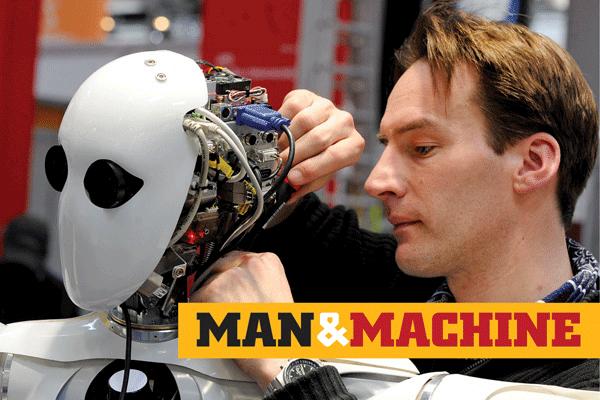
The image of robots we fear, The Terminator, represent a very small segment of what will be a ubiquitous technology. The few designers building animatronic robots resembling humans represent novelty rather than purposeful function. I would suspect that the vast majority of our 21st-century robots will be more like Roombas which don’t look anything like a person pushing a vacuum cleaner.

]]>
Those familiar with Isaac Asimov’s “Three Laws of Robotics“ know that in the realm of science fiction humanity has spawned childlike, aiming-to-please robots like Daneel who appears in several of that author’s novels. At the same time both religion and fiction have contributed automatons of a different nature. Take the the Golem, a legendary monster who arose from the mud to defend the Jews of Prague from Christian mobs, or Shelley’s Frankenstein, a monster conjured by science run amok.
Hawking sees a pending “arms race” between human and artificial intelligence. In an interview with the Financial Times he describes advances in genetic engineering that can improve humanity a generation at a time, every 18 years. Whereas with Moore’s Law continuing to hold true, computers continue to double speed and memory every 18 months. We humans are inching along while the machines we create are comparatively advancing at light speed. In the Financial Times interview Hawking stated, “the risk is that computers develop intelligence and take over. Humans, who are limited by slow biological evolution, couldn’t compete, and would be superseded.”
Hawking and Musk are not alone in expressing these very alarming views. And yet governments seem slow off the mark in recognizing the disruptive and destructive potential represented by advances in robotics and artificial intelligence.
In almost every technological innovation coming from the Industrial Revolution our governments have seen fit to at some point establish regulation and standards. This has helped with communications, aviation, pharmaceuticals, consumer electronics, motor vehicles and more. So why not robotics and artificial intelligence? After all regulation in the past has protected humanity from harm while allowing innovative processes to unfold. So the subject of this posting, that we ask ourselves if governments should establish guidelines and standards to ensure we don’t end up in a war with the technology we create, is more than relevant. It is essential.
The European Union in September of this year has funded a project entitled, “Regulating Emerging Robotic Technologies in Europe: Robotics facing Law and Ethics.” Deemed to be an in depth analysis of the ethical and legal issues raised by robotics and their application, it looks at risks to fundamental rights and freedoms and whether new regulation is needed to address potential problems posed by the technology.
In the document the authors state “overly rigid regulations might stifle innovation, but lack of legal clarity leaves device-makers….in the dark.” Law seldom keeps pace with a fast emerging technology. Of this fact the authors are very cognizant. At the same time as they recognize that premature and obtrusive legislation could hamper promising advances in the field, they also note that a lack of regulation and legal framework can result in unintended and dangerous consequences.
In the December issue of Scientific American, Ryan Calo, a University of Washington law professor specializing in robotics, law and policy, argues the case for U.S. federal regulation. In his concluding remarks he states, “if we fail to think about proper legal and policy infrastructure now, robotics could be the first transformative technology since steam in which America has not played a preeminent role.”