The second story is about “regenerative agriculture” which Robert F. Kennedy Jr. wants to see become the standard after claiming that current agricultural practices at American farms and ranches are making Americans sick.
Let’s begin.
A new survey commissioned by Farmers for Climate Solutions, states that climate change is at the top of the challenges Canadian farmers and ranchers are facing causing reduced yields and profits. The poll involved 858 farmers and ranchers who were asked an open-ended question regarding concerns they face now and ten years into the future. The results put climate change at the top of responses. It was identified by 18% of responders followed by seed, fertilizer and other expenses at 17%.
Brent Preston, President of Farmers for Climate Solutions stated, “Farmers and ranchers across Canada are living the reality of severe weather and understand that climate change puts our livelihoods at risk. The results of this poll provide valuable insights into the challenges we’re facing and show that farmers are ready to adapt.”
The survey was conducted between August 8 and September 4, 2024.
With Robert F. Kennedy Jr. the pick to head up the Department of Health and Human Services in the new Trump administration, his often bizarre statements about vaccines, road kill, and supplements have become common conversation. One thing Kennedy has touted is regenerative agriculture stating that putting it into practice would mean healthier food choices for Americans.
What is regenerative agriculture?
Some agronomists describe it as a holistic approach to farming and ranching with a focus on soil restoration and enhanced biodiversity. Regenerative agriculture involves intercropping, planting multiple crops together, and agroforestry. It sequesters carbon in the soil to reduce greenhouse gas emissions. It enhances natural habitats within the farm and ranch environments paying attention to water resources and enhancing livestock management techniques.
The Syngenta Group, an agrochemical company, describes regenerative agriculture principles and practices on its website. It has produced the infographic seen below.

Kennedy’s claim that conventional agricultural practices are making consumers sick is supported by a number of studies particularly related to the overuse of pesticides, chemicals and antibiotics in conventional farming and ranching.
An article appearing in Frontiers in Nutrition in April 2024 looks at the toxins in pesticide residue that can be left on food and can contaminate freshwater sources noting the potential threat to human health. It associates pesticide exposure from overuse with endocrine, neurological, reproductive and immune system challenges.
An article in Public Health Nutrition, published in June 2019 described how pesticides, antibiotics and hormone usage in U.S. dairy farms were leaving residue in milk produced by conventional methods often exceeding federal safety limits.
Common livestock farming practices today involve the use of antibiotics and hormones to boost growth and speed animals to market. The use of antibiotics is common with chickens and estrogen and testosterone are used with cattle. This accelerates weight gain and growth. The problem is a lack of regulatory oversight that can lead to animals entering supply chains with unacceptable residual levels of these substances that can affect consumers. Even organic farming and ranching practices do not guarantee that their produce is chemical-free.
Kennedy isn’t the only one making the claim that conventional agricultural practices are making people sick. The outgoing Biden administration through the Inflation Reduction Act has made grant money available to farms and ranches employing climate-smart, regenerative agricultural practices with less use of synthetic chemicals, pesticides, fertilizers and antibiotics. California has targeted millions of hectares with a goal by 2045 to implement healthy soil practices and enhance biodiversity on farms and ranches in the state.
At the recent COP29 conference on climate change, agricultural climate solutions were on the agenda looking at regenerative practices to increase the microbial content of soils to make them more fertile and resilient to drought, salinity, insects and other stressors. The conference promoted regenerative techniques to improve soil health, sequester carbon, recharge fresh groundwater sources, and create greater biodiversity in farming and ranching.
Whether Kennedy gets through the Senate approval process or not, when it comes to the agricultural status quo he has a point with many agricultural scientists agreeing with him. On these other issues like vaccines and fluoridation Kennedy’s views aren’t validated by science.
]]>In her latest newsletter, she is tackling the subject of fluoride in drinking water, a recent topic of this blog site and one that the incoming Trump regime intends to dismantle because Robert F. Kennedy, Jr., who will head up the federal health portfolio, considers a poison.
I felt it was important enough to bring the topic back in light of what is likely to happen in the United States with Kennedy in charge of health. I suspect he and those he appoints to lead his goal of disrupting existing health norms by spreading disinformation about fluoride in drinking water.
With Katelyn’s information, you can separate the disinformation from the science and become better informed.
Fluoride is a naturally occurring mineral found in water, soil, air, and some foods. Our bodies need minerals for many things, including strengthening our bones and teeth. Just like our bones need enough calcium, our teeth benefit from getting enough fluoride. Specifically, fluoride strengthens enamel—the thin, hard layer that covers our teeth—which helps prevent bacteria from causing cavities. Preventing cavities is good for many things, including cardiovascular health.
The value of fluoride isn’t controversial—it’s good for our teeth. This is why toothpaste contains fluoride, and dentists apply it directly to teeth. The question being debated is whether we should add it to our public water supplies.
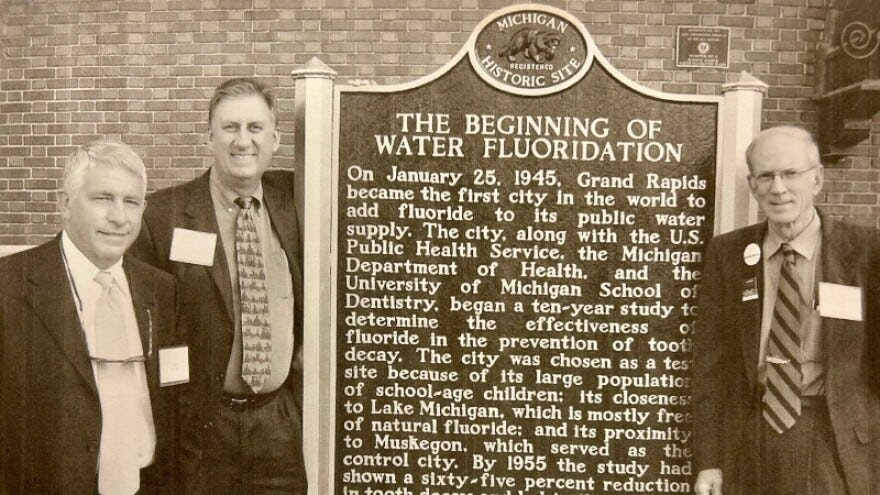
Since 1945, local communities have been putting fluoride in drinking water [Editorial Note: This is true in Canada as well.] Currently, about 3 in 4 Americans receive fluoridated water. This is largely a hyperlocal decision—your city or county decides—but some states, like Hawaii, have banned it.
 |
Water fluoridation has been an effective population-level intervention to reduce tooth decay. As the chart below shows, fluoride was added to water supplies in the mid-1940s, and tooth decay declined. It also has an impressive return on investment—for every dollar spent on fluoridation, $20 is saved in preventing dental procedures.
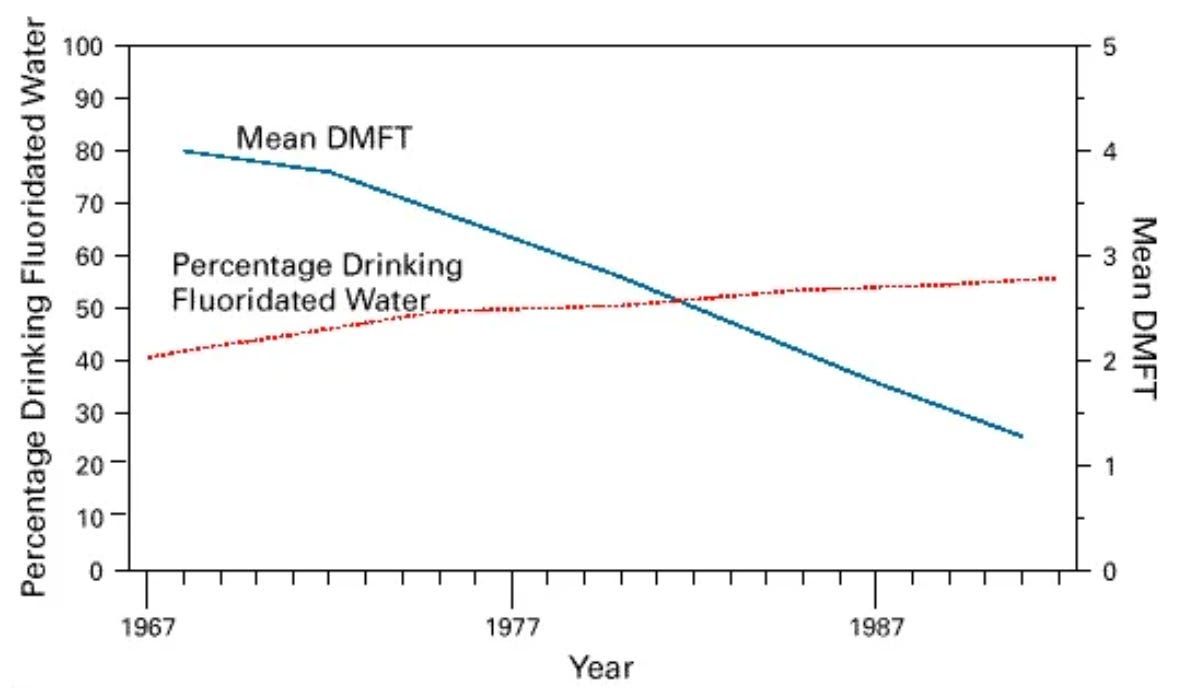 |
Of course, correlation doesn’t equal causation. So scientists have studied what happens once we remove fluoride in water. Tooth decay increases across the population. For example:
The benefit from fluoridated water became more modest when we added fluoride to toothpaste. A 2024 Cochrane review—the gold standard of medical reviews that pooled 21 studies—found studies conducted earlier than 1975 showed a clear and important effect on preventing tooth decay in children. After 1975, there may be less robust benefits.
Because the public water system reaches everyone equally, fluoridation mitigates the impact of disparities in access to dental care in the United States [Canada as well]. This is one of the beauties of public health—a mainly invisible population intervention, helping the most vulnerable.
Lower-income families still struggle to find dentists who take their insurance. In 2023, the American Dental Society found that only one in three dentists nationally accept Medicaid. This helps explain the CDC report that children in lower-income families have nearly three times higher rates of untreated cavities than children in higher-income families.
The impact of this goes well beyond preventing cavities. Poor dentition can be an important source of stigma and shame for a child and can serve as a visible sign of poverty. Studies show that children with poor dentition are more likely to withdraw from social participation, hide their smiles, and have higher rates of school absenteeism. These early life experiences can be a barrier to a sense of confidence and social belonging that can have lifelong effects.
The U.S. Public Health Service recommends a fluoride concentration of 0.7 parts per million in drinking water, a level carefully chosen to prevent cavities. However, some places in the U.S. (~0.6% of the total population) have natural fluoride in their water that reaches up to 1.5 parts per million.
Very high levels of fluoride can be dangerous. Fluoride toxicity first impacts the skeletal bones, beginning at an exposure of 5 mg/kg of body weight per day. If we do the math, the average child (40 kg) must drink 286 litres of fluoridated water daily to reach toxicity. At that point, they would die from water overconsumption.
Rumours have also circulated about a link between fluoride and thyroid function. But again, the dose makes the poison. A meta-analysis—pooling 27 studies on this topic—found that hormone levels started increasing at fluoride levels of 2.5 parts per million—about 3.5 times higher than what is added to our water systems.
In the past five years, a few studies have questioned whether safety signals exist in children’s cognitive development. However, the studies have important limitations that call into question their applicability:
Some, including RFK Jr., have also raised concerns about a link between fluoride and osteosarcoma (a rare bone cancer) in childhood and adolescence. While a rat study suggested a link, several human studies refuted this, as they did not find a link (here, here). In 2022, the American Cancer Society conducted an extensive review and concluded that there was “no strong evidence.”
While it is important to follow ongoing safety carefully, several factors need to be considered to establish causality that we don’t have in the case of fluoridated drinking water in the U.S. These include biological plausibility (there is no real mechanism to link fluoride to IQ), the relationship between fluoride dose in U.S. water and observed human health effects (called dose-response relationships), and whether we see consistency across many human studies and different populations, particularly at the exposure levels that we see in America.
Most Western European countries have ended public water fluoridation. There are a few reasons why:
Water fluoridation is one of the century’s top 10 public health achievements and is still supported by organizations like the American Dental Association and the American Academy of Pediatrics. While the benefit now may be more modest, thanks to toothpaste, it’s important to consider the benefits to all Americans, including our neighbours with fewer financial resources.
]]>The IAOMT was reporting on new findings published by Cochrane, an international medical and healthcare research organization studying the practice of community water fluoridation and its benefits. The IAOMT had concluded from the study that community fluoridation going back to the mid-1970s was a health hazard and provided little benefit in preventing tooth decay in children. That seemed to me to be “off.”
The practice of adding fluoride to community water supplies began in Grand Rapids, Michigan in 1945. Research at the time showed that fluoride levels affected dental health outcomes. Eventually, Toronto added fluoride to its water. Anecdotal evidence of children born before and after fluoride showed a significant difference in the number of cavities in people’s mouths. Instead of a mouth of fillings, young people post-fluoride in the water, had nearly cavity-free teeth.
Today, more than 400 million people in 25 countries have community water fluoridation. In 2018, 63.4% of Americans had community fluoridation. Canada, Brazil, Australia and New Zealand have made the practice universal as a public health measure. The World Health Organization has recommended it citing many studies that showed it reduced caries (tooth decay) in children in populations that were underserved.
The American Dental Association, the Canadian Dental Association, and the International Association for Dental, Oral, and Craniofacial Research, are among many in the professional community that support community water fluoridation as a safe and effective, evidence-based intervention.
The IAOMT is the outlier in its dental community when it comes to community water fluoridation. It has published reports on fluoride neurotoxicity from exposure and linked lower IQ in children to putting it in the public water supply.
In today’s press release reporting Cochrane’s “Water fluoridation for the prevention of dental caries” review, the IAOMT interprets the effectiveness of community fluoridation practices as equivalent to the prevention of decay in 0.24, or one-quarter of a tooth for every child suggesting a practice with little impact on dental health.
The release includes a quote from IAOMT President Yuko Torigoe, who states, “Once again, the scientific literature is showing us that fluoride is not only harmful but also ineffective. It is past time dental professionals embrace other, more meaningful strategies to combat tooth decay that are effective and not toxic to the patient.”
Having read the IAOMT’s interpretation of the Cochrane study and the words of its President, I decided to do a reading of the document. It did state that community water fluoridation programs were becoming less effective over time, not because they were a danger to children’s health, but because most toothpaste brands today had added fluoride.
The IAOMT reference to decay prevention of 0.24 (a quarter tooth) came from one compiled analysis of 157 studies covering 2,908 children in the UK and Australia. The Cochrane review also cited another study of 5,708 children which showed reduction rates of 2.1 decayed baby teeth. It also included research data that showed community fluoridation had increased the number of children with no tooth decay by 3%.
All I can conclude is that the IAOMT and I were looking at the same data and drawing very different conclusions. Despite its well-credentialed website and having the right name, it appears that the IAOMT was allowing its agenda to determine its “truths” and its conclusions were not compatible with the real “facts.”
Community water fluoridation is considered the simplest and most cost-effective way to maintain low-dose fluoride exposure for young people. Since the early 2000s, the US Community Preventive Services Task Force has concluded that starting water fluoridation for children and teens between the ages of 4 and 17, has reduced dental caries by between 30 and 50% and that stopping the practice increased the occurrence of caries by 18%. In other words, adding fluoride to the water in optimal concentrations has proven to be a socioeconomic benefit to the general population and particularly for people living in medically underserved communities.
As for safety, numerous studies have shown no neurological problems from community fluoride water programs. It appears that nowhere else in the public record and scientific literature is there evidence to support the alarming tone of IAOMT studies that suggest the use of fluoride in drinking water is leading to a “nationwide cognitive crisis,” and the endangerment of pregnant women.
The advancement of science requires evidence-based testing. This begins with a hypothesis, an experiment, data and interpretation of the findings. Opinion doesn’t replace the scientific method which brings me to a chief misinformation source for fluoride conspiracy theories.
I’m talking about Donald Trump’s new choice to head up health in his administration, Robert F. Kennedy Jr. Kennedy has opposed community fluoridation programs characterizing them as equivalent to putting industrial waste in the public water supply. He believes fluoride causes cancer and neurodevelopmental disorders. He also claims it decreases children’s IQs.
Now, Trump is putting him in charge of public health for the United States. The Centers for Disease Control and Prevention oppose Kennedy’s views. Meanwhile, Trump says Kennedy’s ideas “sound okay” to him.
]]>