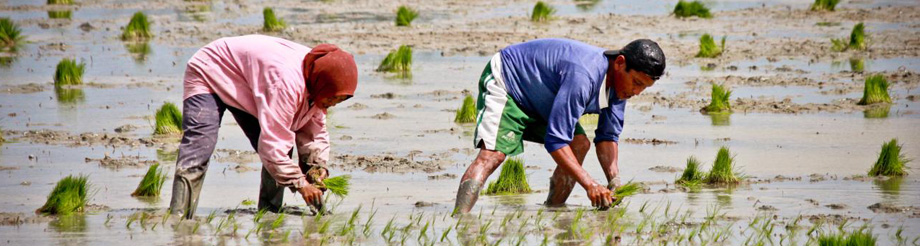
Many staple crops have evolved natural resilience and tolerance to changing climate conditions like El Niños. Recently, however, climate predictability is going by the wayside with ramifications for food security.
Of all staple crops, rice is the one most eaten globally and has been most imperilled by climate change in recent decades. In Asia, 75% of calories consumed come from eating rice, which is extremely heat-sensitive. When an El Niño event happened in 2015, heat contributed to a 15 million-ton drop in rice production throughout Southeast Asia. Rice prices caused a 16% inflationary bump.
Philippine researchers have linked temperature increases to rice yield declines. The ratio is for every 1 degree Celsius rise in the minimum temperature during the growing season, yields decline 10%. That’s why agricultural scientists are targeting the rice genome to identify those genes related to heat tolerance of which there are 97.
Wheat is another global staple crop feeling the effects of global heating. In Asia, every 1-degree increase in minimum temperatures translates to a 6% decline in wheat yields. That’s why agronomists are testing 3,322 new wheat varieties since 2021 with the hope of identifying strains that produce better yields in more extreme heat conditions.
Developing new varieties of wheat and rice can be done through conventional cross-breeding. Increasingly, however, genome editing is preferred because compared to conventional breeding which can take multiple generations to produce results, genetic engineering is much faster taking less than a third of the time.
Hiroshi Maeda, a professor of botany at the University of Wisconsin in Madison is working on modifying citrus crops like oranges and grapefruit. In the United States citrus farmers face devastating challenges from climate change including extreme weather events and freshwater scarcity. Maeda and his colleagues have also taken the genetic modification route to make citrus climate resilient. He states:
“Climate change is happening so fast that classical breeding approaches are not enough to overcome the challenges we are facing. It took 10,000 years for us to domesticate the crops, and we do not have that kind of time. We must accelerate the process using biotechnology, gene editing and transgenic approaches.”
Another staple crop is sorghum which is closely related to corn and an ingredient used to make cereals and pasta. Areas where sorghum is grown in the United States have witnessed extreme temperature changes in recent times with an expanding Arctic polar vortex causing chilling stresses and crop losses.
Rebecca Roston, a plant scientist at the University of Nebraska-Lincoln, is studying plants like sorghum and how they respond to temperature changes, especially cold. Her research looks at the lipid composition of plant cell membranes and how they withstand freezing temperatures. States Roston:
“The reality is that the cold has driven human habitation and agriculture for millennia, and it is a problem that is so big that we don’t see it because it’s opportunity loss, not direct crop loss.”
Roston is using lipidomic sequencing to analyze sorghum and a cold-tolerant cousin plant, foxtail millet, and to understand the metabolic influences that affect crop stress. Unsaturated fatty acids contained within the plant membrane are key to promoting plant survival at low temperatures.
Soybeans have proven to be sensitive to disappearing ozone caused by increases in greenhouse gasses and smog. Notes Joseph Jez, a professor of biology at Washington University in St. Louis, a 1% decrease in the ozone layer corresponds to a 1% drop in soybean yields and since 1979, the ozone threshold has plummeted by more than 47%. That means a race against time to up the ability of soybeans using gene editing and modifications in the face of a more hostile growing environment. Jez notes:
“The plants we have now are not going to be the plants we have in 2050. The big unknown is whether we can either breed or edit the path forward to make plants survive the climate of 2050 or 2100.”
Climate-resilient future crops like corn, rice, sorghum, soybeans and wheat are being epigenetically modified to deal with drought and heat. Rice is being altered genetically to survive flood-prone growing areas. These staple crops are re-engineered to tolerate higher salt levels in the soil as sea levels rise. Re-engineered to withstand diseases, fungi and insect pests, plants are being weaponized against all of these.
In addition, scientists are enhancing photosynthesis in plants to help them grow faster. Root systems are being engineered to go deeper to find water and to become carbon sequestration storage sites. And finally, plants like rice are being modified to use less water and produce lower methane emissions from paddies.
It is a brave new world we face as the planet heats up and agronomists and geneticists try to develop new armour for our plants to survive the anthropogenic climate change that is taking hold in the 21st century.
]]>
Agricultural technology is critical to human survival. With our global population growing by 1.14% per year it means there are 80 million more mouths to feed annually. By 2050 world population estimates vary from 9 to 10 billion. So getting agriculture right should be top of mind for all of us and for governments at all levels.
It was the Agricultural Revolution at the dawn of the Neolithic that set humanity on this path to unprecedented population growth. So it’s good to start with a story that tosses out some of our old conceptions about just when the Neolithic really started.
When Did Humans Start Farming?
We used to think 12,000 years ago. But now a new discovery by researchers from Tel Aviv University, Harvard University, Bar-Ilan University and the University of Haifa have uncovered evidence that puts the date 23,000 years in the past. The discovery is described in the journal PLOS ONE this month.
The evidence comes from finding what the researchers call “proto-weeds” at an archaeological site on the shore of the Sea of Galilee in Israel. Weeds evolved in parallel with cultivated plants. So finding a “significant presence of weeds in archaeo-botanical assemblages” is an indicator of systematic cultivation. What were these early farmers planting? Wild emmer wheat, barley and oats.

Borrowed Barley Gene Reduces Methane Emissions from Rice
Methane is a potent greenhouse gas and is credited with a contribution of 20% to global warming. Rice paddies produce up to 17% of atmospheric methane. That’s because rice is planted in waterlogged, warm soil and methanogenesis occurs in the root systems.
Now consider this. On a global average each one of us consumes 68 kilograms (150 pounds) of rice annually. The largest population growth areas on the planet are in areas where rice is a primary food staple. That means planting more rice to feed extra mouths will mean more greenhouse gases entering the atmosphere. So scientists have been pursuing a way to reduce methane emissions from the growing of rice. And the way they have done it is to introduce a gene from barley that makes the rice plant store more carbon. They call their rice, SUSIBA2. The plant shifts its carbon storage into the rice kernels and stems rather than the root systems. With less carbon entering the soil through the roots it remains an unknown what impact this will have on microbial communities associated with rice cultivation. Hence the scientists are carefully growing and testing the rice over multiple generations. It is anticipated that it will a decade before SUSIBA2 rice becomes commonly planted.
The picture below shows SUSIBA2 rice on the left and regular rice on the right. Note the concentration of microbial bacteria is far less than in the latter. To read the research check out the paper appearing in Nature Letters on July 22nd.

Harvard Study Raises Concern About Falling Levels of Zinc in Staple Crops
A study appearing in The Lancet Global Health this last week notes that increased atmospheric carbon dioxide (CO2) is impacting zinc content and other nutrients in basic food crops. Why is this an issue?
Because zinc deficiency is already a problem today with an estimated 2 billion people on the planet not getting enough of it through diet. For diabetics, people suffering from inflammatory bowel disease, for the health of the immune system, zinc plays a critical role. Zinc deficiency is linked to respiratory diseases and in fact, zinc lozenges are commonly used to shorten the duration of a common cold.
In the study the researchers looked at atmospheric CO2 concentrations of 375 to 384 parts per million (ppm) and zinc intake in populations in 188 countries. They then projected elevated CO2 levels to 550 ppm by mid-century. You may disagree with that higher CO2 level but at current rates of emissions that scenario is deemed likely by 2050.
In their findings the researchers noted that zinc deficiency risk would increase for those living in Africa and South Asia to the tune of 138 million people. The implications for the vulnerability of these populations, already in areas where food production is under stress, cannot be overlooked.
One of the lead researchers, Samuel Myers, points out:
“All of human civilization has taken place during a very stable set of biophysical conditions, but we are now changing those conditions at a rate that’s never been seen before…..Whether we’re talking about land use, deforestation, degradation of global fisheries, disruption of the climate system, biodiversity loss, appropriation of fresh water, changes to aquatic systems — all of the changes are profound and they’re accelerating, and they represent a significant challenge to global health.”

IRRI manages the longest-running rice research project on the planet and note that higher night time temperatures tend to suppress rice yields. According to Grace Centeno, a scientist at IRRI, “Average night temperature over 23 degrees Celsius can lead to yield loss due to the increased need of the rice plant to expend its energy to maintain its biological health.”
In a previous release of the study showing data from 1979 to 2003, rice yields declined by 10% for every Celsius degree increase in nighttime temperatures. Since then the study has continued and negative impact on crop yields is becoming more pronounced. The critical threshold for rice appears to be 23 Celsius (73 Fahrenheit). At these temperatures rice grains have trouble forming properly. Hence reduced yields. A 1% increase in temperature translates to a 6% yield decline.
At 10% yield reductions amount to 0.5 tons of rice per hectare (2.47 acres). In countries where rice is the principle food staple and where population growth appears to be greatest on our planet today, declines of this magnitude can mean the difference between a fed population and famine.
Without remediating climate change all that agriculturists can do is find new varieties of rice that can tolerate these increased nighttime temperatures. And if they cannot then in many countries such as The Philippines and others in South and East Asia, declining yields could play havoc with national stability.
The Case of The Philippines
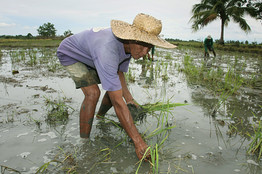
Today in The Philippines where the IRRI study was done rice is grown on small family farms (like the one in the picture above) that average in size from 0.5 to 4.0 hectares. These are largely subsistence operations with small surpluses. There is no new land for farming and with high population growth demand continues to rise.
In 2006 the country produced 11.2 million metric tons of rice with yield growth at that time fairly flat. Once upon a time the country was self-sufficient in rice. But in 2006 it only grew enough to feed 90% of its population which meant the country had to import rice from other Southeast Asian countries producing surpluses. Since then the gap has widened.
Now as rice yields continue to be flat or in decline by as much as 10% based on the study, The Philippines will need to import even more of its major food staple. But from where? If other neighboring countries are also experiencing yield declines who will provide the rice to feed the country?
In 2006 daily rice consumption amounted to 33,000 tons and accounted for 20% of the cost of food per household. Scarcity will only mean higher prices and a greater percentage of the household food budget. Imported rice will certainly cost more as well. Rice is the main staple food for these people as it is for so many other countries in South and East Asia. And what happens when their yields are affected by the same problem, rising nighttime temperatures?
And none of this takes into consideration extreme weather events like the recent Typhoon Haiyan with its devastating impact on the rice crop. In the picture below you can see farmers replanting rice in fields where the typhoon inflicted significant damage.
All in all the situation in The Philippines is not a pretty picture. One solution for the nation is to alter the eating habits of its people moving them from rice as the major staple to another crop. Such a change would be difficult to institute. The most likely outcome at the minimum would be social unrest. The much more threatening scenario is famine.