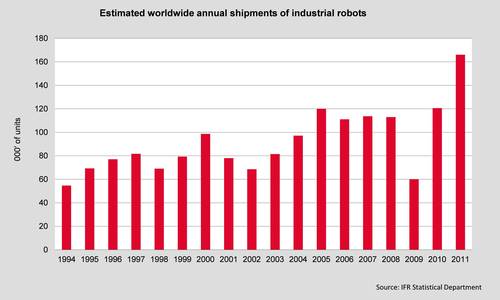
The industrial robots in these statistics cost six figures. But a Boston manufacturer, Rethink Robotics, has introduced a robot capable of performing a wide variety of common, repetitive tasks in the workplace at a fraction of the cost of previous manufacturers. Weighing 75 kilograms (165 pounds), standing 1.8 meters (6 feet), and known as Baxter, this is the first of a new generation of industrial robots that exhibits adaptive skills. Baxter, in a couple of minutes, can be programmed by almost anyone to accomplish new tasks. And unlike other industrial robots Baxter is very affordable at $22,000 U.S.
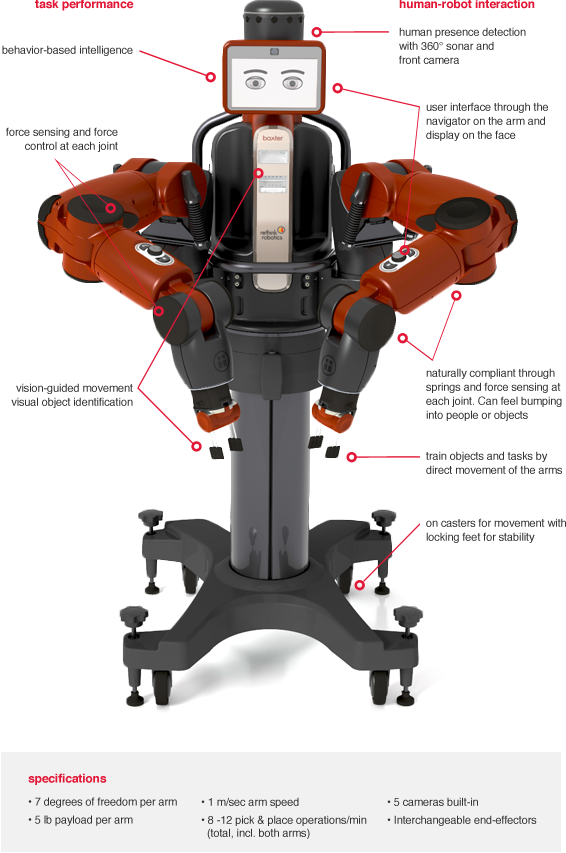
This is truly disruptive technology. Baxter is designed to do small-scale repetitive applications. Baxter can work beside humans in a facility without extra safeguards. Baxter interacts with humans through its LCD display which features eyes and eyebrows that express emotion. That same graphical display serves as an interactive console for human coworkers to reprogram Baxter. By showing Baxter what to do through manipulating his arms, a human worker can train it to do a new task. No software engineers need apply.
Out-of-the-box Baxter is pre-programmed to perform a wide range of manufacturing jobs including operating machines, materials handling, production line loading, unloading, assembly, finishing, inspecting, testing and sorting. In less than an hour Baxter can be on the job. And Baxter automatically alters its behaviour in response to any environmental change such as production line speed ups or variations in parts placement on an assembly line. Baxter can also adjust when a part is missed or dropped, or the assembly line surface height changes.
Baxter has no sharp edges or grippers that can inadvertently trap a human coworker. Baxter’s arms move fluidly and easily. Packed with sensors, Baxter can detect human presence nearby and avoid contact or reduce the force of any inadvertent collision.
Baxter as you can see in the image below comes with a mobile pedestal that allows it to be moved easily to different locations in a manufacturing facility. Its two interchangeable grippers can be switched in minutes. The electric parallel gripper features interchangeable fingers of different lengths with multiple grasp widths. The vacuum cup gripper comes with variable cup sizes and is used for hard-to-grasp objects.
In addition Baxter works with manufacturer enhancements from third parties and in 2013 will include a software development kit so users and re-marketers can reprogram the robot for unique tasks.
Baxter’s built-in smarts allow it to work in a number of industries including:
Will deployment of Baxter in small manufacturing cost hundreds of thousands of jobs? Not according to Rodney Brooks, Chairman and Chief Technology Officer at Rethink Robotics. What it has the potential to do is lower the cost of small manufacturing so that it can be competitive with manufacturing overseas. That can impact hundreds of thousands of companies worldwide. And robots like Baxter will make an increasingly smaller workforce more productive as our population ages and the current generation of Baby Boom workers retire.
]]>In 1976 NASA and the Jet Propulsion Laboratory created and launched the two Viking Martian landers. On board were two robotic arms controlled by a microcomputer. These were the arms that dug the first soil samples from the Martian surface hatching the controversy about whether Mars harbored life or not, a question that remains unanswered to this day.
Today most robots can be found in manufacturing or the military. A few are finding their way into domestic use such as the iRobot line of Roomba vacuum cleaners. Robots are continuing to change, becoming faster, more nimble, capable of specializing in a single task or being used for multiple tasks.

Compare the T3 seen above with the articulated robotic arm on Curiosity, the Mars Science Laboratory (seen below). You can see that in a matter of less than 40 years robotic arms have dramatically improved. Curiosity’s arm is 2.1 meters (7 feet) in length and unlike the T3 which served a single purpose, this arm includes a set of tools with wide ranging application. The arm has an on board colour camera that features a high resolution zoom lens. In addition the arm has a drill, alpha particle x-ray spectrometer, a CheMin mineral and chemical analyzer, SAM, an atmospheric gas analyzer, RAD, a radiation detector, DAN, a hydrogen, ice and water detector, and a scoop for recovering and testing surface and sub-surface soil samples. The arm is dexterous and capable of turning almost an entire full circle.

Where Robots are Going From Here
The next evolution of robots is taking us well beyond specialty robots and into the realm of more generalized usage. This comes courtesy of a number of organizations including one that recently made the news, Rethink Robotics, an offshoot of the robotics program at Massachusetts Institute of Technology. The company’s founder is Rodney Brooks, a co-founder of iRobot. At Rethink the mission is to make robots fit places where automation has never been practiced, in particular, small and mid-size businesses. Rethink robots will be designed to learn and become productive a few hours after coming out of the box. Each will be capable of working collaboratively with nearby humans. Each will have fine motor control, machine vision, tactile touch sensors, and multiple arms. And each will be easily reconfigurable for new work assignments.
Rethink is joined by other companies in a race to produce new robotic capability that will broaden the technology’s usage in business and in our personal lives. Among these are:
Open Source Comes to Robotics
Willow Garage is a company founded by Scott Hassan in 2006 to develop robots for non military applications using open source software to encourage independent third parties to develop the technology further. Willow Garage has developed the Robot Operating System or ROS, a library of tools for developers to create robot applications. Through its online Internet forum the software is offered freely to anyone to use, enhance or to build commercial products.
Willow Garage has created the PR2, a robot development platform for testing new robot applications and technologies. PR2 comes with a robotic arm that features a flexible wrist joint and gripper capable of holding everything from towels to brooms. The PR2 has spawned an active research community that includes universities from around the world.

]]>