I sold post-secondary textbooks to schools, liaising with university professors and community college instructors. My territory took me as far away from Toronto to Sault Ste. Marie, the place where three of the Great Lakes meet. The Sault had two post-secondary institutions, Sault College and Algoma University. I would spend two days on each visit talking to instructors, the bookstore staff, and administrators.
Yesterday, Canada observed its National Day for Truth and Reconciliation, an annual event to remember the victimization of Indigenous people by Canada’s many governments. As I read the September 30th edition of The Globe and Mail, an article described how Canada set up residential schools for Indigenous children. One of those was on the site of Algoma University. It is called Shingwauk Hall. During my visits to the university, I had heard about a historical connection between the school and local First Nation peoples but I didn’t know the history. The Globe and subsequent research enlightened me.
Algoma University’s main campus building sits on the site of what was once a residential school that was established in the latter half of the 19th century to turn First Nations’ children from Indian to White. The goal was to “take the Indian out of the Indian,” to make them forget their culture, languages and traditions. It didn’t create equality for these children who continued to face discrimination in mainstream Canadian society.
The Canada-wide 19th-century residential school program enforced cultural assimilation without equality. Schools separated children from families making them live in crowded residences like the one depicted below. Christian religious organizations largely ran the schools.
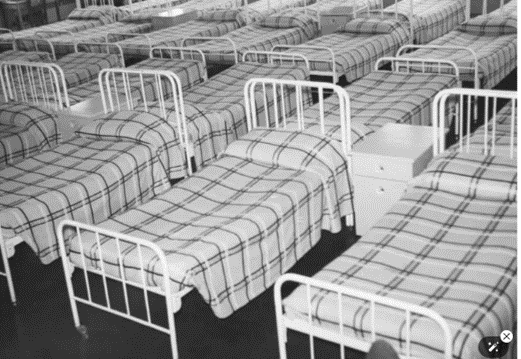
Shingwauk Hall, the main building of Algoma University, was built in the 1930s to replace the original Shingwauk Residential School erected on the traditional lands of the Anishinaabe First Nation and Métis. The Métis were descendants of intermarriage between French voyageurs and Native North Americans, a common occurrence in the fur trade.
The Shingwauk name is associated with Shingwaukonse, an Anishinaabe Chief who believed that a residential school would give his tribe European-based knowledge and skills to enable them to thrive in the new Canadian nation. The school was run by the Anglican Church, the second-largest administrator of residential schools in the country. The vast majority of residential schools were run by the Catholic Church.
I first called on Shingwauk Hall in 1973. Other than the name there was no trace of its residential school past or acknowledgement that the prior purpose of the place was to “take the Indian out of the Indian.” Today, however, Shingwauk Hall although still a working university, is making an effort to acknowledge its residential school past.
The United States has had its version of residential schools. It parallels that which Canada imposed on its natives in their dispossession of North America. Canada acquired its western lands through the purchase of the Hudson Bay Company’s Rupert’s Land, a British Crown monopoly that stretched from the U.S. border to the Rocky Mountains, Hudson’s Bay and the Arctic Ocean. No Indigenous people were consulted during this massive acquisition. Where treaties existed between the British Crown and native tribes, most were soon disregarded.
The U.S. acquired its western territories through the Louisiana Purchase from France, a war with Mexico and later a land purchase, through an agreement to divide the Pacific Northwest with the British, and by purchasing Alaska from Russia two years after the end of the Civil War.
In both countries, reservations confined Indigenous people to marginal lands, ejecting them from their traditional territories. The assimilation experiment followed.
The original Thirteen Colonies involved conversion to Christianity with Christian church organizations administering assimilation experiments that began in the 17th century. The reality, however, produced abusive conditions that inflicted all kinds of indignities on native residents including kidnapping children from homes, corporal punishment, malnutrition and disease.
When unmarked graves were found at a residential school in Kamloops, British Columbia, it lit a fire that led to the beginning of Canada’s national reconciliation effort with a growing acknowledgement of the injustices committed to Indigenous peoples. The Kamloops discovery resonated in the United States with both federal and state governments beginning to reflect on their treatment of Native North Americans. Thousands died in Canada’s residential schools with the last one closing in 1996.
In the United States, however, as of 2023, based on Department of the Interior records, 523 Indian boarding schools have been identified. Some are closed but many remain. In Oklahoma alone, 80 of these schools were established.
The nature of these American schools has changed recently since the passing of the Indian Self-Determination and Education Assistance Act of 1975. Assimilation is no longer their purpose.
Shingwauk Hall in the Sault is no longer a residential school. Today Algoma University features the Shingwauk Kinoomaage Gamig, an accredited Anishinaabe post-secondary institution that since 2008 has been offering programs geared specifically to Indigenous students reconnecting them with their language, traditions and native skills. It is one of nine Indigenous institutes of higher learning that have opened in Ontario.
The main hall at Shingwauk includes an exhibit highlighting the history of the residential school program. Institutions like this and others remembering the European incursion into the Americas are similar to Yad Vashem and other Holocaust memorials and museums that today can be found around the globe. The Nazis and collaborators murdered almost 50% of the world’s Jews from 1937 to 1945.
The European arrival in the Americas led to the death of almost 90% of the native population from communicable diseases in a half-century. For the Indigenous population of the Americas, memorials and museums are needed to remind all humanity of what happened, and of the subsequent subjugation of the survivors. It isn’t enough to celebrate a single day of remembrance without redressing the remaining institutional racism and the continuing underserved Indigenous communities in North America.
For Indigenous people living in Canada and the United States reservations still have to live with boil water advisories, substandard existing homes and a lack of new builds, few basic amenities and overcrowding. The Indigenous population still suffers from environmental exposure to asbestos, lead and mercury pollution. Diabetes runs 2.5 times higher than the average in Indigenous populations. Poverty rates are twice the national average in both countries. Teenagers continue to drop out of school at higher rates than the national average. Alcoholism and substance abuse are common substitutes for gainful employment.
Reconciliation in correcting the legacy of colonialism is just a first step for Canada and the United States. Self-determination for Indigenous communities with public and private capital investments in capacity building is needed. Infrastructure and service gaps have to be addressed. All of this has to happen with Indigenous groups in partnership with national, state, provincial, county and municipal governments.
]]>America was born of a revolution by colonies breaking away from Great Britain beginning with an independence declaration read to gathered Americans in towns and cities on July 4th, 1776. America’s revolution was one dominated by white males, largely of Christian faith, who were concerned about preserving their freedom to worship, to gain wealth, to obtain property, to be represented by peers in government, and to preserve slavery. Women, indigenous people, and, of course, the slaves had no say in the outcome.
Canada was born from a variety of disparate groups with a single thing in common. They did not want to be Americans. They were French Canadian. They were United Empire Loyalists who left revolutionary America to find a safe haven. They were Acadian survivors of British attempts to implement mass deportations in the 18th century. They were slaves brought to Canada from American they were freed black refugees looking to start anew after escaping America. And they were the indigenous people of the country who had signed treaties with the British Crown, and who had aspirations for a future of peace and opportunity guaranteed to them.
Those parts of the land where the colonists settled spread continent-wide from east to west skirting the U.S. border. They came together in Confederation on July 1st, 1867, to ensure their survival from a militarily aggressive post-Civil War America. It wasn’t about rebellion and individual rights. It was a search for a collective peace, order and good government, the words enshrined in the British North America Act which today form the basis of Canada’s constitution.
Left out of citizenship in this new country were women, slaves, freed blacks, indigenous people, and Metis (a French-Indigenous community). Canada’s citizenry and leadership were male, white, Christian, and the antithesis of Americans.
In 2021 on this July 1st the celebration of Confederation has been tainted by the revelation of mass indigenous graves found on the grounds of former residential schools, a program initiated by the post-Confederation government to “kill the Indian in the Indian” and turn indigenous Canadians into the equivalent of good white British citizens. It appears from these mass graves that the killing wasn’t limited to the spirit of the original human inhabitants of the Americas.
Was the Canadian government policy in the past egregious, racist, and genocidal? Absolutely. Was it much different than the policies of European, British and American governments? No.
The policies were the product of the time when European civilization saw its purpose as being the “white man’s burden.” It saw Europe seize much of Africa to civilize its native black population. And when Charles Darwin published his theory of natural selection, it manipulated it into a Social Darwinist creed to define European civilization’s place in the human pecking order. White and Christian on top, and everyone else beneath.
Remember this was a time when phrenologists determined human superiority and intelligence based on head shape and bumps on the skull. This was a time when people were measured for their worth and standing by place of origin, skin colour, religion, and ethnicity, and not by what was between their ears.
But these times in Canada are gone for good. The legacy, however, remains to this day and reconciliation has become the chosen path for Canada to heal its historic failings. It is not easy to fess up to a tainted past and on Canada Day. Many are wearing orange and not Canada’s red and white colours today to remember the lost children and the genocidal policies of our country’s past.
South of the Canadian border, the United States’ celebration should be more muted with the ongoing story of a condominium apartment building’s collapse in the suburbs of Miami and the mounting death toll. This event should be a reminder to Americans about the crumbling state of infrastructure and that the nation’s sense of exceptionalism appears to have reached a limit. A country that could put humans on the Moon less than a decade after its first human spaceflight, appears to be unable to create a safe infrastructure for its citizens such that they die in their beds at night as the building they live in pancakes to the ground.
We don’t know as of yet why this building failed. One of President Biden’s cabinet members suggested anthropogenic climate change was a contributor. I would think probably not. Others speculate about lax standards in Florida’s building code and the laws governing building and maintenance requirements for condominiums including mandatory minimum contingency funds to be used to keep structures and the people living in them safely.
If this were a single instance of failure we might call it an exception. But in the last week a pedestrian bridge across an interstate in Washington, DC, collapsed with several people injured. This one bridge is symptomatic of a nationwide problem. More than 617,000 bridges cross America’s roads, rivers and ocean coasts today. Some are pedestrian, some are for cars and trucks, and some are for trains. Of these, 42% are more than 50 years old, with 46,000 of them deemed structurally deficient. On the latter, 178 million trips are taken daily by people, in cars, trucks and trains. Is it only a matter of time before the next one fails?
Part of America’s ethos has been the individual pursuit of property and wealth, rights not to be trivialized or inhibited by government getting in the way. Unfortunately, safety and good governance take a back step to rights such as these that let:
If Florida’s weak condominium laws turn out to be among the failings in this building collapse tragedy, it shouldn’t be surprising. It is a metaphor for the entire country’s failings as a nation that presumes to lead the world to a better place in the 21st century, a world that is facing an ongoing pandemic, and the growing threat of human-caused global warming.
These are sombre thoughts for Canada Day and for the week when America commemorates its Declaration of Independence.
]]>