Climate change has been the catalyst for governments to create policies that are steering the global transition to renewable energy. International climate agreements and legislation like America’s Inflation Reduction Act (IRA) have created tax incentives and subsidies to promote the adoption of green energy technologies and are stimulating research and development in solar, wind, battery and other storage solutions as well as in modular, thorium and fusion reactor technologies. These government initiatives have come about in realization that the dependence on fossil fuel energy sources has produced the existential threat of climate change.
Collaboration among academic, public and private enterprise is driving technological innovation with significant research and investment being made in seeking new ways to light, heat and cool our homes and businesses around the world.
Climate change has shifted the focus of energy producers from fossil fuels to sustainable alternatives that include hydro, wind, solar and geothermal sources. The ultimate goal is a lower collective carbon footprint.
Solar panels are becoming more efficient and cheaper to make. Perovskite is replacing silicon as the material being used for next-generation solar. Innovative designs are increasing the energy conversion efficiency of panels beyond the former upper limit of 30%. New photovoltaics can now produce electricity even in less sunny environments.
With innovations in wind turbine designs, the amount of energy harvested per tower and from both onshore and offshore wind farms is increasing while the cost per kilowatt/hour (kwh) produced continues to fall.
Intermittency has always been the bugbear for renewable energy production. The sun doesn’t always shine and the wind doesn’t always blow. Innovative battery and other storage technologies are answering the challenge. New battery and storage technologies are balancing grids where renewable energy sources play an increasing role.
Modern battery systems using lithium-ion and flow batteries are proving their worth for both residential and industrial energy use. Pumped-storage solutions are enhancing the role of hydroelectricity in the renewable energy mix. This technology moves water between reservoirs at different elevations. When energy demand is low, water stored at a lower elevation is pumped uphill to a higher reservoir. During peak demand, that water gets released to power turbines and generators.
Geothermal energy is a largely untapped renewable power source around the world today. Countries like Costa Rica and New Zealand are exploiting their hydrothermal energy harvested from underlying volcanic formations. These facilities produce nearly zero-emissions and use much less land per Megawatt/hour (Mwh) (around 0.4 to 3 hectares (1 to 8 acres)) compared to 4 hectares (10 acres) for solar, 7.7 hectares (19 acres) for coal-fired powerplants, and 8 to 16 hectares (20 to 40 acres) for wind.
Beyond exploiting volcanoes, geothermal energy can be harvested several ways including using natural heat from depths of between 30 and 600 metres (approximately 100 to 2,000 feet) to power heat pumps or passively heat structures like greenhouses. At depths of 600 to 2,500 metres (2,000 to 8,200 feet) the harvested heat can be used to produce energy for larger structures, and at depths beyond 2,500 metres (8,200 feet) can power steam turbines.
From the accidents at Chernobyl and Fukushima, nuclear power became a pariah. Not so anymore. Growing data centre demand has Google investing in a mothballed nuclear powerplant at Three Mile Island in Pennsylvania and Bill Gates has put together an investment group to build a thorium-fuelled reactor in Wyoming.
Small modular reactor (SMR) designs are being built in Ontario and new SMRs are being deployed on ships where they can provide power to coastal areas recovering from hurricanes and other climate disasters. SMRs are being seen as alternative power sources for remote locations such as the Arctic or islands where they can provide electricity, heating, industrial steam, and seawater desalination.
Advances in academic and business circles, developing fusion reactors, are closer to the deployment of several commercial designs that hold promise to provide zero-emission power with no radioactive waste, the latter being the current challenge of fission reactor technologies.
Integrating renewable energy into existing power grids requires the robust transformation of power distribution systems. Real-time data monitoring and automated controls are smart grid features that facilitate efficient energy distribution, reduce outages, and optimize energy consumption patterns.
Microgrids are seen as an effective way to manage local power requirements for areas operating in isolation. These smaller grid networks can effectively integrate solar, wind, water-based turbines (wave and current), biogas and passive and active geothermal and can be combined with power storage backup to meet local demands, feed large-scale manufacturing plants, operate all the machinery and equipment in a factory farm, or provide power for desalination. There is even a play for SMRs in microgrid designs.
Microgrids are more effective cogenerators of power than large power plants in serving remote locales. An interesting example of local energy generation can be found in the City of London where waste heat from the Tube, the London subway, is being used to heat nearby homes.
While all of the above plays a part in addressing the pursuit of a zero-emissions energy future, individuals can significantly impact the current energy transition. Smart meters can help homeowners manage energy demand more effectively. Energy-efficient appliances, rooftop solar, and utilizing public transportation are effective ways individuals can contribute to the overall goal. Community-driven initiatives such as local solar panel cooperatives can empower neighborhoods to embrace renewable energy solutions collectively and make the 21st century goal of zero emissions possible by mid-century.
]]>What Jane is describing is complementary to Wind Catcher and if I were an energy utility company looking for green solutions, I’d be paying considerable attention to solar farms on water and Wind Catchers.
Solar farms provide utilities with unique solutions to solve their goals of lowering the carbon footprint of the energy they deliver. But solar power is challenged by the need to be in sunlight. Not all locations provide enough hours of direct sunlight every day. Many rooftops aren’t designed to take solar panels. But one of the biggest challenges is that large arrays of solar panels, called solar farms, can take up a lot of space tying up hectares of land that can be used for alternative purposes such as growing crops. As a result, an emerging alternative implementation of the technology is focused on building solar farms over water rather than land.
A solar farm, also known as a photovoltaic power station, is a large collection of solar panels placed in one area connected to the grid. The first solar farm was launched in 1982 in Hesperia, California. Since then, utilities and companies have built many more. The usual locations are where there are few people, ample sunlight, minimal wetland habitat and flat surfaces. This helps to maximize their efficiency.
Farmers and conservationists don’t always approve of land-based solar farms because the installations cover areas that can be used for growing crops, grazing livestock, or preserving wildlife. A solar farm can impede a wildlife corridor and range where migratory animals and grazing animals travel regularly. A solar farm could cover an area that is home to sensitive and endangered plant species that require full sun. The shadow cast by the panels could disrupt their growth.
In some countries, India for example, there simply isn’t space for land-based solar farms. With its rapidly growing population, India needs to conserve all the land it can for food production. That’s why floating solar farms are seen as appealing. The waterways, reservoirs and oceans upon which they ride will never be used for farming and raising livestock. Although, in the future, we may see floating cities built which would make floating solar farms a valuable energy-producing adjunct to these novel human settlements.
From companies maintaining overwater infrastructure, particularly in ocean environments, there are unique challenges caused by saltwater interacting with sensitive equipment. Currently, a growing technological capacity to maintain equipment in these environments should be transferable to floating solar farms soon.
Researchers looking at marine environment impacts of solar farms look to other built and operating over-water infrastructures. Can a solar farm harm marine wildlife? There are many environmental variables to consider such as water depth and other oceanographical conditions. Early studies and modelling shows that solar farms in shallow coastal areas have negligible effects on the marine environment underneath the deployed array. And if you consider the observed impacts of fixed and floating oil and natural gas platforms to date in ocean environments, they may even prove to be of benefit to marine wildlife.
If overwater solar farms are seen in the same light as offshore wind farms, public NIMBYism may present a challenge. Other popular concerns reflect a lack of knowledge about marine wildlife impacts. And, of course, the presence of near-shore solar farms may be seen as having a negative visual impact.
Aquatic solar farms are becoming more common worldwide. Here are a few countries using this technology:
On the Omkareshwar Dam, the state of Madhya Pradesh is constructing a giant floating solar plant. The plan is to have it operational by 2023. The panels will be able to automatically adjust their position based on fluctuating water levels.
In California, the Healdsburg Floating Solar Farm is situated at a wastewater treatment plant. It’s the largest floating solar farm in the United States. The two-sided panels capture energy from the sun above, and also from below as it reflects off the water.
The energy plant on the Sirindhorn Dam has the claim to fame as the world’s largest floating solar farm. Comprised of over 144,000 individual panels, the massive plant generates energy from both solar and hydropower. Since it became active a year ago, it has already generated 60 million kilowatt hours of electricity.
Floating on a lake that formed in an unused quarry near the town of Haltern am Sea, this floating solar farm is the largest in the country providing 3 Megawatts of power. It is one of many renewable energy projects that Germany hopes will help it to wean itself off fossil fuels coming from Russia in the wake of the war in Ukraine.
Europe’s largest floating solar farm can be found on the Alqueva Reservoir. Its 12,000 panels are supplying enough energy for up to a third of the residents in nearby towns.
This week a Dutch-Norwegian joint venture is planning to deploy a floating solar farm combined with an offshore wind farm off The Netherlands. The company, SolarDuck, will be the first to build a hybrid demonstrator project at this scale. It is one of several planned and under-construction pilot over-water solar farm projects currently on the go and will be located 53 kilometres (33 miles) offshore.
The growing interest globally for floating solar farms is being driven by climate change and a solution that doesn’t take up valuable land suitable for growing food. Combined with other over-the-water renewable energy solutions like wind farms as planned by SolarDuck and others, the technology should see significant growth through the rest of this decade and beyond. Market perceptions are very positive. Valued at US $2.55 billion in 2021, the floating solar farms’ industry is expected to grow to more than $10 billion by 2030. Why? Utilities see advantages in deployment because they are scalable, easy to assemble, adaptable, and can be integrated with other renewable technologies like wind on and over the water.
]]>
One sector is contributing more GHGs than any other while another is using the products produced by the former to add to atmospheric carbon dioxide and methane. Although coal is not mentioned in the government documents, its legacy remains in the atmosphere today even with plans to phase out coal-fired powerplants in the country. What the backgrounder specifically mentions are the oil and gas sector, and electrical power.
The oil and gas sector in Canada today produced 182 megatons of carbon dioxide (CO2) in 2021. The goal by 2030 is to reduce that number to 110 megatons. The challenge to get there is greater because as a country we are net producers of oil and gas for domestic and world markets. The sector employs directly hundreds of thousands, and indirectly through the industries its products support, millions. Canada is the fourth largest producer in the world.
When a private U.S. company abandoned an oil pipeline expansion project, the federal government stepped in to be the purchaser of last resort to help sustain current and future jobs in the sector. The move to do this has been met with mixed reviews by Canadians, some seeing it as a handout to an industry that right now because of the Russian invasion of Ukraine has seen energy prices shoot upward dramatically.
The federal government recognizes that before oil and gas consumption can go down, there is still the need to ensure that the industry survives within new environmental guidelines. That’s because despite efforts to reduce global oil and gas dependency, demand for it in power generation, transportation, manufacturing, and other industries remains high and is continuing to grow. We haven’t yet reached peak oil.
The International Energy Agency’s Net-Zero Scenario, of which I have previously written, sees the continued need for oil and gas through the mid-century and beyond but sees it peaking near the end of this decade or in the early 2030s. Only then will demand decline as the world moves to renewables and alternative energy sources.
What does this mean for areas in Canada dependent on the industry today and in the future?
The 2030 plan calls for energy diversification as a means of reducing our carbon emissions. It means inventing new ways to make the oil and gas sector less carbon-intensive. Carbon intensity has been used by the industry in the past to demonstrate it was making efforts to lower the collective carbon footprint. This has led to process improvements in harvesting and conversion at extraction and production facilities, but to date, total emissions have barely moved downward because improvements in intensity per barrel of oil or cubic metre of gas have been offset by increased production.
The 2030 plan has developed a model for the sector to achieve emission reductions of 31% below 2005 levels by 2030 (or 42% below 2019 levels). This involves implementing a cap on oil and gas sector emissions, but not on production, which means the industry needs to develop technologies and infrastructure to further decarbonize its processes.
The industry has toyed with carbon capture and sequestration (CCS) technology for more than a decade but has always asked for government assistance to cover a good percentage of the cost of these add-on facilities and infrastructure. Many projects have seen oil and gas companies abandon CCS projects leaving the government with nothing to show for its money. A few have survived after receiving healthy government subsidies.
In terms of immediate dollars to help with CCS development, in addition to investment tax credits, the federal government is providing $194 million for the Industrial Energy Management System to help create expertise in carbon reduction and capture technologies. In this way, oil and gas production can continue generating revenue and jobs. But for how long? Will the policy to assist the industry continue to scale as the enforced cap goes down? This is not made clear in the 2030 plan.
That covers CO2 but not methane (CH4). CH4 in the atmosphere can linger for a couple of decades and unlike CO2 immediately contributes to global atmospheric warming. The 2030 plan has set a CH4 emissions reduction target of 75% by 2030.
From where will these reductions come? Capturing methane from orphaned wells, ending flaring, and ensuring that fracking infrastructure for exploration is designed to eliminate methane leaks requires new investments in technology. The federal government will partner with the industry through subsidies and tax breaks sufficient to get the sector to act. Captured methane has many industrial applications including as fuel for boilers, dryers, furnaces, kilns, heaters, and rocket fuel.
The transition to 100% electrification is already underway in transportation, industrial processes, and the heating and cooling of homes and buildings. This sector in 2021 was responsible for 43 megatons of carbon emissions. The goal is to see that number decline to 14 megatons by 2030.
Canada already produces more than 80% of its electricity from renewable or emission-free sources via hydroelectricity and nuclear power. There is a growing installed base of wind turbines and solar farms as well. But to meet the future needs of an all-electric transportation sector, and to counter rising atmospheric temperatures through increased use of HVAC systems means electricity demand will grow dramatically through 2050 and beyond.
The plan for the federal government is to aid in the investments being made in clean electricity infrastructure. A Pan-Canadian Grid Council involving the provinces will promote investments in the power grid fueled by $600 million for the existing Smart Renewables and Electrification Pathways Program, and $250 million will be made available for the predevelopment of future electricity production projects.
In the next installment of our look at Canada’s 2030 plan we will look at the transportation sector which is currently the second-largest source of carbon emissions in the country.
]]>The profit motive for capturing carbon emissions, the pollution that these companies have largely been responsible for, is now a market opportunity said to be worth as much as $800 billion US annually by 2030. Not bad when you can create a global environmental problem and then have others give you money to partake and profit from the solution. And it appears, governments, both national and local, are in an offering mood.
The alternative, of course, would be for these same governments to create a timetable for the closure of existing fossil fuel extraction and distribution operations, as well as the phasing out of polluting power generation facilities. But this is proving to be harder to do, particularly for those countries that rely on a big chunk of revenue coming from coal, oil, and natural gas royalties to help finance government programs.
In the latest move by the U.S. Congress, the federal government is showing that it is buying what the industry is selling, pouring money into projects to support carbon capture. The current amount coming from the latest infrastructure bill is $12 billion. What could $12 billion spent elsewhere buy? If invested in renewable energy projects, such as geothermal, wind, or solar, $12 billion would produce the equivalent of 250 Gigawatts of zero-emission electricity and equal half the cost of 500 Gigawatts of power being generated by coal-fired thermal power plants today.
Instead of building the added infrastructure to capture greenhouse gasses from coal-fired plants, and building and maintaining an infrastructure to pipe and pump the gas underground, the shutting down of coal-fired thermal energy plants and replacing them with zero-emission renewables (note geothermal has no intermittency challenges) would be a far more planet-friendly solution.
Breaking down those costs even further, look at an early commercial implementation of CCS. The SaskPower Boundary Dam in Saskatchewan, Canada, began operating in October 2014. This 824 Megawatt coal-fired plant was rated to capture 1 million tons of CO2 annually. It has yet to achieve that target which represented only a portion of the plant’s total carbon emissions. The cost to capture an optimal one million tons cost the Canadian federal and Saskatchewan provincial governments $1.5 billion CDN or approximately $1.17 billion US.
Now, look at that $12 billion the U.S. Congress is allocating for CCS projects in its latest infrastructure bill. What would that buy? 10 equivalent projects to the one being run by SaskPower, and optimal capture of 10 million tons of carbon emissions annually. Sounds like a lot of CO2, but it’s not.
Here’s a comparison number that will put CCS plans in perspective. Fossil fuel operations today, that is coal, oil and natural gas extraction and distribution, contribute 34.7 billion tons of CO2 to the atmosphere annually. That $12 billion investment Congress has authorized would address 0.02% of those emissions. But, spent on renewables, it would buy 250 Gigawatts of net-zero emission electricity.
The environmental movement sees CCS as a canard, and I am in agreement when one looks at the present cost of these projects and the paucity of emissions captured. The argument environmentalists present notes that money appropriated for capturing CO2 emissions from existing fossil fuel operations allows them to operate well into the future while not capturing nearly enough of the carbon emissions to make a difference. At the same time, these operations contribute additional toxic chemicals and waste harmful to the environment. Environmentalists, instead, see investing in renewable alternatives as a much better bet. They argue for a push to electrify every home, building, and business using net-zero emission sources. And they further state that what they propose would come in at a fraction of the cost of the money needed for CCS investments that have yet to prove their worth, while meeting the goals set out in the Paris Climate Agreement.
But one should never underestimate the lobbying power of the fossil fuel industry which has found in CCS another way to make money while continuing to operate as before. The outward appearance of being more environmentally aware masks an intent to prolong their carbon polluting business model. And when they put on their environmental hats, the projects they propose are no more than delaying tactics to prolong the industry indefinitely into the future.
Take for example ExxonMobil’s proposal in April to build a $100-billion CCS project aimed at capturing emissions from Houston, Texas heavy industry with storage under the seabed of the Gulf of Mexico. Of the $100 billion, how much is ExxonMobil’s contribution? A pittance. Instead, the company is soliciting money from the federal and Texas governments as well as from the City of Houston and industry partners. What does this ExxonMobil proposal buy-in annual captured emissions? Between 50 and 100 million tons of CO2 at best annually by 2030, or less than 1% of the industry’s annual contribution to global greenhouse gas emissions. Extrapolating further, if $100 billion captures 1% of global emissions, then a CCS global solution to capture all emissions would minimally cost $10 trillion and only work if we could find sufficient subsurface storage for the sequestered CO2.
A final note: energy utility companies looking to CCS to prolong coal and natural gas thermal power plants have a pretty poor track record so far. SaskPower in Canada continues to underperform. And in the U.S. the only operational CCS plant, the Petra Nova CCS project in Texas, capturing carbon emissions from a coal-fired power plant, has been mothballed. Petra Nova’s cost, $1 billion US with more than 10% of the money coming from the federal government. To make matters even worse, the emissions Petra Nova was to capture weren’t going to reduce atmospheric warming at all. That’s because the captured CO2 was being pumped into old fields for enhanced oil recovery, which of course when burned, would have just negated the CCS environmental benefit.
So readers. Is CCS worth it? Let me know what you think.
]]>But ideas like this are worth sharing and I invite readers to get engaged in the conversation about the feasibility of this type of renewable energy solution, one that addresses many of the outstanding issues and concerns with present wind turbine technology, and a solution that with price reductions as it scales, could make wind attractive to Developing World countries.
Ian entitles his blog entry New Type of Wind Harvester.
If we must use wind power to appease renewable fans, then at least we should do it in ways that are less irritating to humans and wildlife and a little imagination can go a long way with today’s technology compared to the primitive, almost Victorian heavy engineering used for conventional turbines. This method should be a lot quieter, less visually intrusive, about the same efficiency but unlike wind turbines, potentially able to reduce in cost with Moore’s Law. Initial cost would be similar (the costings I mention are based just on their sample prices, which obviously are usually far higher than finished large scale production), so still nowhere near as good as using shale gas, but it could be. Even then, we’d still need backup generation for when the wind isn’t blowing.
Conventional wind energy harvesting uses turbines on a grand scale, connected to a central motor. The whole thing needs heavy engineering, complex control systems and expensive and scarce materials such as neodymium for the motors. It is possible to build a system that is far more elegant, resource-efficient and less intrusive. Perhaps even much cheaper.

Some time ago a Danish company Danfoss, invented plastic capacitors, that generate electrical energy directly when they are bent. Wind pressure could be used to bend small vanes made of this material by pushing it around a spindle. As it rotates, one side goes through extended, the other side is forced to bend on the way back through the gap. By repeated bending and extending every time it rotates, each vane would generate electricity from the wind. These could be arranged in long strings, and many strings made up into a large sail.
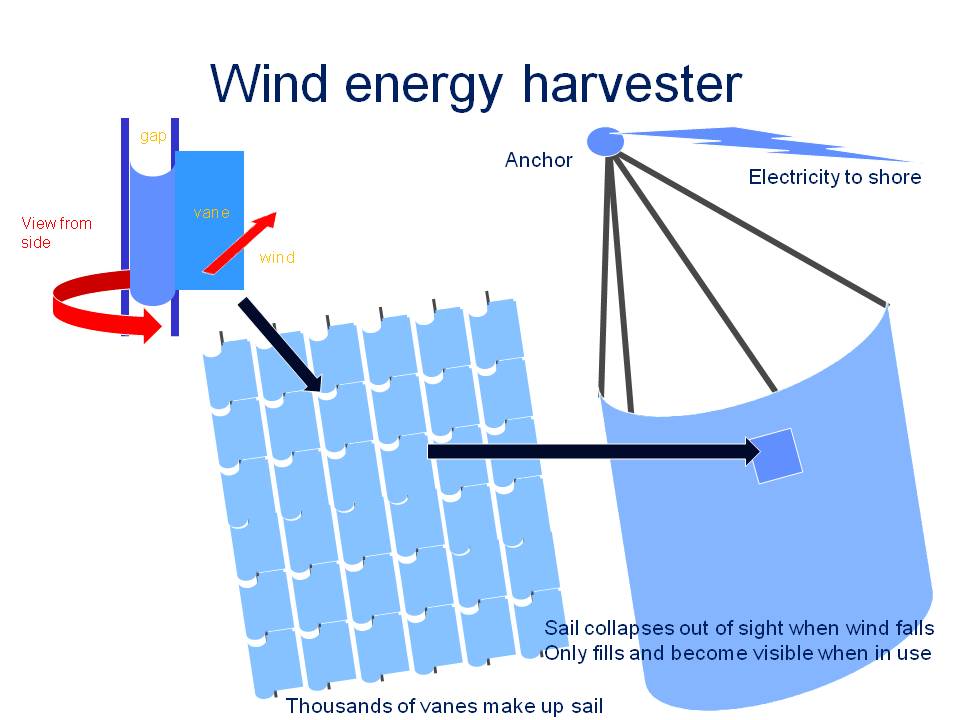
The sail would be tethered to an anchor using ropes, and when the wind blows, it would fill up, the vanes would rotate, and energy would be harvested, with no need for a central motor or any heavy engineering. When the wind dies down, the sail would collapse so that it is less visible. Because the vanes individually would be small, just 5-10 centimetres across, no motion would be visible from any distance away, so they would not be as distracting as conventional turbines. Nor would they kill birds. Plastic capacitor sail generators would therefore have a few advantages over conventional approaches.
The disadvantage is that at the moment the material is fairly expensive, but there are excellent prospects for large cost reductions, and these could make it a far cheaper, as well as a greener, way of harvesting wind power.
]]>As always I encourage you to comment, ask questions and provide input on topics I write about or feature. And should you come across an interesting technology or scientific breakthrough that you feel should be included in this blog please don’t hesitate to let me know. Enjoy the read!
Technology and Politics in the 21st Century: What Happens to Scientific Progress if Mitt Romney Becomes President
It has been interesting following the “non-science” and “nonsense” of this 2012 campaign for the White House. Science and technology may prove to be victims if Republicans win the presidency. Where President Obama has integrated science and technology into his economic strategy to get the United States back on track, Mitt Romney is a whole other ball of wax. He believes innovation is almost exclusively a private sector issue and government need not set a direction or be involved other than doing “basic research.”
Mitt Romney’s technology spend is heavily slanted to the military. His position on stem cell technology harkens to a return to the days of President George W. Bush. Those policies set stem cell therapy research in the United States back a decade.
And on global warming, although never mentioned by either candidate in the debates, there is a significant difference in point of view between the sitting president and his Republican opponent. Mitt Romney believes global warming is not a concern of the United States because taking action would give China and other global competitors an unfair advantage economically. Mr. Romney wants to see a relaxation of EPA rules for development of coal and other fossil fuel sources. He wants the government out of the business of funding potential new renewable projects.
For more on the candidates’ positions read the October 24, 2012 issue of Nature International Weekly Journal of Science.

IKEA Leads the Way with Pledge to 100% Renewable Energy by 2020
If you don’t have some IKEA furniture in your house today you are more an exception than the rule. The Swedish company for 25 years has set the standard for modular, do-it-yourself-at-home assembled furniture. With outlets in 41 countries the company wants to lower its energy costs and environmental footprint by deploying renewable power and engaging in conservation initiatives.
The plan is to make 70% of spent energy renewable by 2015 and become facility self-sufficient in energy generation by 2020. Currently IKEA warehouse outlets sport 342,000 rooftop solar panels generating 25% of the energy consumed by the company. To this they have added wind farms in 6 countries.
As for its conservation initiative the company has pledged to plant as many trees as it uses for creating furniture by 2020. It is implementing clean water projects in all the countries in which it has locations. And finally, it plans to recycle all its furniture products like kitchen cabinets and modular shelving units by introducing smart consumption options to customers.

Welsh University and Indian Steel Manufacturer Combine to Create Buildings as Power Stations
The shared vision of Swansea University and Tata Steel will lead to the development of coated steel and glass clad buildings that generate, store and release renewable energy turning individual buildings into self-sufficient power stations. By 2020 this joint university and industry venture hopes to have permanently altered the way buildings are constructed and rehabbed in the United Kingdom, with coatings and products to retrofit existing structures as well to construct new buildings. Combining solar and wind renewable energy with new advances in storage technologies, and advancements in nano materials using steel, ceramics and glass, the project, called SPECIFIC, has a goal to meet 33% of the United Kingdom’s renewable energy requirements. Watch the video to learn more.

New Smart Material Made From DNA Could Lead to Building Artificial Muscles and Bones
What is the value of a discovery by University of California Santa Barbara researchers of a goo made from DNA that mechanically responds to stimuli in the same way that cells do? According to Omar Saleh and Deborah Fygenson, the discoverers of this blob-like gel, it has the potential to mimic cell behaviour including shape shifting and division. If it can divide then it can grow. Sort of sounds like the sci-fi movie from 1958, “The Blob,” which seems like an appropriate subject to talk about on the eve of Halloween.
The DNA gel is composed of DNA nanotubes connected to each other by links made from DNA. The gel binds together at distinct linkage points along each nanotube DNA chain. Chemical stimuli stiffens the binding. Enough gel and the right stimuli and you can start building things. The discoverers plan to get the DNA gel to twist, crawl and mimic other cell behaviour. Come to think of it maybe it is “The Blob” reborn.

When Did Algae Growing on the Side of a Building Become a Good Thing?
BIQ house is a building being constructed in Hamburg, Germany. When completed in March 2013, it will be a zero-energy installation powered by algae growing on the exterior. Called a bio-adaptive facade, the algae-filled panels, seen to the left of the building in the image below, cannot only be a source of harvested biomass for biofuel, but also through photosynthesis generate solar thermal heat to power the building. When the algae grows quickly in sunlight it will provide shade for the interior while making for a visually interesting display as it constantly waxes and wanes in response to sunlight and the changing seasons.

A Postscript
Once again I thank the thousands of you who continue to drop by each month. It encourages me to write more. If you have a topic that fits within the themes of this blog, and a flare for good writing, then let me know. Guest articles are welcome!
– Len Rosen
]]>
How reliable is geothermal energy?

All of the above are utility-based geothermal power plants. There is another type of geothermal that exploits low-temperature sources, those where the heat source is 150 degrees Celsius (270 Fahrenheit) or less.
Low Temperature Geothermal
Geothermal power generated from low temperature sources has many uses. The heat can transferred to the surface to heat homes, buildings and greenhouses. Geothermal heat pumps can be used for heating and cooling by taking advantage of the constant temperature of the ground, 10 Celsius (50 Fahrenheit), just a few meters below the surface. The heat pumps recirculate antifreeze or air in buried pipes and cool down buildings in the summer and warm them in the winter. These can be passive or active systems. Passive systems use pipes that pass through a building or home and emit heat or cool the air. This is a low cost solution that would work well in the Developing World. Active systems use compressors and pumps to maximize heating and cooling.

For commercial applications of low temperature geothermal the heat can come from a variety of sources. These include:
For power generation from low temperature geothermal conventional turbines are ineffective. But new technology is making it possible to generate electricity for commercial use with turbines that operate much like refrigerator compressors running backwards.
At Southern Methodist University in Texas, the Geothermal Laboratory is researching new technologies for generating energy from geothermal associated with oil and gas fields using waste water to power small binary electric turbines. The energy recovered from these installations is sold to utilities. The cost to produce the energy is much cheaper than comparable solar and wind installations.
In future postings to this blog site we’ll explore this subject even further, and will look at other natural sources being assessed by engineers and researchers to provide alternative heating, cooling and power here in the 21st century.
]]>
Piezoelectricity is energy produced from pressure. The energy gets generated when an automobile, a truck or a train passes over a surface in which piezoelectric devices are embedded. Even a sidewalk or dance floor can be outfitted with such devices.
The cigarette lighter in an automobile is a good analogy for how piezoelectric devices work. In the case of the lighter a spring-loaded plunger is depressed producing high voltage to heat the embedded element.
Piezoelectric devices are embedded within existing infrastructure. As a result they can work day or night, in almost any climate and in any weather conditions. The energy these devices generate is in some sense serving to recover the energy expended by the vehicles that drive over them. With no footprint on the land like solar and wind, piezoelectric technology can include data collectors making roads smart to monitor and report on traffic conditions, vehicle type and weight, and vehicle velocity. And wherever piezoelectric devices are embedded they are practically impossible to damage or steal.
Innowattech Energy Harvesting Systems is an Israeli engineering firm that has developed the IPEG (TM), the Innowattech Piezo Electric Generator, a device that deforms from the weight of a person, vehicle, train or aircraft as they pass over. IPEGS can be installed in asphalt, concrete or composite material-surfaced roads. The company is working with the Italian government to install IPEGS in a highway running between Venice and Trieste to operate all road lighting.
How much energy can a device like an IPEG produce? A single kilometer (0.62 miles) of roadway with IPEGs installed can generate 400 kilowatts of energy based on average traffic conditions. The busier the road, the more energy it produces. Heavier vehicles means more energy gets generated.
On a personal level imagine owning a pair of shoes with soles that contain piezoelectric technology to power all of your mobile devices from phones to music players to flashlights with every step you take.

]]>
Sydney is not unlike many other large urban centres on the planet. Although cities occupy 2% of the Earth’s land mass, they are the users of 66% of all the energy we generate and contribute 70% of total carbon emissions.
Trigeneration is a technology that uses natural gas to generate electricity, heating and air conditioning for building clusters. It is better than twice as efficient as the coal-fired power plants it will replace. And with a reduced carbon footprint will improve the city’s air quality dramatically. The city is also switching to LED street lighting throughout to reduce its energy footprint.
The alternative that Sydney faced was one that would have involved building new power stations and a major upgrade to the power grid. By producing power locally the city will avoid the cost of remote energy generation and the transporting of it over power lines.

The Trigeneration plan includes local building projects that not only will generate their own power but will also recycle water from storm-water runoff to flush toilets and irrigate gardens and parks reducing the city’s water usage. In Australia which increasingly faces drought conditions water is as large an issue as air pollution and energy conservation.
The city hopes to save more than $1.5 billion Australian through implementing trigeneration.
]]>