The company and its founder, Elon Musk, are committed to getting a human colony established on the Red Planet sometime in the 2020s, a decade before NASA. Will they succeed? I’m not sure because Mars will be very hard as a place for humans to survive.
We have yet to master creating self-sustaining environments in any space venture to date. The International Space Station constantly requires supply replenishment and at worst a mission to it can take up to three days depending on the launch window. Consider its location in low-Earth orbit and now look at the distances to Mars and you can understand my skepticism.
Nonetheless, like so many past pioneers, Musk and his SpaceX enthusiasts are out to establish a new human frontier. There has been nothing like it since the Apollo missions, Columbus’ voyages to the Americas, the Vikings’ discovery of North America, and when humans first crossed the Beringia land bridge to North America.
So how will they pull it off for $300 million when NASA’s budget for a human mission to Mars runs into the hundreds of billions? SpaceX commitment to driving down the cost of getting to space is well noted. They have successfully launched a returned first stages of their Falcon 9 booster to Earth and intend to re-fly one of them sometime this fall. That sets a new economic paradigm.
SpaceX intends to reuse almost all of the rocket parts it sends into space, not just the first stage, as it continues to experiment with new technologies. This will be true for the Falcon Heavy, the latest launcher from the company that will be tested sometime before the end of this year. Only the Falcon Heavy will have the payload capacity to support a interplanetary mission capable of delivering an enhanced Dragon 2.0 capsule, called the Red Dragon, to Mars.
What’s interesting is how NASA intends to assist SpaceX in the Red Dragon mission. For every $10 SpaceX is planning to spend, NASA will contribute $1. NASA’s investment will be in the from of expertise including defining landing sites on Mars, hardening the Dragon to withstand interplanetary space travel, and providing access to the agency’s Deep Space communication network.
For this help NASA will fly along in sharing all the data SpaceX collects. The big interest for NASA is seeing how the SpaceX landing technology pans out in the descent to the Martian surface. Aerobraking such as is done by capsules, the former American shuttle, and the Falcon 9 is not possible on Mars. SpaceX must perfect an ability to do supersonic retro-propulsion. To date the heaviest object to land on Mars is the Curiosity rover weighing approximately one ton. Red Dragon will be almost 10 times that weight and those Draco engines built into the current version 2.0 of the technology will not provide enough counter-thrust to stop the capsule from a bone-crushing crash. For later planned missions with human crews, the landing capsules will weigh significantly more than the 10 tons expected for the Red Dragon, so SpaceX needs to add propulsion technology capable of reducing the descent speed for a soft landing and succeed in the tenuous atmosphere of Mars where air resistance is virtually non-existent.
What’s involved in building supersonic retro-propulsion? States Rob Manning, program engineer at NASA’s Jet Propulsion Laboratory, “we have to build a complete system and fly it backwards at supersonic velocity.” SpaceX has demonstrated the possibility of achieving this with its supersonic re-entries of the first stage of Falcon 9. Manning states, “that was the test we always wanted.”
As for the date of the planned Red Ragon mission, the launch window of 2018 is dictated by the optimal positioning of Mars relative to Earth affording the shortest time needed to get to the Red Planet. That window opens up every 26 months. If SpaceX is successful with Red Dragon then it may pave the way for a human mission as early as three optimal launch windows later, sometime late in 2024 with a landing in 2025.
These are the dreams of Elon Musk and SpaceX, the United States’ premier private space enterprise. And for NASA a $30 million investment may be the best and cheapest amount of money it has ever spent on interplanetary missions.

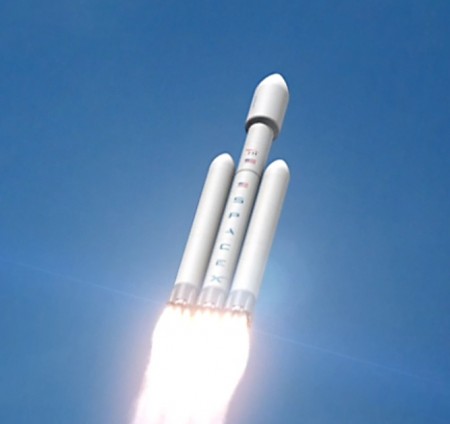
The Red Dragon flight will be in 2018. The capsule technology will largely be based on the Dragon 2.0 design which features an 8-pack of Super Draco rocket thrusters capable of completing controlled descent to the surface of the planet.
What is NASA’s role in the mission?
NASA will help SpaceX by providing technical support including Deep Space communication and navigation, flight systems engineering, and planetary protection to ensure no microbial Earth life forms end up contaminating Mars. From the mission NASA hopes to gain a considerable amount of data for future Martian expeditions.
Elon Musk, the CEO of SpaceX, has made it absolutely clear that it his intention to establish a human colony on Mars sometime during the 2020s. His motivation is the preservation of our species by going what he calls multi-planetary. The Red Dragon is not the vehicle of choice for human colonization. Its interior space is no bigger than a typical sport utility vehicle and on the long voyage to Mars would be insufficient to support a human crew. Instead SpaceX is in the process of completing the architecture for what it is calling the Mars Colonial Transporter (MCT). Part of the SpaceX plan for the MCT (see artist’s rendition in the illustration below is to use a refueled Falcon Heavy second stage in the configuration. Refueling would be done in Earth orbit, something yet to be attempted by NASA or any other space faring agency or country.
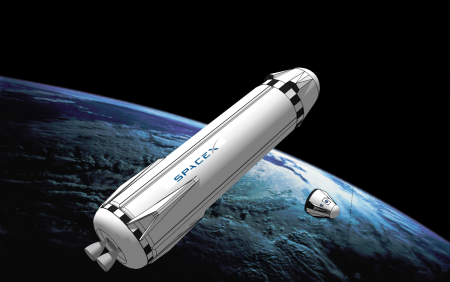
Currently Space X is the only commercial space company with a capsule designed for payloads and human missions that combines propulsive landing capability with the more traditional heat shield and parachutes used by the United States, Russia and China. The latter two are ineffective for a Mars landing. In fact landing payloads on Mars has been a challenge for NASA. The thin atmosphere has little braking capacity to slow down a spacecraft traveling at supersonic speeds. That’s why the NASA rover missions to Mars were delivered by unconventional means. Opportunity and Spirit were literally dropped to the surface encapsulated in an inflated bubble that bounced to an eventual landing on the planet’s surface. Curiosity deployed a sky crane and used tethers along with a descent capsule firing its rocket thrusters to lower itself to the Martian surface. In a human mission the payloads would be much heavier so a propulsive technology is seen as the most effective approach to a Martian landing, or for that matter landings on almost any body within the Solar System.
Dragon 2.0 can do this and deliver between two and four tons of payload to the surface of Mars. Musk has recently stated, “with Dragon launched on a Falcon Heavy, it can go pretty much anywhere in the solar system.” There are even some preliminary landing sites picked out in the Martian Northern Hemisphere for the 2018 mission.
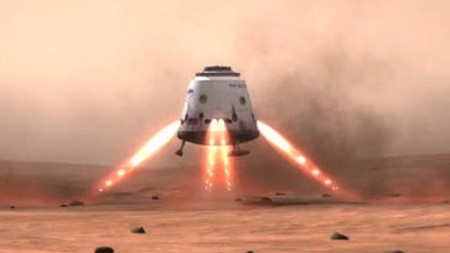
What kind of payload will be aboard Red Dragon? Will it include a rover? Or is that even important? For NASA a deployable payload is of little concern. The primary question the mission will answer is whether Red Dragon can perform as a feasible and inexpensive Mars lander capable of aerodynamic supersonic deceleration to a controlled landing. If it can then SpaceX will have produced the first interplanetary spaceship similar to the ones we have read about in science fiction.
In a NASA document describing the Discovery Missions and Red Dragon it concludes “the capsule’s design already includes most of the capabilities necessary for Mars missions. Options exist to integrate payloads with the vehicle and….current analysis indicates that entry, descent, and landing of the capsule at Mars is feasible, and the capsule’s descent technique would lead on a path toward human-mission landers.”
Welcome to the age of Buck Rogers.
A Postscript to this article:
In the last week SpaceX has posted on their website “payload to Mars” pricing. Using a Falcon 9 launcher, for $62 million you can deliver a 4,020 kilograms (8,860 pounds) payload to Mars. And if you have a bigger payload requirement, $90 million buys you the Falcon Heavy and 13,600 kilograms (29,980 pounds) of payload to the Red Planet.
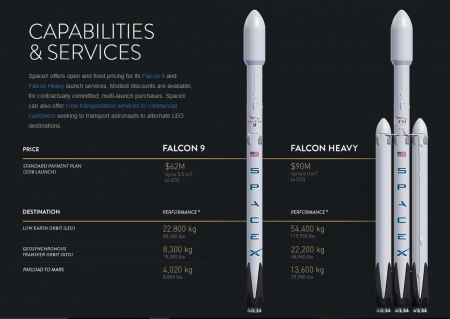
This isn’t a seat sale but the page notes that discounts are available for those committed to a multiple launch schedule. Got to love the moxie.

