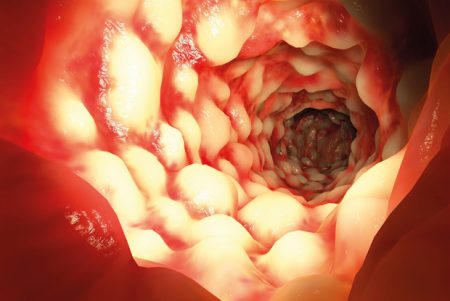
Current methods for confirming the condition based on a patient history involves different versions of examinations of the colon, from colonoscopy to capsule endoscopy, to balloon-assisted enteroscopy. CT scans and MRIs are also used to look at the entire bowel tract to pinpoint the extent of inflammation and potential ulcerations in the lining of both the small and large intestine.
The drugs of choice are anti-inflammatories including corticosteroids and aminosalicylates. Immune suppression medications are also used with methotrexate often prescribed. And then there are antibiotics given to try and heal ulcerations and abscesses in the bowel including Cipro and Metronidazole. And for the treatment of common symptoms patients take fibre supplements, pain medication, iron supplements, Vitamin B-12, Vitamin D, and calcium.
Diet and nutrition counseling is something every Crohn’s patient receives to help reduce inflammatory bowel episodes. Limiting dairy products, low-fat foods, and high-fibre is recommended.
Ultimately, however, many Crohn’s patients end up having surgery to remove the damaged portions of the bowel and to excise abscesses and drain infections.
The Mayo Clinic provides an excellent summary of Crohn’s Disease, treatment, and lifestyle options.
With no cure for Crohn’s researchers have turned to look at how to reverse what causes it – a broken immune system. Among those seeking an answer are researchers at Queen Mary University of London, and the University of Sheffield, where a clinical trial has started using stem cell transplants. In a press release James Lindsay, Professor at Queen Mary is quoted stating, “Despite the introduction of new drugs, there are still many patients who don’t respond, or gradually lose response, to all available treatments…..We’re hoping that by completely resetting the patient’s immune system through a stem cell transplant, we might be able to radically alter the course of the disease. While it may not be a cure, it may allow some patients to finally respond to drugs which previously did not work.”
So what’s involved for patients enrolled in the clinical trial? There are a number of steps including:
The protocol being used here is based on stem cell transplant treatments of patients with multiple sclerosis which have seen some success. The hope is that the newly acquired immune system will no longer attack the patient’s bowel and digestive tract, and will better tolerate medications used to reduce Crohn’s symptoms. You can watch a YouTube video which provides additional information about Queen Mary University’s clinical trial.
The clinical trial is being funded by the UK’s National Institute for Health Research (NIHR). Tom Walley, Director of the NIHR evaluation in the Queen Mary press release states, “Stem cell therapies are an important, active and growing area of research with great potential. There are early findings showing a role for stem cells in replacing damaged tissue. In Crohn’s disease, this approach could offer real benefits for the clinical care and long-term health of patients.”
The current clinical trial is built on a previous stem cell trial where the approach was similar but the drug doses, particularly the chemotherapy, produced serious side effects. Despite this, the first trial did show some positive results. So in this current trial, treatment doses of the drugs being used are lowered with the hope that this will lead to better patient outcomes.
For Crohn’s sufferers, of which my nephew is one, the results of this clinical trial may lead to a far more promising future in having to cope with this debilitating disease.
]]>

June 3, 2018 – I don’t know about you but going for my semi-annual dental checkup is not one of my favourite pastimes. When I give someone rights of access to my mouth I can’t help but remember the movie “Marathon Man” and the nightmares it precipitated. Fortunately, I trust my dentist and am glad I chose her. But what will I tell her when I see her this month after reading about the latest new research from Queen Mary University of London, where scientists and engineers may have discovered a way to grow mineralized materials including tooth enamel and bone.
Tooth enamel is considered the hardest tissue in our bodies. And although bone is hard it can do one thing enamel can’t. Break a bone and the body can regrow. Break a tooth and you are out of luck. Once tooth enamel goes we have to have dentists deal with the consequences: cavities, pain, damage to the root, and eventually root canal and a crown. These are problems that more than half of the world’s population deal with in a lifetime, and the reason why dentists exist.
Sherif Elsharkaway, a dentist, and an author of the paper appearing in Nature Communications entitled, “Protein disorder-order interplay to guide the growth of hierarchical mineralized structures,” describes the work as “exciting because the simplicity and versatility of the mineralization platform opens up opportunities to treat and regenerate dental tissues.” The mechanism behind regrowth is creating hierarchically organized architecture from apatite nanoparticles that mimic the characteristics of natural human enamel. Controlling the mineralization opens up opportunities for regenerative medicine including regrowing tooth enamel.
The lead author, Professor Alvaro Mata, Queen Mary’s School of Engineering and Materials Science, describes the utility of the discovery in terms of our ability to learn from nature. He notes that being able to have precise control at the molecular level makes it possible “to exploit disordered proteins to control and guide the process of mineralization at multiple scales…..a technique to easily grow synthetic materials that emulate such hierarchically organized architecture over large areas and with the capacity to tune their properties.”
With my upcoming visit to the dentist in another two weeks, I can hardly wait to tell her that she may soon be practicing a very different type of dentistry.
