How will it work?
The two provinces will be able to buy Mexican carbon credits and sell them to industries operating within their jurisdictions. Similarly Mexico will be able to purchase credits from the Canadian provinces to sell to the industries in its market. The revenue earned from the credits will be used by each jurisdiction differently. In the case of Quebec and Ontario, the focus is on funding green projects within the provinces. Mexico may choose to use the revenue similarly.
That certainly is the case in California based on a separate announcement yesterday. California legislature and governor agreed to put over $900 million collected through cap-and-trade into green projects focused on reducing emissions. The state so far has raised more than $1.4 billion in its carbon market but only two-thirds has yet been assigned to projects which include:
Cap-and-trade is being tried in other countries as well. It was instituted as part of the European Union’s Emissions Trading Wcheme in 2005. China announced a regional and urban cap-and-trade pilot program in 2013 starting with the city of Shenzhen. In 2015 China added the cities of Beijing, Tianjin, Shanghai, and Chongqing as well as the provinces of Guangdong and Hubei. The next step will be a national rollout beginning in 2017.
Ontario’s program takes effect on January 1, 2017.
If you are unfamiliar with how cap-and-trade works, it is a market driven scheme to reduce emissions and begins with a cap set on emissions. The cap is then lowered over time. The trade portion includes allocated carbon allowances which companies must meet within the cap. If they don’t they pay for credits to cover the excess emissions. Companies that are efficient in reducing emissions under their allocated allowance can sell the difference to companies that don’t meet theirs. First tried in the late 1980s in North America and eventually globally as a means to use market mechanisms to combat ozone depletion through emission reductions of chlorofluorocarbons, its application to greenhouse gases seems to be working already in Europe and California.
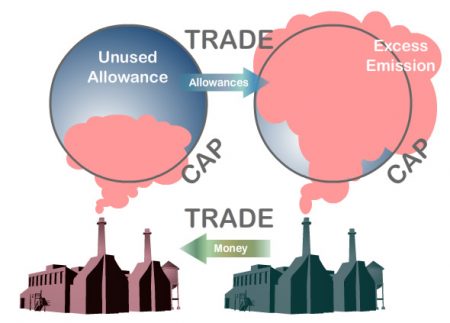
Not everyone is sold on cap-and-trade as a mechanism for combating greenhouse gas emissions and climate change. George Soros, the billionaire, in 2007 stated, “The cap-and-trade system of emissions trading is very difficult to control and its effects are diluted…It is precisely because I am a market practitioner that I know the flaws in the system.” Others describe it as a stealth approach to combating climate change rather than tackling it head on. Companies with deep pockets can purchase offset credits and continue to produce carbon pollution with impunity while passing the costs on to their customers.
]]>

Other states are starting to build EV infrastructure with companies like Tesla ramping up a North American-wide network for its Model-S sedans. But Tesla technology is proprietary. What needs to happen is a build out of generic super charging stations drawing from clean renewable energy sources. And that seems to be the idea behind the two latest Canadian initiatives, one in Quebec and one in Ontario. Mind you they are modest when compared to what California has already achieved.
Quebec’s EV Initiative
In October the Quebec government announced its plans to expand the use of EVs in the province. Montreal will be the site for 106 charging stations to be installed between now and next spring. That’s in addition to the 80 already in place. Plans are to have 1,000 in the city by 2020. The mix will include 240 volt charges each with two plugs and the recharge fee will be $1.00 CDN per hour. The city will also have 400 volt fast charging stations and recharge rates are $10.00 per hour although a 10 minute charge will give an EV a 50 kilometer (31 mile) range. The province expects to have 100,000 EVs and hybrids on the road within five years and is spending $420 million to get Quebecois to switch from diesel and gas-engine vehicles.
What makes EVs an attractive Quebec option. The recharge power will be coming from 100% renewable sources because Quebec produces a surplus of hydroelectricity.
Ontario Modestly Kick Starts EV Infrastructure
Joining Quebec, Ontario yesterday announced it is spending $20 million to build a network of public charging stations for EVs. Currently there are 5,400 registered EVs in the province and only 5 fast-charging stations, all in Toronto. The Ontario announcement didn’t specify the number of chargers to be deployed with this investment. The government announced it wants to partner with the private sector in building the network and the money is to kick start the process. The type of technology Ontario has in mind costs $40,000 a unit and can recharge an EV up to 90% in less than 30 minutes. Private companies can apply to the fund on a first-come, first-served basis.
Like Quebec, Ontario’s recharging stations will come from clean sources although the mix is different including nuclear, hydroelectric, wind and solar power.

]]>