If there is a definition of normal materials, quantum versions don’t fit the bill. They don’t behave according to the Newtonian Laws of Physics. And for this, we should be thankful because quantum materials have helped in creating all kinds of novel inventions including superconductors, new types of powerful magnets like the kind used in tokamak fusion reaction chambers, fault-tolerant quantum computers and sensors, and more.
Recently researchers in Germany, Japan, and the United States discovered that the behaviour of quantum materials could drastically alter the behaviour of normal materials. In this case, the normal material was water.
Quantum materials appear normal but they don’t act that way. Their electrons act with increased intensity causing quantum effects and allowing electricity to flow at extremely low temperatures without voltage loss. Normal materials can’t do that.
Using this unique quality of quantum materials made it possible for the researchers using a cryostat to build a super thermos cooled to nearly absolute zero while inside it water remained in a liquid state. Boggles the mind, doesn’t it?
The published results of the experiment appeared in December in Nature Physics in an article entitled, “Spin–orbital liquid state and liquid–gas metamagnetic transition on a pyrochlore lattice.”
Every physical system appears in various states. For example, an electron has a charge and spin which produces a measurable result that we can read. That is its material present state. But quantum states don’t just deal with the present. They consider change over time. For example, water can turn into vapour or ice depending on temperature changes.
In Newtonian physics, we can calculate the normal variability of the ability of a material to change its present state. But Newton didn’t have the means to drill down to look at atoms and subatomic particles and how external changes influenced their behaviours.
Today, quantum states are described in mathematical terms that describe changes in state related to spin, superposition, and entanglement. Here we run to theorems like the Schroedinger equation. (If you have watched “The Big Bang,” the reference to Schroedinger’s cat in the box experiment may come to mind.)
Quantum states unlike classical physical states are measured in probabilistic ranges. The mathematics used helps describe these quantum states. The reconstruction of quantum states is called tomography.
So what is entanglement? It happens between two different types of particles which have wavelike attributes. The typical analogy for the interaction of these particles is as if they are two boats whose wakes cross as they cross a body of water. Sometimes the waves in the wake cancel each other out. Sometimes they amplify the movement in the water to create a bigger wave. The interference that occurs is called entanglement and it can be measured.
In a recent experiment, physicists have observed for the first time quantum interference occurring between two dissimilar subatomic particles. This entanglement interaction was a known phenomenon in two particles of the same kind, let’s say photons. But had not been observed in interactions between different subatomic particles.
What does this mean for scientific progress in the quantum world? A better understanding of quantum mechanics and the ability to measure matter in the subatomic world. In the end, I am sure this will lead to even more inventions with practical applications to help us solve the challenges we face in the 21st century.
I came across this debate several months ago online in Foreign Policy (FP) Magazine. FP columnist, Vivek Wadhwa, and Stanford University professor, Mauritz Kop posed the question and then came to a mixed conclusion.
They were comparing the “demon of artificial intelligence” (AI), “or the technologies masquerading as such” with quantum computing, a technology that they stated if gotten wrong would compromise private communications and banking, and disrupt the security of every digital computer on the planet.
They referred to two AI examples. One was autonomous vehicles. The second was the algorithms baked into social media. They didn’t know about OpenAI and ChatGPT. It would have been interesting to add it to the AI versus quantum computing debate.
Tesla automobiles suffer from an AI that is imperfect. Hence some Teslas using the highest autonomous settings have crashed. That may say more about the stupid human occupant than the quality of the code and sensors packed into these vehicles.
And then there are the AI algorithms that hypercharge human prejudice on social media leading to fake news, misinformation, conspiracy theories, the undermining of scientific discovery, learning and delegitimizing government.
To this add quantum computing and state the two debaters, you have technologies dangerously capable in the wrong hands of causing all kinds of turmoil. For example in China, advancements in quantum computing and quantum communications may have theoretical value in advancing science and technology, but considering that country’s hyper-supervisory state control behaviours, the road to future perdition could be one paved by the outcomes of quantum physics combined with the current and future advancements in AI.
The two debaters in the end agreed that AI and machine learning in their current state was already out of control and damaging the present. They concluded that the addition of quantum computing might produce a recipe not worth cooking.
]]>
These are Peter’s picks and there is no doubt that the implications for the planet and humanity from these advances will be significant in this decade and beyond.
Did he miss any field and scientific and technology breakthroughs that should have been included? I will consider that and maybe add some of my own in the coming weeks. So please continue to visit this site and let me know if you agree with his or my additions to his best breakthroughs of 2022 list.
The #12 breakthrough is the approval of laboratory-grown meat by America’s Food and Drug Administration (FDA). In November, California-based Upside Foods received FDA approval for its lab-grown chicken. Before the company can begin selling its product it still needs approvals from the Department of Agriculture Food Safety and Inspection Service (USDA-FSIS) which is expected soon. This marks the second country to approve lab-grown meat. The Singapore Food Agency (SFA) granted Eat Just Inc. approval for its cultured chicken in December 2020.
Of the 80 billion animals raised for meat annually, 70 billion are chickens. Demand has increased six-fold in the last century. I think the chickens of the world will thank these cultured meat companies in the years to come. And so will the environment as agricultural practices change to reflect the move away from livestock. Animal welfare advocates will also be much happier. And cultured meats may solve food insecurity issues for those areas of the planet facing agricultural challenges from climate change.
The #13 breakthrough is perennial rice. China’s Yunnan University has created PR23 rice, a perennial. They have been published in the journal Nature Sustainability. Rice is an annual which means it needs to be planted every season. But PR23 can be harvested and automatically regrows. In tests, 8 consecutive harvests were produced over 4 concurrent years. Using PR23 reduces farm labour by 60%, and production costs by 50%. Farmers in Southern China have planted more than 15,000 hectares in the last year representing a 4-fold increase from 2020. Considering that rice is a staple and food source for 4 billion on the planet, the development of a perennial version can alleviate food insecurity in South Asia, Africa and elsewhere. After this, the next food crops on the bucket list to develop perennial versions are wheat and corn.
The #14 breakthrough is the Tesla Humanoid Robot called Optimus which stands 1.7 metres (5 feet 8 inches) tall. It lifts 68 kilograms (150 pounds) and carries up to 20 kgs (45 lbs.). It travels at speeds of 3 kilometres (5 miles) per hour. Future versions will climb stairs and hills, use tools such as drills and screwdrivers, and develop other abilities.
Tesla plans to mass-produce Optimus selling each for less than $20,000. This could make robots a future household and work fixture. Elon Musk, CEO of Tesla and SpaceX sees Optimus as a part of the “future where there is no poverty, where you could have whatever you want in terms of products and services. It is a fundamental transformation of civilization as we know it.” That may be an overstatement, which Musk is known to express, but we will see.
The #15 breakthrough is the XPrize ANA Avatar called NimbRo. NimbRo won for its University of Bonn team, the $10 million prize. What avatars make possible is for humans to work through a robot in real-time without being at a location. NimbRo allows its operator to hear, see, and interact with a remote environment. In winning it teamed up with an operator to complete 10 tasks earning a perfect score. Avatars make it possible for humans to do tasks in areas that normally would be hostile to them: think disaster relief, nuclear reactor accidents, dismantling a bomb, or search and rescue operations.
The #16 breakthrough is robotaxis getting approvals for use in public transportation. Alphabet’s Waymo and GM’s Cruise are two leading companies developing these autonomous vehicles. Waymo was the first to offer fully autonomous public rides which began in Phoenix, Arizona in 2020. In November 2022, it won approval from the California Public Utilities Commission to carry passengers in robotaxis without a safety driver present. GM Cruise has operated a robotaxi service in Austin and Phoenix and recently was approved to offer a fully driverless ride-hailing service in San Francisco.
The use of robotaxis will lower the cost of personalized transport and should increase car-sharing taking more cars off the roads and streets of cities. This ultimately can lead to less land used to support automobiles. That means fewer parking spaces, more manageable road networks, and turning asphalt and concrete into parks and sustainable housing. This should help reduce the urban heat island effect in cities and mitigate global warming.
The #17 breakthrough is eVTOLs which stands for Electric Vertical Takeoff and Landing vehicles. The emergence of flying cars made the U.S. Federal Aviation Administration propose new rules in 2022 to help pave the way for commercial air taxis to operate by 2025. The goal is to have them in Los Angeles in 2028 for the Olympic Games.
Top companies include Joby Aviation which this year received Air Carrier certification and formed a partnership with Delta Air Lines. Another company, Lilium, demonstrated the Phoenix-2, an eVTOL that transitions from hover to wing-borne flight. Saudia Airlines signed an MOU to purchase 100 and develop an eVTOL network across Saudi Arabia. Archer Aviation formed a partnership with United Airlines to deliver 100 eVTOLs for passenger service between Newark Airport and downtown Manhattan. And BETA Technologies demonstrated human-piloted eVTOLs winning military airworthiness approval.
It looks like eVTOLs are about to take off in major metropolitan cities with the market estimate for these services to be worth $30 billion by 2030. As eVTOL networks grow this will change where and how we travel making difficult-to-reach geographies more accessible.
The #18 breakthrough is in the proliferation of Qubits in new quantum computing platforms. Qubits are the equivalent of the bits and bytes that can be found in today’s computers. Several significant advances in 2022 have included extending qubit lifetimes by a factor of 5. Other advances include tuning large numbers of qubits to interact with each other while maintaining coherence using what is called quantum many-body scarring (QMBS). These advances address the biggest challenges in quantum information science. Longer coherence times mean more useful qubits for applications in physics, chemistry, medicine, transportation, finance and other fields. McKinsey estimates that four industries, in particular, automotive, chemicals, finance, and pharmaceutical will see quantum applications worth $700 billion by 2035.
The #19 breakthrough comes with IBM unveiling its largest quantum computer yet called Osprey, a 433-qubit machine that is three times larger than the 127-qubit Eagle which the company announced just last year. The new processor has the potential to perform complex quantum calculations far beyond the capabilities of any classical computer. As IBM points out, “the number of classical bits that would be necessary to represent a state on the IBM Osprey processor far exceeds the total number of atoms in the known universe.” And IBM has plans for a 1,000-qubit chip to be released in 2023.
The larger the quantum computer, the greater its ability to tackle more complex problems. For example, Toronto-based Xanadu this year used a 216-qubit quantum chip called Borealis to tackle the “Gaussian boson sampling” problem, a benchmark used to measure quantum computing prowess. The Borealis did it in 36 microseconds. A conventional computer would have taken over 9,000 years.
The #20 breakthrough is progress using synthetic data to accelerate artificial intelligence (AI) systems development. Data feeds AI systems. Good data is great. Bad data, not so much. The real world can be messy and data can be riddled with biases. Gartner estimates up to 85% of AI projects end up delivering erroneous outcomes because of data bias. That’s where synthetic data comes in.
Synthetic data is artificial. It mimics real-world observations. It is used to train AI machine-learning models. This year researchers at MIT, IBM Watson, and Boston University built synthetic datasets from 150,000 video clips capturing a range of human actions. Machine-learning models used the clips for training. Videos with fewer background objects produced better outcomes than AI using real data. What this potentially means is that synthetic data by 2030 will overshadow real data in AI models and will save hundreds of millions of dollars annually.
The #21 breakthrough is text-to-image generation. Open AI’s DALL-E 2 and Stability AI’s Stable Diffusion are advanced machine-learning text-to-image platforms. DALL-E 2 is built to understand natural language and turn it into images, creating creepily accurate renderings. Today, 1.5 million active users are working with it to create over 2 million images daily at no cost. OpenAI has partnerships with Microsoft, Shutterstock and others to increase the platform’s use and influence. Stable Diffusion’s Stability AI is currently used by more than 10 million people. And apps from TikTok to Lightricks are also AI-powered art generators.
For creatives doing art and design, these tools are game changers. A recent New York Times interview with several creative professionals talked about how partnering with AI was allowing them to generate more creative ideas faster. Filmmakers are using the tools to create pitches for studios. And generative AI isn’t limited to images. It can also be used to generate computer code from text. That can make anyone a programmer.
The #22 breakthrough and the last in this list is ChatGPT, a conversational chatbot created using OpenAI and the recently released GPT 3.5 language. This chatbot is a tool for AI-human collaboration and works by taking conversational input and producing code or text output. It can be used to answer coding queries, run virtual computing platforms, write song lyrics, and even novels. When OpenAI released ChatGPT on November 30, 2022, by December 5th over 1 million people were using it. What will be the new forms of art and business that this type of AI tool creates?
Peter Diamandis concludes his 22 breakthroughs with this comment related to the implications of advances in AI, stating: “By the end of this decade, there are going to be two kinds of companies, those that are fully utilizing AI and those that are out of business.”
]]>So here are four quantum computing stories that made news in 2019.

]]>
The language of computing in the quantum space goes from bits to qubits. That’s just one of the mysterious aspects of quantum computing. Qubits don’t use the logic of bits which are either on or off, or in a yes or no state. Instead, they can be both on or off or in a state somewhere in between. Even more mysterious is something called quantum entanglement which means that a measurement done on a data bit in one quantum computer can influence the measurement of a data bit on a remote system instantaneously without the appearance of any physical activity.
Because qubits are not bits, they are not limited to binary logic where there are only two states of existence controlled by logic gates. Something is either on or off, or yes or no, or black or white. With qubits, however, we can see the technology producing a solution that is neither on or off or yes or no, or shades of grey. Quantum computers, therefore, act more like us.
Today’s quantum computer processors can only operate in a controlled temperature environment barely above absolute zero. That’s a temperature equivalent to -273 Celsius or -460 Fahrenheit degrees. require systems that are kept at temperatures near absolute zero. At that temperature, atoms and molecules exhibit some weird quantum states and can transfer information between them even if an unlimited distance apart, a form of teleportation which makes you immediately think of the Star Trek Transporter which is pretty futuristic.
Because quantum computers are already here if not in common use, then communication with today’s Internet requires us to consider the potential security risks. The Internet today secures data transmitted over it by using mathematical formulae that scramble and unscramble content using a key, a string of characters that must be known to the sender and receiver. Our user names and passwords give us access to programs and applications which rely on built-in private keys that make the sending and receipt seamless. A quantum computer, however, can break into encrypted data on today’s Internet making the sending and receipt transparent to a quantum computing user.
That means we need new algorithms that encrypt data that can be secured from quantum snooping. First, we will have to shore up our classical algorithms so that a quantum computer cannot crack the key. But following that as quantum computers become more common we will need quantum algorithms that today do not exist.
Today secure websites like 21stcentech.com use “https” which stands for hypertext transfer protocol secure, which protects the integrity and confidentiality of data coming from the site to your desktop, smartphone, tablet, or laptop. Websites that appear with the prefix “http” are not secure.
The emergence of the Quantum Internet will first be observed with websites whose prefix will begin with something like “httpq,” the “q” standing for implementation of quantum-secure algorithms ensuring that quantum-based systems information has joined the realm of the Internet. But unless you use a quantum computer you will not be able to access pages designated by such a prefix or any other that becomes the secure Quantum Internet communication standard.
And as the Quantum Internet develops we will see a transformation in information sharing that takes advantage of quantum entanglement and superposition for data in a quantum state. Although today, communication between two quantum computers is somewhat inhibited by the medium by which we send and receive qubits, which limits transmissions to relatively short distances, a recent development out of China may represent the first steps in the Quantum Internet’s emergence.
In 2016, China launched the Micius satellite to demonstrate ground station to satellite communication, using quantum teleportation. The satellite succeeded in teleporting a photon instantaneously. The first intercontinental quantum cryptography service had arrived.
Researchers in Europe and China then tested the technology by creating a secure videoconference operating under the laws of quantum physics. This was the first intercontinental quantum network and a major stepping stone in the founding of what will become the global Quantum Internet.
In a recent Gizmodo article, Ryan Mandelbaum, writes, “The quantum internet is coming sooner than you think …when things change over, you might not even notice.” I would add maybe it is here already and we haven’t.

Raising expectations that quantum computing has finally arrived to replace the high-speed computing systems used today may be premature. Software continues to evolve on classical computing platforms that will substantially extend the capabilities and capacity of current technology with artificial intelligence (AI) and machine learning leading the way. In fact, researchers believe they can emulate the way quantum computers work on classical computing systems making the rush to the former and the displacement of the latter irrelevant.
The editorial concludes that quantum computers remain a “not-yet-existent technology in search of problems to solve.” Whereas, classical computers with AI are going gung-ho at tackling the real problems humanity face.
In fact, there are those who would argue that quantum computing remains beyond our current technological capability. According to Professor Mikhail (Michel) Dyakonov, of the Laboratoire Charles Coulomb, Universite de Montpelier, writes in an article which appeared in the November 15, 2018 edition of IEEE Spectrum, entitled “The Case Against Quantum Computing,”
“The number of qubits [quantum bits] needed for a useful quantum computer, one that could compete with your laptop in solving certain kinds of interesting problems, is between 1,000 and 100,000…That’s a very big number indeed. How big? It is much, much greater than the number of subatomic particles in the observable universe.”
Error correction in a quantum computer is so complex that engineers would quickly lose interest in the technology, states Dyakonov. He goes on to pour cold water on the claims by quantum computing theorists that errors per qubit per quantum gate can be handled using the threshold theorem which states that the physical error can be kept to low levels through the application of quantum error correction schemes which use logical qubits.
But Dyakonov points out that you need many physical qubits to create a logical qubit. How many? “No one really knows, but estimates typically range from about 1,000 to 100,000,” which means a quantum computer containing a million qubits.
A reality check: Google’s quantum computer, Bristlecone, runs on a 72-qubit gate-based computer processor. That’s up from its previous 9-qubit system, and considerably larger than the runners-up at IBM with their 50-qubit processor.
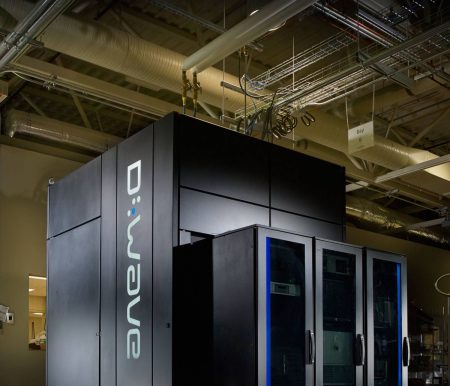
And then there is D-Wave, the Burnaby, British Columbia-based quantum computing company which claims to have a 2,048 qubit device and it open-source library of GitHub software for beginners. Already on the market, the 2000Q. D-Wave is claimed by the company to be the first commercial quantum computing system combined with software to do real work. D-Wave systems are in use at NASA, Volkswagen, Los Alamos National Laboratory, Lockheed Martin, USC, and Google itself, although the latter isn’t mentioning D-Wave in making its claim to 2019 as the year when quantum computing goes mainstream. And when you consider that D-Wave systems at 2,048 qubits are at Dyakonov’s lowest threshold for useful computing that is not subject to error, I think that might leave one with the impression that Google’s statement is a bit of an overreach.
Today, what kind of practical problems are quantum computers solving? Here are a few examples, and I might add there aren’t many:
With the exception of the first one, it’s pretty clear that current quantum computing applications focus largely on the obscure rather than mainstream problem solving. So don’t expect quantum versions of Microsoft Excel or Word on that first quantum computing device that Google states may become available next year.

]]>
Although I have decided to shine a light on these seven subjects in these first two postings of 2018, there are many other fields where 2018 will see significant advances, and I intend to cover most of them as the year unfolds.
If any one field of science is to be singled out as game breaking, it is the one that is parsing the genetic makeup of all life on Earth with the intention of curing inherited and acquired diseases that cause changes to our DNA and RNA. Under the name “gene drive,” we saw in 2017 the first use of CRISPR/Cas9, to correct diseases of a genetic origin. In 2018 we will see the first therapies carried out on patients suffering from a variety of cancers, ALS, Muscular Dystrophy, Multiple Sclerosis, Sickle Cell Anemia, Huntington’s, Alzheimer’s, and other inherited or epigenetically acquired diseases. And this is just a beginning use for this amazing scientific breakthrough. Variants of CRISPR can now edit nucleobase pairs, the steps in the staircase that is the DNA ladder.
Not just humans will be the recipients of gene drive technology. New variants on staple crops will help feed a world where climate change presents a considerable threat to agriculture. Scientists are engineering wheat, corn, rice, soybean, millet, cassava and other principal food crops to withstand drought, excessive heat, saltwater intrusion, insect and weed infestations, and other environmental challenges to feed a planet that will see our human population increase by more than 2 billion by mid-century.
Genetic modifications to insects that not only infect humans with diseases like Malaria, Zika, Chagas, West Nile Virus, Chikungunya, and others will do more to wipe out these diseases than all previous efforts to date. We will see the first deployments of genetically altered insects that will sterilize whole populations responsible for destroying the food we grow.
This technology is just getting started in 2018 with the next 10 years being positively revolutionary.

The race to build the first commercial quantum computer using silicon, complete with operating system and application development tools, has almost been run. Why silicon? Because we have been building other types of computers with this material since the dawn of the age of computing. But quantum bits or qubits, the equivalent of bits in regular computers, have always been a bit of a challenge to build into a physical substrate. Producing qubit chips using current manufacturing technology, as a result, has been difficult.
Today, the leading supplier of quantum computers is a small company headquartered in Vancouver, British Columbia. D-Wave sells a single quantum computer for as much as $15 million U.S. per unit. Its customers aren’t everyday computer users but rather companies like Google, NASA, and Lockheed-Martin. IBM and Microsoft may have home-grown quantum computing devices of their own but they aren’t building any for customers just yet.
The big breakthrough may come from Australia where University of New South Wales researchers have architected a quantum chip built using silicon that is based on “flip-flop” qubits. These qubits are controlled using electric signals, instead of magnetic ones which makes construction of the chip far easier. The precise arrangement of single atoms to ensure qubits function properly is no longer a constraint meaning conventional manufacturing processes will soon be able to turn out significant numbers of these qubit chips. With this new type of qubit, quantum entanglements can happen hundreds of nanometers apart. That makes quantum computer manufacturing to scale realizable for the first time in 2018. That’s almost a decade ahead of what prognosticators and futurists have been predicting.

Heavy-lift payload capacity is about to become a reality in the space business in 2018 as SpaceX prepares to launch its Falcon Heavy this month in a test that will be just the first of many space firsts. These include the first human-crewed launches to the International Space Station by SpaceX and Boeing. By the end of the year, SpaceX plans to send two tourists on a trip to and around the Moon, duplicating the Apollo 8 mission of 1968.
We should also witness the finalists in the Google Lunar XPrize attempt to come away with the $20 million that remains at stake. No finalist represents a big corporation which is an interesting development. All are working with small budgets showing that billions need not be spent to get to the Moon. Should one or more succeed, it will lead to accelerated commercialization of both the near-Earth and lunar space, a development that only a few short years ago was considered inconceivable.
CubeSats and an increased number of commercial space launch providers will further democratize the study of Earth, near-Earth and Deep Space. The miniaturization of sensors and instrumentation have made it possible to build satellites that can do real research for as little as $10,000, and can be launched economically with a bundle of other CubeSats on commercial or national space carriers such as India, and Japan, for a fraction of what it cost for NASA, Roscosmos and even China. Calling 2018 the year of the CubeSat may not be that far from the truth.

Electric vehicles (EVs), autonomous transportation, and hyperloops have dominated 2017 transportation headlines. In 2018 expect to see autonomous ships and long-haul trucks become part of the tech talk conversation. The commitment to EV technology among the major manufacturers of automobiles globally is a welcome response by these companies to do their bit to reduce our reliance on fossil fuels. Autonomous vehicles being tested today in a limited number of cities around the world will see a growing proliferation of both closed circulation and public street testing.
Now consider adding three more technologies to emerge in 2018.
The first is the reappearance of commercial supersonic transport with a number of vendors in the running to create a next-generation version of the Concorde. Aerion, Boeing, and Lockheed-Martin are all in the running.
The second is the race to create commercial travel through suborbital space to shrink the time and distances for global travelers. There are so many companies which have thrown their hats into this ring that we should see considerable progress made in solving the technological barriers to entry in 2018. The companies in the running include Virgin Galactic, SpaceX, Blue Origin, and the UK’s Skylon hybrid jet-rocket plane.
Third is the evolution of vertical urban transport with magnetic levitation elevator technology that soon may change how cities get built. Thyssen Krupp is the technology leader in this field. And the implications for future buildings will turn them from today’s vertical towers, into structures that may resemble the branches of trees. Maglev elevators have no cables. They run on rails that can go vertically or horizontally or somewhere in between. This is technology that has profound implications for what could be defined as micro-urban transportation within and across complexes of buildings, literally highways for passengers to travel through the urban sky.

]]>
Researchers tell us that quantum computers will be able to solve complex problems, that they will be faster than the supercomputers we have today, that they will be able to break any existing cryptography while putting in place unbreakable security in all quantum devices.
Quantum computers will analyze the Universe for us in entirely new ways, whether we are studying black holes and supernovas or revealing the latest new particle finds in quantum physics, or unlocking further the mysteries of DNA and RNA. But they can only do this if developers create software that works on quantum computers. Back in January of this year, I wrote about the challenge of developing the programming for quantum computing. D-Wave has developed an open source tool, Qbsolv, to encourage programmers to begin software development. Another developer, Scott Pakin, has created Qmasm, a quantum macro assembler to help with the writing of machine level code. Another company, 1QBit, is also building software for quantum computers, in particular, D-Wave devices.
In the latest Caltech study which was presented at the Institute of Electrical and Electronics Engineers 2017 Symposium on Foundations of Computer Science, researchers provided what they called solutions to “semidefinite programs.”
So what is semidefinite programming?
It is programming designed to solve complex problems where there may be more than one answer, such as solutions that provide minimums and maximums. Think about what kind of software tool would help design a critical component for a rocket to better understand the material constraints under a number of conditions. In conventional computing, this is a complex problem that could tie up a system for hours or even days. In quantum computing with semidefinite programming, the problem can be addressed in minutes providing a range of tolerances and comprehensive risk analysis.
Fernando Brandao and Krysta Svore, are co-authors in the published results of the study. Brandao, a theoretical physicist at Caltech, believes that the quantum algorithm they developed could rapidly describe the quantum states of subatomic matter and its behaviors. Svore manages the Quantum Architectures and Computation Group at Microsoft Research. In their paper which you can access through the Caltech Library Service, it states that the new quantum algorithm they developed achieves an exponential speedup when solving complex linear and quadratic equations.
Real world examples and not theoretical ones where semidefinite programming using quantum computers will prove helpful:
All of these are good candidates for quantum computing but without the programming tools, the value of the advances on the hardware side is moot.

“A fermion is a particle that
A. has an intrinsic angular momentum that is a 0.5, 1.5, 2.5, etc multiple of Planck’s reduced constant, and B. cannot occupy the same state as another particle of the same type. Electrons and protons are common examples. They are in contrast to bosons, which have 0, 1, 2, 3, etc spin, and can condense into the same state.”
B. cannot occupy the same state as another particle of the same type. Electrons and protons are common examples. They are in contrast to bosons, which have 0, 1, 2, 3, etc spin, and can condense into the same state.”
Electrons and protons are common examples. They are in contrast to bosons, which have 0, 1, 2, 3, etc spin, and can condense into the same state.”
Are you confused enough yet?
What I can glean from this description is that a fermion is a group of sub-atomic particles that are the opposite of the boson of Higgs-Boson fame. That’s because fermion particles spin in a different direction than bosons. Among the subatomic particles you may be more familiar with, electrons, protons, neutrons, quarks, and neutrinos are all classified as fermions.
So fermions sound pretty old hat when compared to bosons. But not according to the latest discovery by physicists at Stanford University. The scientists announced in the last week that they had found “strong evidence” for the “angel particle.”
What makes this particle different and why the moniker “angel?” It is really an analogy to biblical creation, tying it to the Big Bang, the beginning of our Universe. It also is a reference to the Dan Brown novel, Angels and Demons, with antimatter playing a significant part in the plot.
What is antimatter?
According to physicists, at the seminal moment of the Universe emergence from the Big Bang, there were equal amounts of matter and antimatter. Antimatter formed particles that were the opposite of matter. And back in 1937, Italian theoretical physicist, Ettore Majorana, envisioned a particle that could exist as both in a single state. These matter and antimatter particles are today known as Majorana fermions. But they existed only in theory until Stanford’s evidence emerged.

In the July 21, 2017, edition of the journal Science, the Stanford discovery is written about. The Stanford experiments were conducted using superconductors which allowed for observation of these never seen before fermions. Professor Shoucheng Zhang of Stanford notes that the team “predicted exactly where to find the Majorana fermion and what to look for as its….signature.”
Where does this evidence lead us in practical terms?
Majorana fermions may provide an environment for the next leap in quantum computing. With qubits surrounded by particles of both matter and antimatter, these essential quantum bits can exist without being disturbed and losing their data. This would mean computers many million times more powerful than today’s D-Wave quantum computer which I have written about in previous postings.
So now we have the Higgs-Boson, called the “God particle,” an unstable piece of matter deemed to play a big part in what makes matter possible; and the Majorana fermion, the “Angel particle,” capable of combining matter and antimatter in a stable state with implications for all kinds of future discoveries.I’m always amazed and amused by how science will choose to name discoveries using religious terminology. But maybe that makes it easier for the average person to understand the implications of the discovered evidence.
And in both cases, scientists have chosen to give these discoveries a religious context. Maybe that makes it easier for the rest of us to understand the implications of their discoveries. Or maybe they are just poking fun at creation myths.

What is open source? In the world of software many developers have made available the original software source code for computer languages, operating systems and applications. These open source tools are the opposite of “proprietary “ or “closed source” systems. Open source arose from the 1980s free software movement, a guerilla response to companies like Microsoft and IBM who sold closed source software licenses with expensive upgrades and maintenance contracts.
Developers of the various UNIX operating systems were among the initiators of what eventually became the Open Source Initiative. The Firefox and Chrome browsers that I use on my desktop and chrome-book laptop are products of open source. The Android operating system found on the majority of smartphones today is open source. Users are encouraged to enhance the code, develop applications, and share their results.
D-Wave, with the release of the source code of Qbsolv, is joining the open source movement in the hope it will be a quantum computing game changer. And they are not alone in this pursuit. Last year a Los Alamos researcher, Scott Pakin, released Qmasm, a quantum macro assembler, to help Qbsolv developers create programs that current D-Wave systems can’t even handle. These will be programs for future releases of ever more powerful D-Wave systems.
Other quantum computing developers see the merit of making the technology more accessible. For example, IBM offers a cloud-based quantum computing platform for “students, researchers and general science enthusiasts” to get a hands-on experience creating and running algorithms and experiments using qubits. Even Microsoft has created a quantum computing simulator to give developers an opportunity to write code and experiment with qubit-based applications.
Early users of Qbsolv have found it beneficial. It has enhanced the problem solving capability of D-Wave systems by a 20-times factor. States Fred Glover, Professor at University of Colorado and CTO of Opt Tek Systems, “Qbsolv opens a world of possibility for developers….Quantum applications are a new frontier and we’re just beginning to scratch the surface.” The current problems addressed, however, seem less real-world and more esoteric.
For example Qbsolv is being used to find “a faster solution to the multiple-sequence alignment problem….to study the evolution and function of DNA, RNA and protein.” Another application developed by Los Alamos scientists has helped to “find better ways of splitting the molecules on which they performed electronic structure calculations, among the most computationally intensive of all scientific calculations.”
Where can Qbsolv take quantum computing? Scientists see its potential for helping solve some of the world’s biggest challenges including improving crop yields to feed a growing human population, or addressing the planet’s changing climate through more accurate modeling of the environment, or finding new ways to treat and cure disease. A recent quantum application successfully predicts epileptic seizures in patients 20 to 40 minutes before they occur.
What is Quantum Computing?
Moore’s Law (or the exponential growth of integrated circuits) actually refers to the fifth paradigm of computing. A list of those progressive paradigms goes like this:
Quantum computers represents a sixth paradigm because they work in a fashion entirely different from everything that has gone before.
Classical computers perform operations using classical “bits.” Bits can be in only one of two states: “0” or “1.” In contrast, a quantum computer uses quantum bits, shortened to the term qubits. Thanks to a principle called quantum superposition, qubits can have a value of “0,” “1,” or “both 0 and 1″ at the same time. This capability allows quantum computers to solve certain types of complex problems that are intractable for conventional computers. Frankly, really exciting problems for society today, as you’ll see below.
The power of qubits is they scale exponentially. A 2-qubit machine allows you to do four calculations at once. A 3-qubit machine can do eight calculations. A 4-qubit machine gives you 16 calculations, all simultaneously. By the time you get to 300 qubits, you’ve got a computer that can do more “calculations” than there are atoms in the universe. That’s why the blog TechTarget described Quantum computing this way: “Development of a quantum computer, if practical, would mark a leap forward in computing capability far greater than that from the abacus to a modern day supercomputer, with performance gains in the billion-fold realm and beyond.”
What Are the Implications of Quantum Computing?
The implications of true quantum computing are staggering. Here are my list of the Top 5 Applications:
Bottom Line: When quantum computing pans out, we’ll be able to control the very building blocks of the universe.
The question is who is going to figure it out first…
Who’s Working on Quantum Computing?
There’s a race going on – a race to prove something called “quantum supremacy.”
Quantum supremacy is essentially the test that validates that the computer you have is in fact a quantum computer. In the United States three major players are in the game right now:
Perhaps a fourth, D-Wave Systems, located across the border in Vancouver, British Columbia should be added to this list.D-Wave has developed chips with qubits, but these haven’t yet been conclusively proved to operate as a quantum computer. Both Rigetti Computing and Google believe they will reach “quantum supremacy” in the next 12 to 18 months.
Think about that: the next one to two years…The revolution is coming fast.
To put this into perspective, I had a chance to catch up with Chad Rigetti, the CEO of Rigetti Computing (he’ll be one of our amazing mastermind participants at the 2017 Abundance 360 Summit this January).
Below is a picture of the most powerful classical computer on the planet, Tianhe-2 in Guangzhou, China.
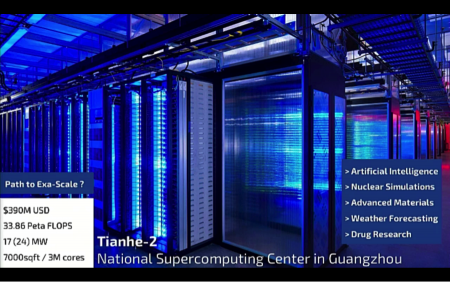
It costs $400 million. The computer burns about 20 megawatts of electricity – enough to power 20,000 households. And it’s about half the size of a football field, with 3.2 million Intel cores.
President Obama, in the attempt to drive America’s return to high-performance computing supremacy, declared that the U.S. would build an exoscale computer, 30x more powerful than Tianhe-2, by 2020. The problem with this is that with current technology the cost will be a billion dollars and will require a nuclear power plant to run it.
“We need to do this,” explains Chad Rigetti. “But there is another path. Quantum computing.”
Below is a picture of two developmental systems in Rigetti’s lab in Berkeley, CA.
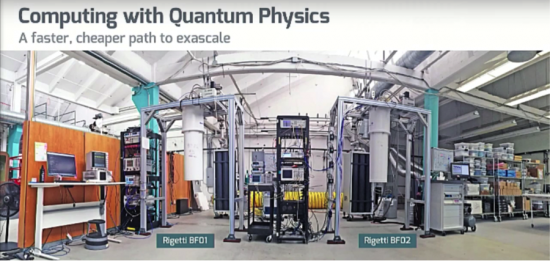
The big white cans about the size of a human are cooling systems, and inside each cooling system is a single quantum chip. In these machines today, there is a 5-qubit processor. The crazy part: A single chip with about 50 to 60 qubits on it would be more powerful than the entire Tianhe-2, a half-a-football-field-sized machine.
This is what quantum computing unlocks. Rigetti is rapidly developing quantum integrated circuits and the software platform that will allow developers to build on top of them. Along with efforts at Google, IBM, D-Wave, and many other companies and research labs around the world, we are rapidly approaching a quantum computing revolution. Get ready.
]]>


