FBCE studies mixtures of liquid and vapour in contact with heated surfaces of equipment for use in space. As cool liquids interact with hot surfaces, boiling and vaporization occur which reduces the heat load of the targeted equipment. The cycle goes from liquid to vaporization and through condensation back to a liquid state in a closed cycle.
For NASA, using flow boiling and condensation processes ensures optimal operational temperatures for its equipment for future space missions to the Moon, Mars and beyond. The end result is thermal optimization for critical components supporting human and robotic space missions.
The work for NASA is being done at Purdue University where a team is making flow boiling and condensation more efficient while at the same time reducing the form factor for the hardware needed to work on spaceships crewed by humans, robotic missions, and equipment used on the Moon and Mars.
Developing the technology is yielding a surprising application for us here on Earth that could be a significant breakthrough for the electric vehicle (EV) industry. EVs have range issues and require regular recharging. The charging stations require the EV operator to plug the vehicle into a charging outlet. This is done using an insulated charging cable through which the electric current flows. That produces a considerable amount of heat. The higher the current, the greater the heat.
A fast-charging station delivers up to 520 amperes of current versus 150-ampere chargers designed to recharge EVs today. The 520 ampere fast chargers can top up an EV battery in about 30 minutes. The cable used to connect the vehicle to the charge station is thick and heavy because it contains an outer shell of liquid coolant that envelops the wire directing the current to the battery. The coolant removes the excessive heat because without it a customer plugging in would be unable to hold the cable or remove it because it would be too hot to handle.
But what if you decided to increase the number of amperes flowing through the charging cable? The benefit of doing this would be a faster recharge. The number the industry wants to reach is 1,400 amperes, enough juice in the wire to recharge an EV in five minutes, or about the same amount of time it takes to fill a gas tank of an internal-combustion-engine driven vehicle.
How much and what type of coolant could allow you to make a cable that would still be manageable for an EV driver to stop, plug in, and in five minutes be on his or her way? This is where the Purdue University engineers doing the FCBE come in. They experimented with dielectric liquid coolants (liquids used as electrical insulators in high-voltage applications such as transformers, capacitors, powerlines and cables) that they pumped through charging cables. Trying various coolants allowed them to find one that delivered 4.6 times the charge at 2,400 amperes, a thousand amperes more than the 1,400 needed to charge an EV battery in five minutes.
The next step for the engineering team is to find an industrial partner or launch a spinoff to develop a commercial version of the cable. Subcooled flow boiling cables won’t be the first time an invention has come from a NASA-inspired and funded project. Think velcro, vacuum-packed foods, cordless vacuums, ear thermometers, memory foam, winglets on airplanes, and the proliferation of sensors in almost every industry, all first conceived from NASA-funded experiments and projects. But of all these many 20th and 21st-century innovations, I think the EV charging cable may prove to have the biggest impact although I must admit, my memory foam mattress that gives me a restful sleep each night would be a close second.
]]>The trick to fast charging is the voltage carrying capacity of the medium being used to recharge. Cables currently specified for use by EV manufacturers require between 20 minutes (fast charging stations) to hours depending on the type of charge station such as those installed in homes.
A byproduct of putting more charge through a cable is excess heat. Purdue’s team of engineers has been working on removing the heat by using coolants built around the charging wire within the cable. The trick has been to come up with a solution that is not bulky making it difficult for an EV owner to use.
The prototype patent-pending solution is a thin-wire charging cable that uses a liquid-to-vapour cooling wrapper around it and that is capable of accommodating a current of up to 2,400 amperes. Amperes are the common measure for rating electricity going through a wire.
The 2,400 exceeds the 1,400-ampere minimum needed by EVs to reduce charging times to five minutes. Compare that to current charging cable technology which can handle up to 520 amperes with most chargers at 150 amperes or less. Batteries and charging stations will have to be rated to 2,500 amperes before this technology goes commercial. If you are interested you can view a video describing the technology on YouTube.
In a press release issued by Purdue, Issam Mudawar, a professor of Mechanical Engineering whose laboratory has been the skunkworks for this new invention, states, “My lab specializes in coming up with solutions for situations where the amounts of heat that are produced are way beyond the capabilities of today’s technologies to remove.” His work with the Ford Motor Company may yield a commercial product within a few years, one that could be a game changer.
At Ford, Michael Degner, Senior Technical Leader, of research into advanced engineering noted that, “Ford is committed to making the transition to electrification easy. We are glad to work closely with Purdue’s research team, which has the potential to make electric vehicle and commercial fleet ownership even more appealing and accessible.”
The project speaks well of the ongoing creative innovation in collaborations between academia and the car industry to move away from internal combustion engine technology to EVs. Considering that it is Ford at the forefront of this transition is most interesting. In the company’s press release about the new cable, Ted Miller, Ford’s Manager of Electrification Subsystems and Power Supply Research states, “Ford has been actively involved in battery research and electric vehicles dating back to the days of Henry Ford and Thomas Edison.” And yet it was the Ford Motor Company’s early 20th-century fixation and standardization on vehicles using internal-combustion engine technology that killed one of its rivals at the time, the battery-powered electric car. And in choosing gasoline, a byproduct of the fossil fuel industry, Ford, to a great degree has contributed to the global warming we are all experiencing now.
]]>Project Drawdown, a global program designed to arm communities with the tools to mitigate climate change, talks about green and cool roofs. Green roofs involve applying soil and plants to rooftops for living insulation. Cool roofs use white paint to reflect up to 80% of the solar energy received back into space.
If we were to start painting the world’s roofs white now at a rate of 8 to 10% of the total annually and were to install green roofs at a slighter higher rate of 9 to 11% annually, by 2050 between 47 and 75 billion square metres (506 to 807 billion square feet) would be covered states Project Drawdown. The combination would reduce carbon emissions by between 0.6 and 1.1 gigatons. And lifetime operating savings on heating, cooling and maintenance would amount to between $330 and $593 billion US.
These calculations have been done with the current reflective white paints bouncing back 80% of the sunlight. But what if the reflective efficiency of the paint were to be improved? The pursuit of an inexpensive reflective technology in the form of paint has been undertaken by researchers at Purdue University in Indiana. They have created white paint that reflects 98.1% of sunlight. The paint is considerably better than anything on the market today and could become a practical way for homes and buildings to stay cool.
Xiulin Ruan is a Mechanical Engineer from Purdue University and co-author of the new study that describes the paint’s properties. He and his associates call their invention, Ultrawhite BaSO4. They describe their discovery in an April 15th, 2021 issue of the ACS Applied Materials & Interfaces Journal.
As reported by Scientific American, Ruan has stated, “Our model shows if you’re in, say, Reno, Nevada, or Phoenix, Arizona, you can save up to 70 to 80% on air conditioning in the summer” just by painting a home roof of 90 square metres (1,000 square feet) with their paint. If the building were to be clad in its entirety by the paint, it could even bleed heat away from the structure.
The key ingredient in the paint is barium sulphate nanoparticles in various sizes. The variety contributes to the scattering of light wavelengths. The materials are relatively inexpensive to produce and the paint can easily be commercialized. Ruan and his team have patented their formula and hope to bring it to market in the next two years. He noted, “it is a very affordable nanotech.”
In a separate BBC interview, Ruan states, “We estimate we would only need to paint 1% of the Earth’s surface with this paint — perhaps an area where no people live that is covered in rocks, and that could help fight the climate change trend.”
Barium sulphate is a powder derived from the mineral barite. Today it is primarily used as a compound added to fracking mud. Commercial deposits of the mineral are found in the United States, China, India, and Morocco.
]]>Professor of Agricultural Economics, Wally Tyner, states, “Some of the same groups that want to reduce greenhouse gas emissions also want to ban GMOs. But you can’t have it both ways. Planting GMO crops is an effective way for agriculture to lower its carbon footprint.”
The research was done using a modeling tool developed at Purdue called the Global Trade Analysis Project (GTAP-BIO). Two hypothetical scenarios were input into the model. These were:
GTAP-BIO predicted overall increases in food costs under a global ban. It also predicted the United States would be the biggest beneficiary of the ban since its agribusiness was significantly more robust than other countries. On the other hand China and other major crop importers would find themselves paying more for food.
Banning of GMO would lead to a 3.1 million hectare (7.7 million acre) increase in cropland.
To the best of my knowledge this is the first time researchers have made the case for GMO crops as a means of fighting climate change.The researchers were not surprised about the economic consequences of a GMO ban. It was the model’s prediction about greenhouse gas emissions that was the unexpected “eye-opener.”
Back in May of this year in an article appearing in Scientific American, the National Academy of Sciences, in a 400-page report, concluded that GMOs are not a danger to the environment or human health. The report also concluded that the significance of GMO in the fight to deal with climate change was specifically related to adapting crops to the changes global warming would bring. Richard Amasino, a member of the Academy who participated in writing the report stated, “If we had the basic knowledge to enable corn to grow at higher temperatures, then we’ve got a buffer to climate change. But do we understand the basic biochemistry of how that might work? No.” In their report which looked at over 1,000 scientific papers on GMO none indicated that GMO could actually reduce our global carbon footprint.
This just adds a new wrinkle to the ongoing debate pro and con related to GMO.

What is a microbot?
A very small robot that can be directed by operators through the use of electromagnetic fields. The size of these devices can be measured from as small as a few nanometers to several millimeters. Microbots can work alone or in groups exhibiting swarm behavior. In a swarm they communicate with each other and coordinate actions. It is all very sci-fi. Remember Michael Crichton’s “Prey?” The book told the story about microbots escaping from a laboratory and becoming a self-sustaining, self-reproducing, intelligence. You would think the story would have scared researchers from even considering developing the real thing.
But that hasn’t happened because microbots even in swarms are a useful technological innovation. It is their tininess that makes them so powerful. Microbots contain no on board means of locomotion, which begs the question, just how did Crichton’s microbots manage once outside the confines of their laboratory?
In the real world of microbots the technology responds to external magnetic fields. But unless an application requires all microbots to act the same, it would seem the devices would have little real world application. The trick, therefore, is to make each microbot work individually. That requires external magnetic controllers sensitive enough to manipulate each individual precisely without affecting others in the immediate surroundings.
That’s what engineers at Purdue University set out to do. They built a magnetic controller that can operate individual microbots within a group. They did this by creating tiny coils that alternate attractive and repulsive forces. This allowed them to manipulate individual 2 millimeter-sized microbots within a group. Now the team is working on the next generation of even smaller microbots measuing 250 micrometers (0.25 millimeters) in diamter. Their current success has been described in a paper appearing in this month’s issue of the journal Micromachines.

SRI International, whose Motobot (the motorcycle riding robot featured at this January’s Consumer Electronics Show) excited the crowd, has also been experimenting with magnetically-activated microbots. In a posted YouTube video SRI’s version of microbots can be seen crawling at real-time speeds of 35 centimeters per second. In another segment you watch microbots doing a variety of assembly tasks in a coordinated process. SRI sees these types of microbots as integral to manufacturing, building integrated circuits and smart structures.

But that’s not all, biomedical engineers are exploring how to manipulate robot molecules and use them as surgical instruments. They call their invention, nanorobots, tiny charged particles that work in concert within blood vessels. Applications include unblocking occluded arteries.
At Drexel University, MinJun Kim, is working with an international team from the United States, Switzerland and South Korea to perfect nanobots controlled by magnetic resonance imaging (MRI) machines. After all an MRI uses magnets to create images. This new MRI application turns the machines into command and control centers capable of steering molecule-sized nanobots through the bloodstream while watching them do their work.
Right now the nanobots are only being tested in animal studies. After these molecular machines blast through a clog in an artery they will swim away and biodegrade. If all goes well human clinical trials are expected to start in 2019.

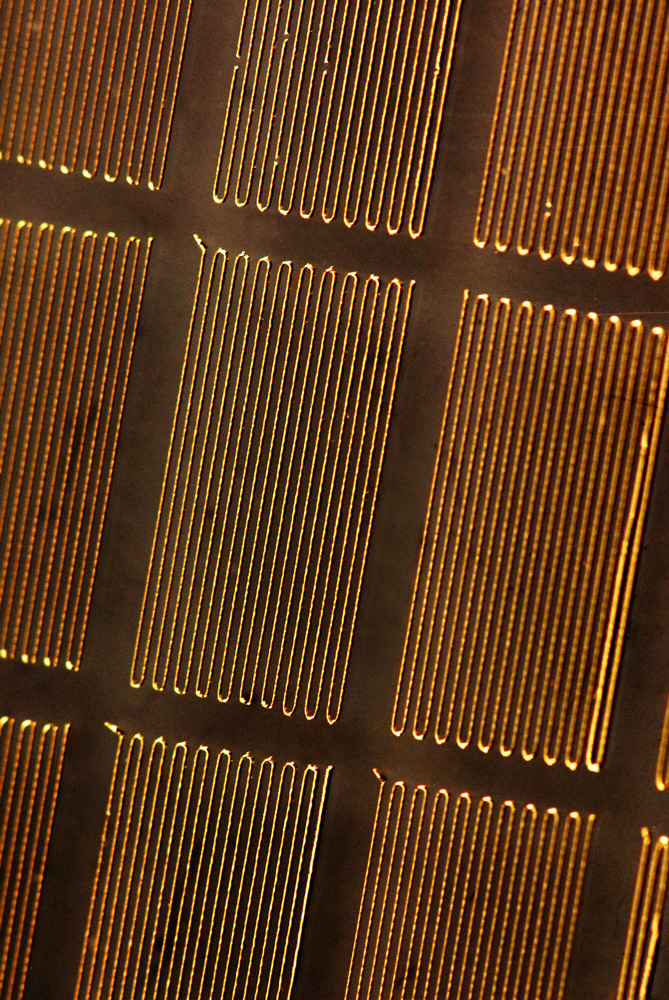
The findings were published in a research paper entitled Stretchable Electronics, appearing in the June 18, 2014 issue of the journal Advanced Functional Materials.
The alloy used is Gallium-Indium which when exposed to ambient conditions forms a Gallium-oxide skin that can be printed on a silicon-based elastomer, polydimethylsiloxane. The result is a sensing material that can be stretched as much as the substrate polymer upon which it is printed. The researchers claim the material with embedded sensors is capable of stretching 500% of its length.
That means you can make clothes with embedded sensors or a robot with a skin that feels just like ours. Could a Data be around the corner?