This week Google announced that the data was now available for all 50 U.S. states. Google’s research concluded that 79% of roofs across the country are viable for solar. In the states of Hawaii, Arizona, Nevada and New Mexico, 905 of homes had roofs suitable for installing panels. In more northerly states such as Pennsylvania, Maine and Minnesota, the results showed more than 60% of roofs were viable.
The city with the most solar potential is Houston with an estimated almost 19,000 Gigawatt-hours of rooftop solar capacity per year. The remainder of the top 5 includes Los Angeles, Phoenix, San Antonio and New York.
If you are contemplating installing solar panels then this is a must-see site. The data and computing resources Google has put into the project will help anyone calculate an optimal solar plan. Visit the site and enter your address and zip code to get a roof analysis which combines a number of data sources plus imagery and 3D modeling. Data sources other than Google’s imaging, modeling and shadow casting include:
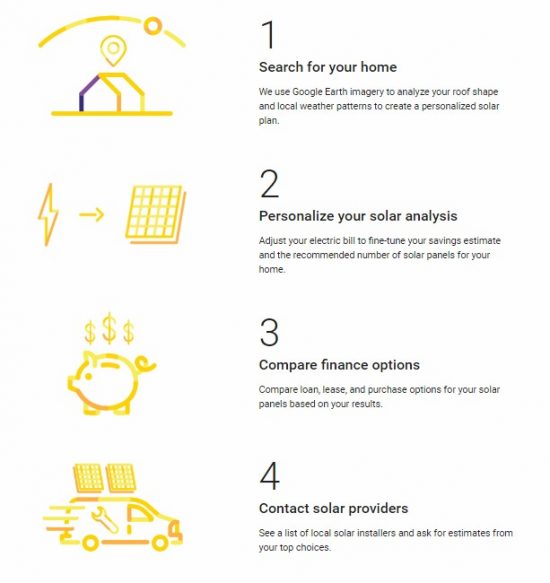
The end result is an accurate picture of the solar energy potential of a home or building that takes into account, not just the shadows cast by trees and nearby buildings, but also the position of the Sun year round and historical cloud and temperature pattern data.
Project Sunroof calculates the optimal energy footprint for a roof and runs the numbers on the price of panels, purchase options such as leasing, loan or cash, and produces a final cost. The application includes taxes and tax credits, both federal and state, utility rebates, renewable energy credits and net metering. There is even a database of solar providers who can install and service the panels.
Google’s plan is to map the solar energy potential of the entire globe. We will keep an eye on the rollout of this effort.

]]>
For those looking at solar as an alternative to the way they get energy today they need to determine if their roof has sufficient solar capacity based on a number of variables. Certified solar installers can make these calculations but it involves someone coming to your home, climbing on your roof, and scrutinizing your current energy consumption. Can they miss something in their evaluation? Absolutely. It could be a newly planted neighbour’s tree that in three years will block a section of your roof from receiving direct sunlight. It could be they don’t have access to detailed weather information to determine the number of cold weather and cloud days.
Enter Project Sunroof. Currently only available in San Francisco and Fresno in California, and Boston in Massachusetts, this Google initiative provides an online tool that uses the same high-resolution images found on the application Google Earth as well as information contained in a number of databases to calculate a roof’s solar energy potential. No one calls. All you do is enter your address on the website and Project Sunroof does the rest.

The application calculates the amount of sunlight your roof receives over a year. It does this combining aerial imagery and maps, database information, 3D modeling, checking out shadows from nearby structures and trees, determining roof sun angles through the year, and reviewing the history of cloud and temperature patterns in your location. It then recommends an installation capable of generating up to 100% of your electricity needs based current electricity consumption and roof solar capacity. The application also provides up-to-date solar industry pricing plus information on leasing or buying. It calculates taxes, rebates, and net metering credits offered by your local energy company. And if requested it will connect you to reputable solar installers in your neighbourhood.
For the moment Project Sunroof is a pilot going through a shakedown test. But it soon may be coming to your city to help you make the decision to go solar or not.


