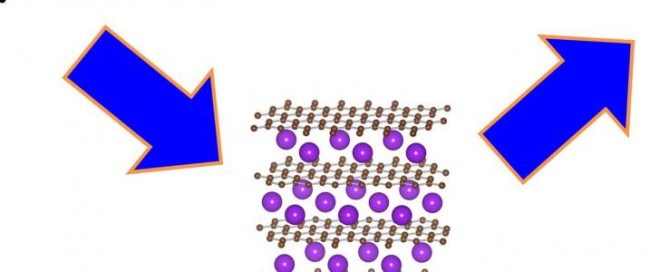
Nikhil Koratkar, Professor of Mechanical, Aerospace, and Nuclear Engineering at Rensselaer describes their invention, a potassium-ion battery that “could offer a sustainable and low-cost alternative to the incumbent.” Koratkar and his research team have published the results in PNAS, and if you don’t have a subscription you can still access the content here.
Potassium is a larger, heavier and less energy-dense element than lithium. It also when used as an anode can result in accumulations of what are called dendrites on the surface through repeated charge and discharge cycles, eventually causing the battery terminals to short out, overheat, or catch fire. This occasionally happens with lithium-ion when the insulating membrane that separates the electrodes is imperfect either from a manufacturing defect or later damage. We’ve seen the videos of smartphones, laptops, and even Tesla sedans going up in smoke.
So how has the Rensselaer team overcome the dendrites getting big? They operate the battery at a high charge and discharge which creates a uniform temperature rise that allows the anodes to self-heal smoothing the dendrites. When the battery is not in use a built-in safeguard monitors the self-healing process ensuring the battery can continue to function through thousands of charge and discharge cycles.
Koratkar believes there needs to be a shift away from lithium to metal batteries. He states, “Metal batteries are the most efficient way to construct a battery.” If the dendrite problem can be resolved, and it appears that it has, then potassium could become the next material standard for battery technology.
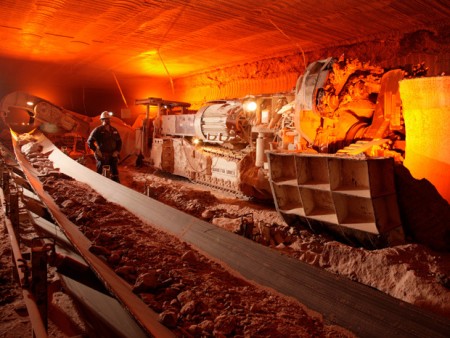
Both potassium and lithium are alkali metals. Potassium, however, has some distinct advantages. For one it is the seventh most abundant element in the Earth’s crust 343 times more common than lithium. Potassium in the form of potash is mined extensively in Canada with the country producing in 2018, 22.7 million tons. Compare that to lithium which has estimated total reserves of between 18 and 40 million tons. We may not run out of lithium, but abundant potassium has a good case for becoming an alternative for batteries.
The advantages we can gain with a potassium-ion battery alternative to lithium-ion for EVs and backup storage for renewable energy sources, would help us to decarbonize faster, reduce greenhouse gas emissions, and mitigate the worst effects of climate change.

]]>
So there is nothing new about potassium other than the fact that the Oregon State researchers have put an old scientific bugbear to bed, that potassium could not be combined with graphite. Xiulei Ji, the lead researcher in the Chemistry Department at Oregon State remarks, “for decades, people have assumed that potassium couldn’t work with graphite or other bulk carbon anodes in a battery….That assumption is incorrect. It’s really shocking that no one ever reported on this issue for 83 years.” The 83 year reference goes back to earlier research in the 1930s that was abandoned.
The implications of a commercial potassium-ion battery are enormous. The abundance of the material makes it a much better candidate for the mass production of rechargeable batteries than lithium. It can approximate the energy density of the latter. It can match the charge and discharge cycles. And it should be a lot cheaper to make.
The university is seeking commercial partners to help turn their laboratory prototype into a finished product. This could prove to be a battery game breaker with implications for mobile devices, automobiles, and residential and commercial utility storage.