Lignin occurs in two types of plant cells – fiber and vessels. The fiber cells provide structure. The vessel cells provide the conduits that channel fluids through the plant. Together they make up as much as 25% of plant biomass. Researchers are experimenting with genetic modifications to these cells eliminating a key gene responsible for lignin. The problem, however, is any modification affects the structural integrity of the plant as well as the water transport system which allows the plant to receive nutrients and grow.
So which cells would researchers want to genetically modify? Certainly not the vessel cells because that would negatively affect growth and viability. But the fiber cells could be modified selectively in some areas of the plant where structural integrity would not matter.
Why do this? Because producing cellulosic ethanol today is not cheap. Companies in the field have found pretreatment, that is cooking the biomass in a hot acid bath to break down lignin to cellulose to sugar, to be very expensive. The process which is called pulping involves too many chemical additives and too many steps.
In a previous blog I wrote about switch grass as a viable biofuel source. It contains lots of lignin. Researchers at Lawrence Berkeley National Laboratory have shown that they can selectively target the plants’ lignin content in specific areas without affecting the overall structural integrity of the stems, stalks and vessel cells. If this can be made to work then switch grass and poplar may replace corn as principle biofuel crops.
Currently corn ethanol costs 55 cents a liter or $2.50 U.S. a gallon to produce. With genetic modifications cellulosic ethanol production could reduce the production cost of a liter of ethanol from biomass by 26 cents or a $1 per gallon U.S. That may not seem like a lot but right now every liter of gas sold in Canada and every gallon in the U.S. contains today ethanol costs are heavily subsidized in the United States and other countries by tax incentives to encourage production.

Humanity discovered how to control fire hundreds of thousands of years ago with wood and dung our primary fuel sources. Tens of thousands of years ago our ancestors discovered that wood could be converted to charcoal. Peat fires to this day are still a principle heating source in parts of the world. And animal dung provides humans living in desert regions with an alternative to wood.
Humanity has also grown crops and converted them to fuel. Olive oil lit the lamps of Greek and Roman antiquity.
The age of whaling provided whale oil for lamps burning in the homes of European and North America well into the 19th century.
I found this Henry Ford quote that goes back to 1925.
“There is enough alcohol in one year’s yield of a hectare of potatoes to drive the machinery necessary to cultivate the field for a hundred years.”
In World War II, Germany took Henry Ford’s advice and partly fueled their transportation and industry using alcohol derived from potatoes.
In that same war Great Britain experimented with grain-derived alcohol as a fuel for its war industries.
To this day 9-10% of human energy consumption comes from the burning of biomass for heating and cooking. And the two primary sources remain animal dung and wood.
The Biofuel Dilemma Today

Creating biofuels today Brazil, the United States, and other countries are using soybeans, corn, sugarcane, sugar beets and other crops instead of potatoes and grain (Germany and Britain’s experiment) to create ethanol, an alcohol-based fuel. The harvesting of these crops for fuel is changing the mix of what farmers in the Western World grow today and will be growing in greater quantities for the forseeable future. That’s because in a world where population growth is driving the need for greater food production, and energy demand is driving biofuel development, farmers are finding themselves asking the following question.
“Should I grow more food, feed or biofuel crops?”
The argument for food is obvious. The Developing World lacks the capacity to deliver enough domestically grown food to meet population demand. China, India, most of Africa, Southwest Asia and Russia are net importers of food.
The argument for feed seems obvious as well. The increasing demand for meat and dairy products in the Developing World and the continuing demand in the Developed World represents a thriving export and domestic opportunity for countries such as the United States, Canada, Australia, Argentina and those in Western Europe.
The argument for biofuel is more about geopolitics and security. In the United States and Europe, biofuel production means less dependence on imported oil for energy use. For the United States, corn represents the primary biofuel source. Corn usage for ethanol has increased annually for a number of years at a rate greater than the total national corn yield.
The second largest North American source for biofuel is vegetable oils. One-third of all the Canola grown in Europe and North America is used for industrial lubricants or biodiesel. Soybeans, largely grown for domestic and foreign food consumption, are being converted to oil for industrial use.
In the Farm Foundation Issue Report – What’s Driving food Prices in 2011? it reports on changes in agricultural land use from 2005-2006 to 2010-2011. Most significantly, the top three crops are those being grown for ethanol, biodiesel and industry.
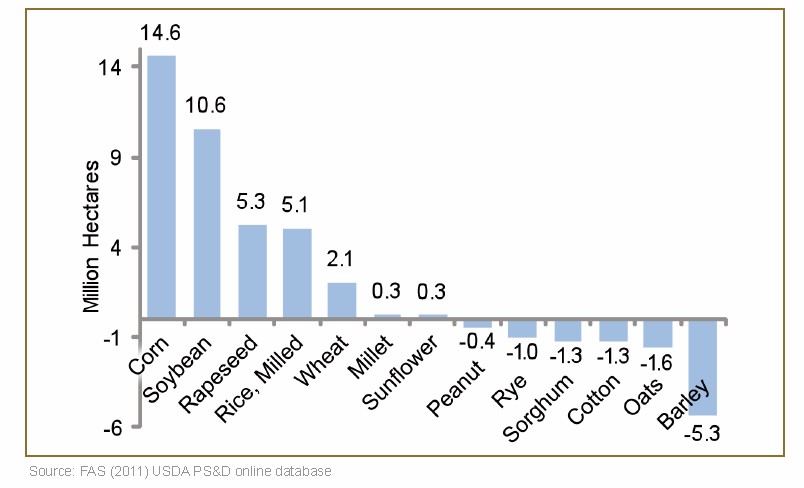
American energy policy contributes dramatically to the growth in demand for biofuels. In 2010 corn-based ethanol production in the United States reached 13 billion gallons. The corn-based ethanol target for 2015 is 15 billion gallons. The U.S. government has set a target of 36 billion gallons by 2022.
A 2009 feasibility study by the Sandia National Laboratories in Livermore, California, looks at achieving a target of 90 billion gallons of ethanol by 2030, of which 75 billion gallons would come from non-food crops and 15 billion from corn, soybean and other food or feed crops. Farm-based biofuel sources included agricultural residue such as corn stover and wheat straw. Farms could also harvest switchgrass and short-rotation woody crops such as poplar and willow.
Biofuel’s Near Future – the Next 20 Years
Cellulosic Ethanol
The Sandia study sees almost all of the capacity for biofuel growth coming from cellulose. Cellulosic ethanol can be derived from low-value residue of industrial processes such as sawdust and scrap wood. Add to this the byproduct residue of farming and the harvesting of woody shrubs and grasses from land not under cultivation. In deriving ethanol from “waste” sources the competitive dilemma for farmers to choose among food, feed and biofuel crop production is mitigated. The pressure to plant more traditional crops on marginal land goes away.
Cellulosic ethanol production has its challenges. Producers need to find an economical way to break down the woody fibres, called lignin, to get to the cellulose to convert it to sugars and ultimately ethanol. By studying the digestive processes of herbivores such as cattle, or studying the way termites break down wood fibre, scientists are developing better conversion processes. The first large-scale cellulosic ethanol plants in North America are expected to come on stream in 2013 able to pump out several million gallons. Getting to 75 billion gallons from this source requires continuous investment.
Algenol
Creating ethanol from algae, called algenol, represents another biofuel option that takes the farm out of the energy production equation. The process involves growing algae in waste water, seawater and brackish water near existing manufacturing or fossil-fuel power plants where CO2 is a byproduct. Capturing and pumping the CO2 into the water along with exposure to sunlight generates algae growth with ethanol the byproduct. Called photobioreactors, these facilities can be located anywhere human activity is generating sufficient CO2 output to justify putting an algae-to-ethanol generator in place. One company in the forefront of commercializing algae-t0-ethanol is aptly named Algenol. Their goal is 20 billion gallons per year of ethanol by 2030.
Biodiesel
Biodiesel is another biofuel that can be produced from soybeans and other agricultural products. But biodiesel can also be produced in very novel ways, from the left over vegetable oil in a deep fryer, from kitchen grease, from rendered animal fats, and what typically is seen generally as waste oil.
Biodiesel has several advantages over other biofuels. It is biodegradable. It helps take care of waste oils that normally get dumped into domestic water supplies or landfill as garbage. It is less toxic and provides fewer emissions than conventional diesel fuel.
Germany and the United States are the world leaders in the production of biodiesel. In 2005 the United States produced 75 million gallons. Comparably Germany in 2006 reported sales figures of 600 million gallons. American output was forecast to reach 1-2 billion gallons by 2010.
Worldwide Biofuel Growth
In 2010 global biofuel production equaled 54.6 million gallons per day. This number is expected to more than double to 113.4 million gallons per day by 2030. Biofuels will generate 8.5% of global energy by 2030, up from 7.7% in 2005.
]]>