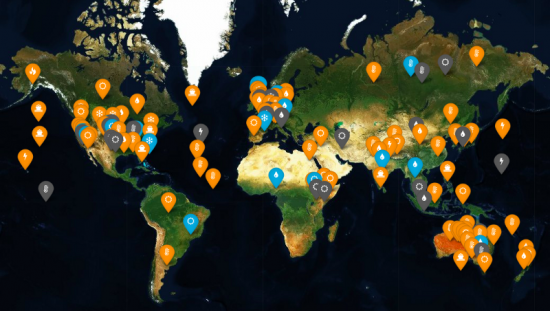
March 3, 2018 – The above map of the world attempts to illustrate the effects human activity is having on global climate. The map is the creation of Carbon Brief, a United Kingdom-based organization that covers climate science, and climate and energy policy. In 2017 its web presence was recognized by the Online Media Awards as the Best Specialist Site for Journalism.
All indicators highlighted on the map represent extreme weather occurrences. The ones in orange, the overwhelming majority, have been attributed to human influence. The ones in blue have no human influence attached to their occurrence. The grey ones are inconclusive.
The countries most affected by human-influenced extreme weather appear to be the United States and Australia. This attribution is not necessarily a reflection of a concentration of extreme events, but rather better scientific reporting in the affected countries. For example, Australian scientists are big into heatwave studies. Almost a quarter, 24%, of heatwave events are represented in the concentration of orange seen on the map. In only one case have scientists concluded that there was no human-causal link, and that was in the city of Melbourne, although as part of that study, the city of Adelaide further west indicated extreme weather influence from human activity.
The data points here represent 144 weather events compiled from 138 separate scientific papers. Of these, 68% have been made more severe because of human influences on climate. Nearly half, 46% of these events are related to heat. Heavy rainfall and floods represent 14%. Droughts make up 21%.
It should be understood that the human contribution to a weather event does not mean that humans caused the recorded extreme. And if an extreme event occurred in an area it doesn’t mean that there is a greater likelihood of a repeat each year.
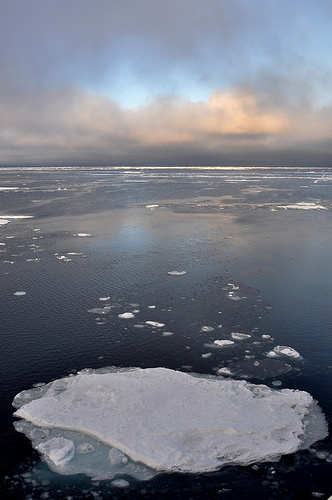
Also note that there are no site markings in the extreme north above the Arctic Circle where sea ice melt is associated with changing conditions there, along with speculation related to occurrences of polar vortices in areas where they are not commonly seen. For example, the current “Beast from the East” plaguing Europe, a winter storm so severe in this last week that it is bringing the business of the continent to a halt. Could this be human-influenced, a consequence of a warming world ocean escalating Arctic sea ice to retreat, and causing Jet Stream oscillations that draw down colder air to places where it infrequently occurs?
How bizarre is this latest European weather event? In February the extreme north on nine separate days experienced above zero Celsius temperatures, 30 degrees warmer than the norm in the Arctic winter. This warm air intrusion during a period of winter darkness also led to record warmth in Siberia with temperatures as much as 35 Celsius above average. The northern tip of Greenland remained above freezing for 61 hours, three times longer than in any previous year.
The displacement of cold air by warmer air in the Arctic ended up pushing the former into Europe and parts of North America. Where the latter has experienced these polar vortices in recent years, the phenomenon is new to Europe. And not only does cold air displace the warm air, it also alters wind patterns. In the case of the latest European storms, westerly winds have been reversed to become easterly.
In the United States, weather forecasters blame air from Canada when a polar vortex arrives. In Europe, the blame game looks at two culprits. First, there is the Siberia effect, and second, Scandinavia, where the cold high pressure, normally over the North Pole, now firmly has implanted itself over Norway, Sweden, and Finland.
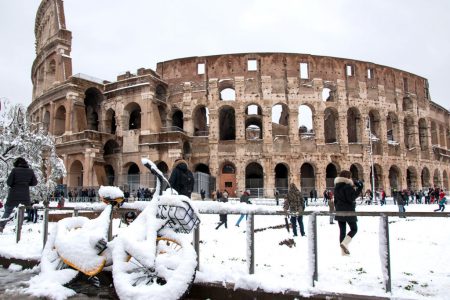
As Arctic sea ice continues to disappear the Jet Stream will be further weakened allowing cold air to drop into the mid-latitudes in the Northern Hemisphere. For climate skeptics, who point to every low temperature as validating their arguments that global warming is a fiction, polar vortices represent ammunition. The nonsense of this only becomes apparent when climatologists describe the correlation of changes to the Jet Stream from rising ocean temperatures globally and particularly in the Arctic. The warming ocean correlates with the increased warming of the air above it from the tropics to the mid-latitudes. This warming extends throughout the entire vertical water column to the ocean depths. Combined with the warming is the increased amount of carbon entering the world ocean absorbed from increases in carbon dioxide in the atmosphere. It’s all interconnected and only the foolish and blind-sighted don’t see the correlation to human activity.
Global warming describes the phenomena of rising mean average temperatures observed over the last several decades. It is not necessarily attributed to human impact. The term was first associated with climate change when it appeared in a scientific paper published in 1975. This was also the first time the term climate change was introduced. The term global warming became the predominant one related to changing climate in 1988 when James Hansen, a NASA scientist, used it when reporting to Congress stating, “Global warming has reached a level such that we can ascribe with a high degree of confidence a cause and effect relationship between the greenhouse effect and the observed warming.”
Now climate change is much more than global warming. In the human context it refers to the total impact of carbon pollution in the atmosphere and oceans of the planet and looks at changes to wind patterns, ocean currents, precipitation and storm frequency as well as temperatures.
Climate change explains cold as well as warm. For example the polar vortex that impacted North America and Europe in past winters is an intensification of the impact of climate change on wind currents. The winter of 2014/15 when the Northeast of the United States and Canada experienced extreme cold is associated with destabilization of the normal wind pattern of the Jet Stream. The dominant upper atmosphere wind current weakened and became wavy with the condition persisting for weeks. Instead of a strong flow from west to east, it meandered in a wavy pattern that wandered from north to south and even split in two. In 2015/16, the El Nino in the Pacific reversed the impact of the polar vortex leading to a much milder winter in the same areas of North America.
Whether the term global warming or climate change gets used, today, most of us see them as interchangeable. But neither term got mentioned much when the American Presidential debates ran in the last two months. No moderators asked about the subject or used the terms in any of their questions. Some argue that this lack of coverage was entirely consistent with American polling on the subject of national priorities where climate change or global warming don’t make it into the top 10. In fact in recent polls Americans who perceive global warming and climate change as a serious threat declined to only 57% of those surveyed. Americans who said they were worried about climate change – up 9% to 64% from 55% in 2015.
So if the media isn’t asking does it reflect the same degree of complacency found in the public? Not really. In this case considering the United States has signed on to the Paris Climate Agreement of December 2015, it would have been appropriate to ask the candidates how they intended to meet the target carbon reductions promised by the current government of the United States.

]]>
Climate change isn’t today’s or tomorrow’s weather. Climate change is the analysis of the dynamic changes in our physical world and its surroundings. Climate change looks at our Sun’s energy output, at Earth’s axial wobble, at atmospheric composition, at ocean currents and thermodynamics, at changes to planetary biomass. Climate change models all of these variables and creates simulations that cover years and decades, not days.
Sometimes even the best scientists confuse us all when they point to a hurricane and say “this is evidence of climate change.” A single hurricane is not! A trend over decades that tracks changes to hurricane frequency and intensity may very well be!
In the December 2014 issue of Scientific American, an article entitled “The Jet Stream is Getting Weird“ explains the winter of 2013-14 polar vortex as a weird change in the pattern and flow of the polar jet stream.
If you are not familiar with the jet stream it is an ever present wind that circles our globe some 9 to 14 kilometers (approximately 5.6 to 8.7 miles) above the surface of the Earth. There are two of these in each of the northern and southern hemisphere. One is located at high latitudes and the second in the mid-to-low latitudes.
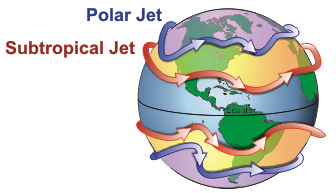
Our weather experiences are largely the product of systems that follow the path of these jet streams. Just look at any weather map (see below) and where you see ridges of high pressure and troughs of low pressure you can impose on that same map the jet stream (seen in blue) in lock step.
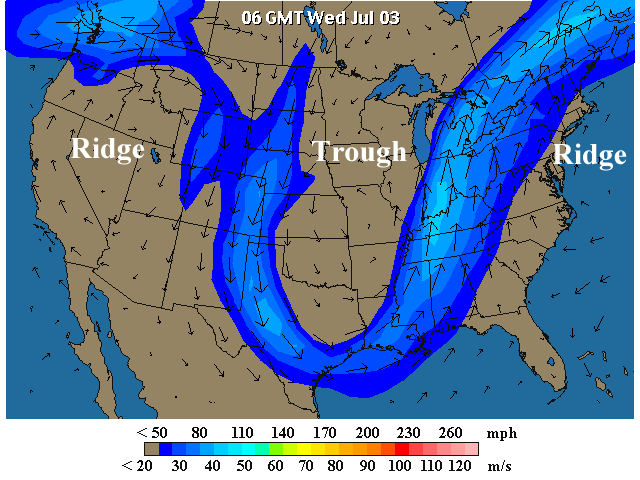
The one closer to the poles is the subject of the Scientific American article. It describes a jet stream contorted beyond anything previously measured leading to “outlandish weather.” The Polar Vortex of last winter that dropped temperatures in Eastern North America to the point that the Great Lakes almost froze in entirety, a very rare event, is blamed on a stalled jet stream that maintained a weird weather pattern for weeks on end.

Is a stalled contorted jet stream an indicator of climate change? It may very well be. That’s because big atmospheric forces influence it and the persistence of an altered pattern in its track could be symptomatic of our altering atmosphere. But it also may be a symptom of the cyclic nature of a number of variables such as solar intensity, axial wobble and phenomena such as the El Nino and La Nina events which occur every few years in the western Pacific Ocean and subsequently set off a chain reaction that impacts North America.
The Polar Vortex of last winter and the changing pattern of the jet stream were more than coincidence. The cause remains controversial. Was the melting of Arctic Ocean sea ice primarily responsible? Meteorologists have noted in numerous studies that Arctic amplification of the atmosphere in northern latitudes has been in evidence for the last 15 years. But there is no consensus as of yet that this is derived directly from the shrinking summer sea ice. That’s because the observed energy gained in the atmosphere from increased warmth over the open sections of the Arctic Ocean is not seen to be sufficient enough to drive the kind of changes observed in the wobbling of the jet stream. It could just be natural variability. After all North America and Central Asia have experienced long winter cold snaps in the past.
So this is where it gets hard to determine if what we saw last winter was weather or climate change. We need more data observed over a longer period to make the call.

Is the pace of a melting land-based ice on Greenland and the trend of declining Arctic sea ice responsible? As one climate scientist recently stated, “What happens in the Arctic doesn’t stay in the Arctic.” And climate models are confirming this.
According to a study by the Atmosphere and Ocean Research Institute at the University of Tokyo, there is a distinct connection between freaky cold weather in the Northern Hemisphere and Arctic ice loss. The study appeared in the journal, Nature Geoscience on October 26, 2014. Its conclusions, that global warming is doubling the risk of extreme winters in North America and Eurasia. The study involved simulations from 22 climate models.
What do the simulations show?
Coincidentally the models match observed weather. Hence confidence in using them to predict likely long term climate effects.
So Toronto getting a blast of winter earlier shouldn’t be a surprise. And based on what the long-term weather forecasts are predicting, fall right in line with the climate models and simulations.
And scientists who do these climate simulations also point out that sometimes all we are witnessing is natural variability which may have nothing to do with sea ice decline.
Some climatologists argue that the Arctic Ocean is too small an area and the sea ice decline not significant enough to be responsible for the movement of cold air masses in the way we are presently observing. They seek another explanation, that this is just a freaky series of weather events coincident with declining sea ice cover but not caused by it. Could it be natural variability, and if not, could changes in solar radiation levels, cosmic rays, volcanic eruptions, wind patterns and oceanic heat transport be the potential cause or causes?
No scientists, however, have yet to find the smoking gun for any other explanation and until they do, the prevailing opinion is the warming atmosphere caused by greenhouse gases (GHGs) is the only clear and plausible correlation. And that the carbon dioxide, methane, and other GHGs are largely coming from human industrial and extractive processes, and not from nature.
He goes to describe a prevailing theory that explains last winter’s polar vortex (see below a sample of last winter in the weather map from mid-January 2014) that hung over much of eastern North America. That theory is known as Arctic amplification. It hypothesizes that Arctic warming being greater than lower latitudes is altering the flow of the jet stream resulting in cold extremes being pushed south.

But the data in the study points to something very different. Overall it appears that cold pulses are actually on the decrease in the mid-latitudes of Northern Hemisphere and that Arctic amplification is actually reducing seasonal temperature variance. That’s because atmospheric circulation patterns point out that northerly winds and associated cold days are getting warmer far more rapidly than southerly winds and warm days. In the article Screen’s actual words state, “cold days tend to occur when the wind is blowing from the north, bringing Arctic air south into the mid-latitudes. Because the Arctic air is warming so rapidly these cold days are now less cold than they were in the past.”
The mathematical models Screen has developed indicate a trend that should continue into the future predicting declining temperature variability in cold months but not in the summer. One caveat to all of this. The Arctic represents a very complex Earth climate system and no mathematical model to date fully reflects all the linkages and variables related to sea ice loss, reduced snow coverage, permafrost melt and methane emissions as well as atmospheric circulation. So much more work needs to be done before we can be absolutely certain that Screen’s predictions will actually be right on.
But for those of us who endured one of Eastern North America’s coldest winters of late, Toronto’s second coldest in 25 years, we may take hope that future winters won’t approach the severity of this last one.

“The entire United States, including Alaska, covers less than 2 percent of the surface of the earth. So if the whole country somehow froze solid one January, that would not move the needle on global temperatures much at all.”
The weather outside may be dreadful in the eastern part of North America this winter but it is no more dreadful than the winters I remember in the 1970s when the Ohio River and Upper Mississippi froze making the shipping of coal and other goods more difficult in the American heartland. And there were a few winters in the 1980s that seemed pretty brutal as well.
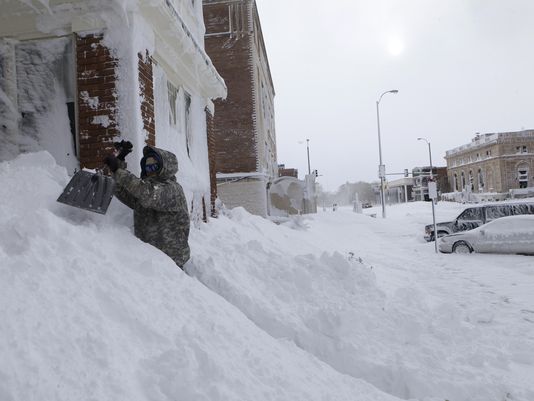
But this is North America and not all parts are experiencing climate change denying cold. California is warm and until the last couple of weeks suffering from a prolonged drought. Alaska is warmer than normal as is the Yukon, its neighbour. Australia is roasting and Sub-Saharan Africa is experiencing prolonged drought. Europe’s winter has been fairly benign. So the weather of North America is hardly a basis for judging the entire planet’s climate. The truth is weather is not climate and the climate skeptics should be reminded of this every time they point to a cold day in the middle of winter to support their positions.
I write a lot about climate change and the evidence being gathered to support those reports from the International Panel on Climate Change, the IPCC. I often point out that climate models are imprecise and that we are still learning about the subtle nuances of the Earth environment through the continous collection of vast amounts of climate data. Just in the last two days I have written about aerosols and trade winds and how they can alter climate from decades to millennia.
Incorporating what we learn from these new studies will make our climate models better in the future so that we can better assess the impact of our contribution to the atmosphere, industrial CO2 and other greenhouse gases.
By no means would any climatologist tell you that we have mastered the entire picture of our planet’s climate. But they will express with confidence that there is enough data now to point to human influence on the atmosphere and ocean that warrants considerable concern about the future well being of our species and the others here on Earth.
A final comment for those still convinced that we will see an Ice Age before we see the Arctic Ocean melt and much of Antarctica’s ice fields slip into the Southern Ocean. In today’s New York Times article there is a reminder of just how short our memories are about past weather here in North America. Here is one quote:
“In the winter of 1976-77……the temperature in Chicago stayed below freezing for 43 days straight, and in 1985 the city had a below-freezing stretch of 40 days. The longest stretch [of below freezing] so far this winter was 11 days. Similarly, New York’s longest stretch below freezing this year has been six days, less than half as long as the freezing periods in the 1970s.”
From sunny Florida, the only place in Eastern North America that is warm this week, I am Len Rosen, your science and technology blogger.


