
How To Mine A £60 Trillion Asteroid by Fuel Fighter.
Those ideas have ebbed as the commercialization of outer space is taking hold first in the United States, and now in other nascent space programs in other countries. In particular, a number of private companies have become competitors to national space agencies and their previous monopoly in outer space. Space to be used for the benefit of all mankind, as first proposed in the 1960s, has now added a bottom line.
In 2015 the United States Congress passed legislation giving commercial companies the right to appropriate resources from space. Two laws, the Space Resource Exploration and Utilization Act, and the Commercial Space Launch Competitiveness Act, give American companies the right to exploit space resources including the mining and harvesting of minerals and water from the Moon, asteroids, and planets. The only exemption is the biology discovered. The latter of the two acts specifically states, “A U.S. citizen engaged in commercial recovery of an asteroid resource or a space resource shall be entitled to any asteroid resource or space resource obtained, including to possess, own, transport, use, and sell it according to applicable law, including U.S. international obligations.”
These laws reverse the American commitment to the Moon treaty of 1979 which forbade countries from exploiting our nearest space neighbour as well as planets and asteroids until an international agreement on common use was enacted. It would appear an international agreement is no longer likely, particularly in light of the rise of private companies focused on commercial space development. From commercial satellites in near-Earth to geostationary orbits around our planet, to robot miners of asteroids, it is not such a dramatic leap.
So it should be no surprise that America’s abandonment of space inviolability is being joined by others of which the first is the Grand Duchy of Luxembourg, the European Union’s tiniest member. This week Luxembourg enacted a new law with Article 1 stating, “Space resources are capable of being appropriated.” Responsibility for issuing permits comes from Ministries in charge of economic development and space activities. They are authorized to issue permits to any person requesting the right to explore and “use space resources for commercial purposes.” Rights will be granted to public companies, corporate partnerships, and private limited liability companies registered in Luxembourg.
One of those registered Luxembourg companies is Planetary Resources, founded in 2009. The government, along with the Société Nationale de Crédit et d’Investissement, a Luxembourg bank, has made a 12 million Euros investment and extended a 13 million Euros grant to this American company that now has its European headquarters in Luxembourg. Established in 2009, Planetary Resources describes asteroids as the resource that will “unlock the Solar System’s economy.”
The company intends to utilize space resources, particularly near-Earth asteroids, described as the “low-hanging fruit” of the Solar System. The focus will be on harvesting water and platinum. Water is seen as a space game changer for human presence in space. It can be drunk. It can serve as shielding for space habitations. In its molecular components, hydrogen can be exploited for fuel, while oxygen for life support.
Planetary Resources is sending out robotic explorers to identify asteroids rich in minerals, particularly platinum, which on Earth is found at asteroid impact sites or is a product of volcanic eruptions. Platinum has many uses here on Earth and creating an almost unlimited supply will spur an era of innovation in advanced manufacturing.
So it would seem that Luxembourg’s new space appropriation law serves the country well. After all, they are creating a law to protect their investment.
]]>
They plan to provide a year in review, current developments of their Arkyd series of spacecraft, (telescopes, interceptors, prospectors and extractors) and future plans for exploring, prospecting and mining.
Planetary Resources intends to exploit what it calls the “low-hanging fruit” of the Solar System. The “fruit” are the Near Earth Asteroids or NEOs. There are close to 9,000 known NEOs with 1,000 new ones discovered every year. Using low-cost robotic spacecraft the company intends to assess NEOs for composition and accessibility and then begin to visit, with robotic mining technology, those deemed commercially viable.
Mining in space will be a lot different from mining here on Earth. For instance the most precious resource the company will seek immediately is water. Water in the form of ice is abundant in asteroids. For example, Ceres, the largest of the asteroids in the Asteroid Belt is almost certainly almost entirely ice. But although the Dawn spacecraft may go and study Ceres, Planetary Resources isn’t interested that much in the science associated with such an asteroid mission. Instead its goal will be to turn smaller icy NEOs it assesses and visits into life supporting materials (water and oxygen) as well as hydrogen fuel for future missions. And for stony, metallic NEOs it assays, it plans to use the materials and precious metals it extracts to fund its operations and build a space infrastructure, and do it all at a handsome profit.
So if you want to hear first hand from Planetary Resources on their first anniversary send your RSVP and listen in on Wednesday.

]]>
Russia’s Revived Space Program
The Russian announcements indicate that Roscosmos intends to make a significant new investment, 2.1 trillion rubles (almost $70 billion U.S.) between now and 2020. Some of that money will be allocated to building a new delivery system for human space flight to replace the Soyuz capsule and launch vehicle. Russia’s Soyuz and R-7 rocket have been the backbone of their human space program for 50 years. And today Soyuz remains the primary way flight crews get to and leave the International Space Station (ISS). Russia’s launch capability started to show cracks with the loss of one Soyuz resupply vessel in August 2011, leading to the delay of subsequent flight crew missions. Although sketchy on details, Russia plans to have a new propulsion system and transportation module ready for testing by 2018 with full deployment for human space missions by 2020.
Russia is also getting back into the business of sending robotic spacecraft to the Moon and Mars. The first new Moon mission in 42 years is planned for 2015 and will be followed by others over the next five years. Russia is opening a new space city called Cosmodrome Vostochny and the first Luna-Glob will be sent to the Moon from there. The launcher will continue to be the same as those currently used for Soyuz missions. The Luna-Glob will test a new surface landing system. Russian scientists have chosen six lunar landing sites for future missions. And one planned for 2017 will be a joint Russian-Indian module called Luna-Resurs. For Mars where Russia and its predecessor, the Soviet Union, have had little success, the next effort to get to the planet will be a joint one with ESA planned to arrive in 2016. This will be followed by a joint effort to land a rover like Curiosity in 2018. And ultimately Russia intends to send humans to the Moon to establish a lunar base (see image below).

NASA Finds Partnership Works for Them
NASA and ESA signed an agreement this month calling for ESA to build the service module for Orion, the space capsule touted for future Deep Space missions with humans aboard. The service module hardware seen in the artist rendering below will include propulsion, power, thermal control, water, air and other essential supplies for supporting the crew and capsule. The first Orion test flight is scheduled for 2014 with plans to send an unmanned capsule 5,800 kilometers (3,600 miles) into space. The service module will get its first test in 2017 when NASA plans to send the first Space Launch System (SLS) rocket in an unmanned flight to circle the Moon and return to Earth. Human flights to the Moon and back on Orion are currently scheduled for 2021 with flights to Near Earth Asteroids (NEA) planned for the mid-2020s. Add this announcement to last weeks when NASA awarded Bigelow Aerospace a substantial contract to supply the ISS with an inflatable module and NASA recent awarding of contracts to three other private space ventures and you can see a picture emerging of how the agency intends to achieve its Near Earth and Deep Space goals.
NASA also announced this month a call for its Innovative Advanced Concepts Program (NIAC) seeking proposals from academia and industry to achieve new breakthroughs in aerospace technology. They plan to fund 15 proposals covering technologies for shielding spacecraft from radiation, developing ocean exploration technologies on Earth that could be exported for use on Moons like Europa, improved air purification systems for space capsules, and new methods of propulsion and power systems for operating space capsules. NIAC currently limits these opportunities to U.S. citizens and organizations based in the U.S. In 2012 NIAC funded 28 proposals each receiving between $100,000 and $500,000.

Mining Asteroids Competition Heating Up
Asteroids, often seen as the space junk left over when the Solar System organized itself into the Sun, planets and dwarf planets, are the target of two commercial ventures, each planning to mine and harvest these rocks in space. Some months ago I wrote about Planetary Resources with its ambitious plan to launch 5 space telescopes to search out asteroids suitable for exploitation. The first of these will be launched in 2014. By 2016 probes will land and do assay work sending samples and data from asteroids back to Earth. Mining would begin in 2022. Backed by some major billionaire entrepreneurs including Larry Page and Eric Schmidt from Google, and James Cameron, the film producer, to name three, the venture intends to harvest valuable materials like iron, nickel, water, and platinum from these space rocks, generating billions in revenue.
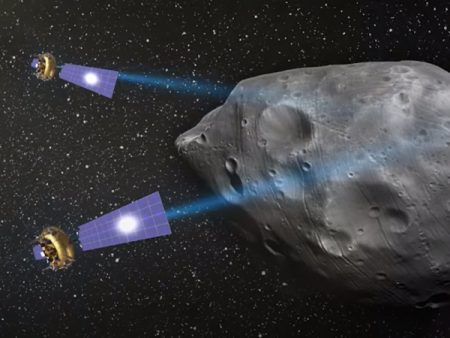
But Planetary Resources are no longer the only team at play among the more than 10,000 asteroids already mapped of which 1,700 are deemed potentially rich in assets worth exploiting. The competition, Deep Space Industries (DSi). This week the company announced its plan to launch a number of spacecraft given the name FireFly, to do asteroid prospecting. DSi is taking a different approach. Each Firefly is a CubeSat, a small (25 kilogram or 55 pound), low-cost satellite that will piggyback with launches of telecommunication satellites. Each FireFly mission is designed to last from 2-6 months. The FireFly missions will be followed in 2016 by DragonFly launches. These 32 kilogram (70 pound) spacecraft seen in the artist depiction below will bring back between 27 and 68 kilograms (60 to 150 pounds) of samples harvested from selected asteroids. See the image of what DSi’s first targets will be Earth-crossing asteroids seen as easier to reach than the Moon and as potential threats to Earth should one strike the planet. A 50-meter (165 feet) in diameter asteroid could weigh more than 200,000 tons composed of 20% iron-nickel. In some cases DSi plans to move asteroids to make them easier to harvest but it will only do this with rocks less than 30 meters in diameter (less than 100 feet) that are Earth crossing. Asteroids of this size should they accidentally enter the Earth’s atmosphere would break up and burn out in the atmosphere.
Both companies see much of what they produce being used to help build a space economy focused on space construction from habitats at LaGrange points or on the surface of the Moon and Mars, to materials for building Earth and Solar System satellites. Only a small percentage will actually be sent to Earth.

]]>
Why Our Solar System Has An Asteroid Belt
The Asteroid Belt consists of rocky debris unevenly distributed in the zone between the planets Mars and Jupiter. This is not the only place where asteroids exist. Asteroid clusters can be found along both Jupiter and Mars’ orbital plane in front and behind the planets at specific points far enough away from them to remain reasonably stable. These asteroids are called Trojans. Other asteroids can be found at similar points along the orbital plane of Neptune. And some asteroids have odd orbits that take them near Earth. In fact scientists estimate neary 9,000 asteroids larger than 50 meters (over 150 feet) cross the orbit of our planet. These are the type of asteroids that pose a potential collision threat with our planet, the type of asteroid that has been associated with the mass extinction event of 65 millions year ago.
Why did asteroids form? Scientists theorize that the Asteroid Belt and Trojans represent the debris of the early Solar System. The Belt itself is believed to represent a zone within the Solar System that failed to form a planet because of the proximity of Jupiter with its massive gravitational pull. The normal gravitational accretion that led to Mars and Earth was stopped by Jupiter.
The Asteroid Belt itself is very thinly populated even though there are millions of these rocky chunks. We have discovered 220 larger than 100 kilometers (62 miles) in diameter of which the largest is Ceres, with a diameter of approximately 1,000 kilometers (620 miles). Total mass of all of the asteroids in the belt is estimated to be about 4% of our Moon with Ceres accounting for 1/3 of the total. Asteroids are unevenly distributed through the Belt. This was first observed in 1886, caused by resonances with Jupiter’s orbit, and named Kirkwood Gaps after the discoverer of the phenomenon. This uneven and thin distribution has made it much easier to launch missions to the outer planets with little in the way of actual debris posing a hazard to spacecraft.

In one mission, Galileo, the spacecraft actually rendezvoused with two asteroids, Gaspra and Ida, while on the way to Jupiter. Gaspra was potato shaped, riddled with craters and 19 kilometers (approximately 11 miles) in length. Ida looked similar and was 52 kilometers (approximately 33 miles) in length and even had its own moonlet named Dactyl, a fragment 1.5 kilometers (less than a mile) across. Dactyl circles Ida at a distance of 100 kilometers (62 miles). The two moons of Mars, Phobos and Deimos, (see image of Phobos below) appear to be asteroids captured by that planet’s gravity in the distant past.How long have asteroids been around? 4.6 billion years, as old as the Solar System itself. We have been observing them through Earth-based telescopes since the early 19th century. William Herschel was the first to coin the word asteroid to describe them. Spectroscopic analysis allows us to remotely determine their composition. Three-quarters of asteroids are carbonaceous chondrites, that is they are carbon-rich. The majority of the remainder are stony and metallic with many reddish in colour indicating the presence of large deposits of iron.
We Send Robot Spacecraft to Visit Asteroids
NEAR
In 1996 NASA launched the NEAR (Near Earth Asteroid Rendezvous) mission, a robotic spacecraft programmed to rendezvous with two asteroids, the first Mathilde, and the second Eros. In 1997 NEAR made its closest approach to Mathilde, viewing it from about 1,200 kilometers (750 miles). This provided scientists at John Hopkins University with a first close up look at a carbonaceous asteroid. Mathilde appeared as black as soot in images transmitted to Earth.
In February of 2000 NEAR rendezvoused with Eros, a 34 kilometer (21 miles) long asteroid and began a a year-long orbit around it at altitudes that varied from 3.2 kilometers (2 miles) to 52 kilometers (35 miles). In February 2001, although not a lander, NEAR descended to the surface of Eros providing detailed images of the asteroid’s surface.

Before NEAR it was thought that asteroids were metallic or carbonaceous rubble. Eros turned out to be neither. It’s rocky composition was similar to the Earth’s crust. It was geologically active with more than 100,000 craters wider than 15 meters (50 feet), many filled with rocky debris and dust to a depth of more than 90 meters (300 feet).
Hayabusa
In 2003 the Japanese Space Agency (JAXA) launched Hayabusa, a research spacecraft designed to rendezvous with an asteroid and return samples from its surface back to Earth. Hayabusa used an experimental ion propulsion system similar to the one deployed by Deep Space 1 in 1998. NASA developed and tested this technology in space for the first time in a mission to a comet in 1998. An ion propulsion system provides pretty tenuous power. In fact, if you were to use it to power a car it would take four days to accelerate from 0 to 100 kilometers (60 miles) per hour. But in space this type of engine creates a steady incremental push to a spacecraft and when operating over months and years provides a very effective propulsion system.
Hayabusa’s target was the near-Earth asteroid, Itokawa. It took two years and one gravity-assisted pass of Earth for Hayabusa to reach the asteroid, travelling over 2 billion kilometers (1.2 billion miles) to its target, 300 million kilometers (180 million miles) from Earth. Once there it studied Itokawa from altitudes between 3 and 20 kilometers (1.8 to 12 miles) touching down twice on its surface in November 2005 to take samples. Hayabusa then began its return to Earth in April 2007 with samples on board. Hayabusa’s sample was retrieved from a reentry capsule in June 2010.

Dawn
The Dawn spacecraft, launched in September 2007, today is orbiting Vesta, the first of the two asteroids it intends to visit between now and 2015. The spacecraft took four years to reach Vesta using a Martian fly by in 2009 to provide gravity assistance in accelerating the spacecraft on a trajectory to the asteroid. Upon arrival at Vesta, Dawn entered into orbit.
Dawn deploys a solar array that extends 19.7 meters (65 feet) to capture the much more tenuous light energy available to it at the distances it is operating in the Solar System. That same solar array provides the power to drive the xenon ion propulsion system, the third time this technology has been successfully deployed.
Dawn’s other technologies include: two framing cameras to provide detailed imaging in visible and infrared light, a gamma ray and neutron detector to measure the composition of each asteroid, a visble and infrared mapping spectrometer to work in association with the cameras to get accurate elevation reads and determine the minerals on each asteroids’ surface, and radio transmitters for sending signals to Earth and detecting gravity field variations.
In July of 2011 Dawn transmitted the first close- up images of Vesta (see the picture of the Snowman craters in the composite image of asteroids above). What it has discovered so far about this asteroid has revised our thinking about the geology of Asteroid Belt objects. For example there is evidence that Vesta first formed in a molten state as evidenced by its iron core. Vesta also has mountains, the largest more than twice the height of Mount Everest. Vesta also has dark, sooty deposits on its surface which appear to have arrived after the asteroid formed, probably delivered by collisions with carbonaceous Asteroid Belt objects. Like Eros, Vesta remains geologically active with its surface constantly being reworked over time as these collisions create debris and dust that settles into craters and narrow gullies that form ridge and valleys across parts of the asteroid.
When Dawn finishes its assignment at Vesta it will move on to its second objective in the Asteroid Belt, Ceres. Arrival is planned for August 2015 where Dawn will take up orbit to study the asteroid the same way it currently is studying Vesta. Ceres will be very different from Vesta. It’s larger and much further out in the Asteroid Belt. Earth observations indicate that it is composed of at least 25% water ice. So in its visit Dawn will give us an entirely different perspective on the composition of asteroids within the Asteroid Belt.
Why Mine Asteroids?
So we know that asteroids come in all shapes and sizes and are composed of everything from ores to ice. Which may explain why a wealthy group of entrepreneurs want to exploit asteroids as resources. A single asteroid could be worth billions of dollars if it were to be mined. And it will require billions of dollars in investment to succeed. The company plans to launch up to five space telescopes within the next two years to search for and identify asteroids of commercial value. Prospecting robotic spacecraft will follow within five to years. These robots will sample and assay target asteroids in preparation for a subsequent mission of robot miners and refiners who will then bring their precious cargo back to Earth. The economics of such a venture requires further study.
But it is far more likely that Planetary Resources will end up creating way stations in space by finding asteroids that are largely made of water, like Ceres but not as big. Water is the commodity that can become a precious resource when broken down into its constituent elements, oxygen and hydrogen. In addition water is life sustaining for any human presence in space. Water harvested in space can lead to Deep Space habitation where humans can provide a string of stops along the way to other destinations in the Solar System and beyond. But there will be many hurdles to overcome for this commercial plan to succeed including issues of legality and the development of whole range of new technology. We’ll explore the topic of the commercialization of space in subsequent blogs. So keep on reading and send me your questions.
]]>
