Restoring damaged nerves from an injury is difficult. You cannot easily suture broken nerve ends and make them reconnect. I’ll give you an example from personal experience. I broke my legs in a tobogganing accident when I was in university. After multiple surgeries to rebuild the broken weight-bearing bones of my left limb, my nerves from the mid-point below my knee to the ankle no longer worked. This didn’t impede me from walking but I constantly had to pay attention to bumping into things, or accidentally burning or cutting myself on that leg because I couldn’t feel a thing.
That’s the problem this Israeli team of biomedical engineers and medical doctors decided to tackle. They looked at the most recent research into neural prostheses which use sensors to connect severed nerves. But the existing solutions required external power sources. In other words, a battery.
For restoring the sense of touch in a finger, a battery was seen as impractical. So the research team at Tel Aviv University decided to develop a triboelectric nanogenerator, called a TENG. The TENG could be powered by the body’s own movements and nerves. Connecting it directly to a healthy nerve, therefore, would restore sensation.
The TENG is an implantable piezoelectric sensor powered by natural frictional forces. The sensor consists of two tiny plates, each 0.5 centimetres square. When frictional forces cause them to come into contact an electric charge is transmitted to the connected undamaged nerve. If implanted for an injured finger, the frictional tension can vary based on whether the person is using a firm or weak touch.
The TENG can be implanted anywhere in a body to restore tactile sensation. It is built from biocompatible materials so it is well tolerated. So far the team hasn’t used a human subject. But in test animals, they have used the TENG to restore normal walking despite motor nerve damage. In the near future, TENG sensors will be used in a clinical trial with human patients to restore feeling in their fingers.
States Dr. Ben M. Maoz at Tel Aviv University, “Restoring this ability can significantly improve people’s functioning and quality of life, and more importantly, protect them from danger. People lacking tactile sensation cannot feel if their finger is being crushed, burned or frozen.”
The research and invention are described in a journal article that appeared on June 17, 2021, in ACS Nano. The article is entitled, “Restoring Tactile Sensation Using a Triboelectric Nanogenerator.”
]]>
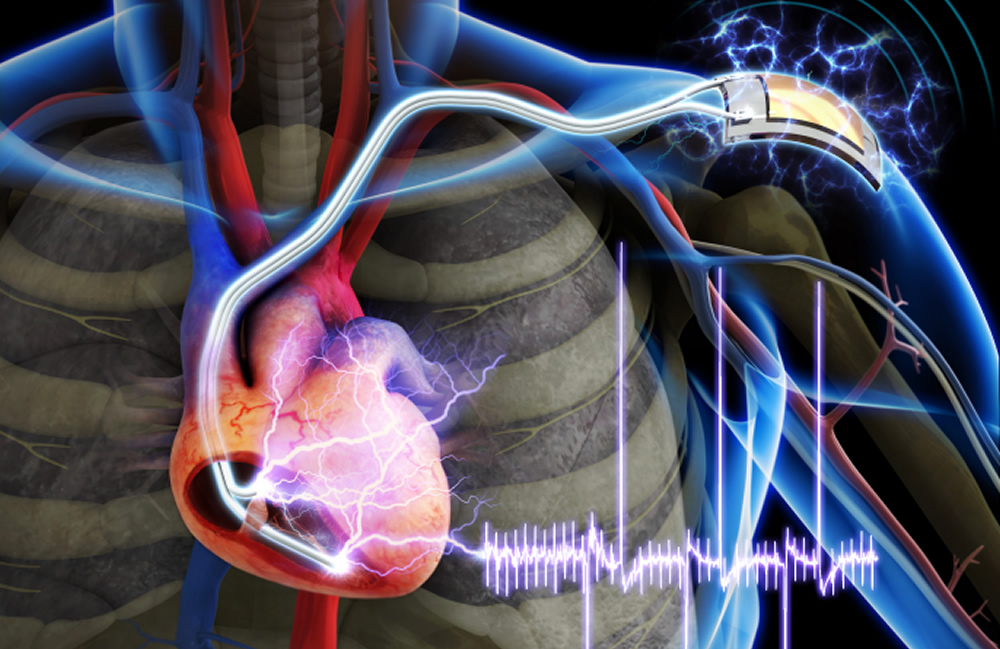
Recently I wrote about another pacemaker technology that uses electromagnetic waves to charge a miniature pacemaker in a rabbit. The KAIST device was demonstrated in a rat. The energy generated from small body movements by the rat reached 8.2 volts and 0.22 Milli-amperes. Both energy levels were considered sufficient to directly stimulate the rodent’s heart. In the picture above a piezoelectric device is shown powering a human heart pacemaker. The source of energy comes from the harvester, a shoulder patch that transmits energy to the internal device from the slightest movement.
Professor Keon Jae Lee in the Department of Materials Science and Engineering at KAIST is quoted as saying: “For clinical purposes, the current achievement will benefit the development of self-powered cardiac pacemakers as well as prevent heart attacks via the real-time diagnosis of heart arrhythmia.”
Piezoelectric technology is being looked at in a number of 21st century applications including under road surfaces to power highway lighting and signage and to recharging electric vehicles while they are on the go. These piezoelectric devices are, however, large. The schematic illustration of the pacemaker, seen in the illustration below, shows a nano-sized device, far different from its big brother cousins.

I have written in the past about roadways implanted with piezoelectric devices and in some sense this works similarly but not in response to pressure. Because what the NCSU researchers have invented is a device that emits a weak magnetic field with no EV present but when a car equipped with a matching receiver passes by, the device triggers a strong magnetic impulse which delivers power the vehicle. The difference in field strength amounts to a 400% surge in the magnetic energy emitted. Once the EV passes the device reverts back to its weak signal.
The current laboratory prototype is a series of segmented transmitter coils with each broadcasting a magnetic charge at a rate of 0.5 kilowatts. A matching receiver coil in the EV makes the connection work efficiently. The NCSU team plan to scale up the system to generate a magnetic charge in the range of 50 kilowatts, about equivalent to fast charging direct current devices EV owners can install in their homes.
The paper describing their invention appears in the journal IEEE Transactions on Power Electronics.


