The post Solar Energy Technology Is Going “Perovskite” appeared first on Techso Mogro.
]]>In 2013 when photovoltaic cells made with perovskite were first being assessed they were less energy efficient than those using silicon. Over the past decade, however, perovskite has gained on its silicon cousin in terms of improved power conversion efficiency (PCE), the industry standard rating for solar cells. How perovskite has made gains is in the architecture of the cells themselves. Instead of a single layer of silicon photovoltaic cells, perovskite cells could be stacked one atop the other. This meant per square centimetre, a much higher PCE. Instead of a 15% PCE back in 2013, perovskite cells in 2024 produce a 34.6% PCE and a theoretical upper limit of 43%, higher conversion rates than the best silicon-based photovoltaics on the market today with a PCE of 24.1%. The upside to silicon is believed to be no greater than 30%. So, already perovskite photovoltaics are exceeding that upper limit.
I recently received an IDTechEx marketing release written by Maia Benstead, an IDTechEx Technology Analyst. She describes the current and future path of solar power and the fast pace of growth in deployment. Silicon photovoltaics remain the dominant player in the market but the limits on the PCE of these cells challenge the industry.
That’s where perovskite provides a solution and the IDTechEx latest report sees growth in the market for photovoltaics between 2025 and 2035 being led by the adoption of perovskite thin-film and perovskite-silicon tandem solar cells. IDTechEx forecasts that by 2030 perovskite cells will begin to replace the first generation of solar technology as silicon cells reach their end-of-life.
The IDTechEx report forecasts that tandem perovskite/silicon cells will replace existing silicon panels for use in solar farms and rooftop solar. Perovskite thin film will introduce new market opportunities for solar because cells made this way will be 90% lighter than silicon and provide greater flexibility for use on vertical surfaces of buildings and even as building wraps to turn an entire structure’s exoskeleton into a renewable energy generator. Thin film will also create a market for solar cell integration into Internet-of-Things (IoT) smart sensors to power light-emitting diodes (LEDs), photodetectors, x-ray detectors, nanoscale quantum dot semiconductors and all kinds of consumer electronics.
So what’s not to like about perovskite? The material is abundant. It can be turned into solar photovoltaic power generators from panels to different shapes and sizes that can conform to all kinds of surfaces. IDTechEx forecasts that perovskite panels will become comparatively priced to silicon by 2035.
Not all is bright and beautiful in the perovskite world. There are perceived downsides to seeing this material replace silicon in the next decade. These include:
IDTechEx predicts despite these concerns that perovskite photovoltaic installations will reach 85 Gigawatts annually by 2035 representing a substantial percentage of new and replacement solar installs.
The entire renewable energy industry numbers for wind and solar according to BloombergNEF by 2035 will reach 1 Terrawatt annually by then.

The post Solar Energy Technology Is Going “Perovskite” appeared first on Techso Mogro.
]]>The post Solar Panels: What You Need to Know appeared first on Techso Mogro.
]]>One thing is certain. Solar power is an inexhaustible fuel source as long as the sun is shining. We can access it from sunrise to sunset every day and it is noise and pollution-free.
Using solar panels fulfills much of our energy needs while eliminating the creation of greenhouse gas (GHGs) emissions. But like other renewable energy sources, solar power technology has some drawbacks. It doesn’t work when the sun goes down and requires supplementary backup power to bridge the night.
Is it 100% green? Questions remain about the way panels are manufactured, and the way in which they are disposed of and recycled. But before we look at the environmental downside it is good to know what options exist in types of solar panels available today and in the near future. So here is a list along with the pros and cons for each type.
There are four types and they vary in appearance, design, efficiency, performance, and cost.
Monocrystalline solar panels provide high-performance and high-efficiency ratings. This type of panel is manufactured using a single pure silicon crystal. It converts sunlight into electricity with conversion efficiency rates of up to 21%. Besides delivering good performance, monocrystalline panels require little space. A small area on a roof is all that you need for installation. These panels are black in appearance with each silicon wafer presenting rounded edges. They are more expensive than other panel types. A downside is in manufacturing they produce a lot of pure silicon waste.
These panels have a blue appearance. They are made from melted silicon cut into square moulds. The process of manufacturing is less complicated and more cost-effective compared to monocrystalline, producing much less waste. Polycrystalline is more affordable than other panel types. The conversion efficiency of these panels is somewhere between 13% and 16%. They also don’t perform as well in higher temperatures and take up much more roof space for the same amount of energy yield one gets from monocrystalline panels.
These panels use alternative photovoltaic materials to pure silicon. Most commonly they are made using cadmium telluride (CdTe), copper indium gallium selenide (CIGS), and amorphous silicon (a-Si). Manufacturing involves depositing thin layers of the material over a metal, glass or plastic substrate.
Thin-film panels are easy to manufacture with the flexible substrate making it possible to use them in a variety of applications. They have a median efficiency rating of 15% to 16% and perform well in low-light and high-temperature conditions. The downside is they tend to degrade faster and often come with a shorter warranty than pure silicon panels.
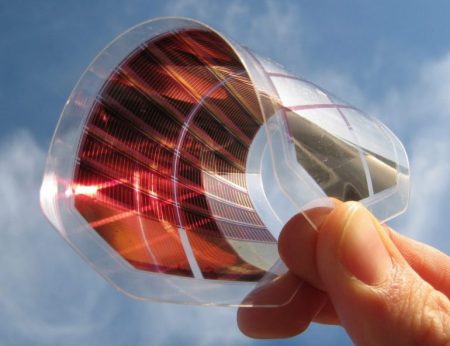
Perovskite is the next generation in solar panel material evolution. These panels use cube and diamond-like octahedral crystals to absorb light and produce efficiency ratings currently of between 23% to 25%. Those working on perovskite solar believe the efficiency of these panels can be improved to 40% energy conversion in the near future.
Another advantage to perovskite is it is abundant and more versatile, and cheaper to produce than silicon panels. The downside is the waste produced from manufacturing perovskite panels is toxic to the environment. That’s why we are not seeing the material replacing the alternatives today.
The manufacturing process for most solar panel types today is not entirely clean and produces pollution. There are hazardous chemicals and materials including lead, cadmium, nitrogen trifluoride, and sulphur hexafluoride. Mishandling of hydrofluoric acid, a highly corrosive liquid used to clean silicon wafers can lead to contamination of land and water resources.
Commercial solar farms require a considerable amount of space to produce high volumes of electricity. Land clearing can lead to irreversible damage to an environment causing increased soil erosion, destruction of native vegetation, loss of natural habitat, displacement of wildlife, altering of natural drainage, and replacing existing land usage such as farm and pasture.
What happens to solar panels at the end of life. Used panels and solar energy systems create a large amount of toxic waste that contains molten salts, hydraulic fluids, coolants, and lubricants. These are not easy materials to recycle causing problems for manufacturers and consumers and leading to the irresponsible and improper disposal of the materials at end of life. What’s needed is best practices for the collection, transportation, stockpiling, and disposal of panels at the end of life
Solar power remains promising and exciting. Manufacturers, consumers, and other stakeholders need to understand the long-term environmental impacts the technology can have on the environment before mass implementation creates a solar waste and environmental crisis. That means creating new industry guidelines that align with environmental performance requirements.
The post Solar Panels: What You Need to Know appeared first on Techso Mogro.
]]>The post The Journey to a 1,000 Mile Between Charges Electric Vehicle appeared first on Techso Mogro.
]]>Another approach to extended-range vehicles is to add solar cells to the EV surfaces. Aptera, a California-based solar car start-up, is building golf carts that promise a range of 1000 miles. This is twice the range of current Tesla automobiles. In fact, some Tesla models can get up to 620 miles (992 kilometers). Lightyear, another EV manufacturer, has a family of solar cars that can approach a 500 miles (810 kilometers) range using extensive solar bodywork and efficient in-wheel motors. Tesla has plans to implement solar in future EVs capable of adding a kilowatt of power to its models. When feasible, Elon Musk even wants to add foldable and unfoldable solar panels that can be used to recharge batteries when the vehicle is parked. And finally, Hyundai has plans for an EV with a translucent solar roof.
If you think these innovations are a bit out there, check out these other range-extending technology ideas:
Not all of these ideas will convert into real products. But with some of them, the promise to extend EV range to the 1,000-mile goal should be workable within the decade.
For the bigger picture go to the IDTechEx report, “Electric Vehicles: Land, Sea and Air 2021-2041”. And for additional information please visit www.IDTechEx.com/
The post The Journey to a 1,000 Mile Between Charges Electric Vehicle appeared first on Techso Mogro.
]]>The post Solar Materials and Efficiency Improvements Are Transforming the Business of Power Generation appeared first on Techso Mogro.
]]>Diamandis notes that solar panels have been with us for several decades, but that the uptake of the technology has been less than stellar considering the scientific evidence that shows us that reliance on fossil fuels for power generation is making climate change an existential problem.
You would think sunlight, such a ubiquitous source of power, would, therefore, be the way the world should be going. Yet based on 2015 data, only 1% of global electricity was being produced on our planet from solar energy sources.
Is this about to change? Diamandis says so and sees an abundance of solar in our future.
Every five days, the Sun provides Earth with as much energy as all the supplies of oil, coal and natural gas ever found. Capturing just one 6,000th of the Sun’s energy would meet 100% of the world’s current requirements.
We are currently riding a wave of advancements in both solar panel efficiency and novel methods of expanding surface area coverage. The cost of solar energy continues to plummet with the price per watt averaging around $3.00 USD this year. While the efficiency of current run-of-the-mill solar panels still hovers around 16-18%, half of their theoretical efficiency potential, new materials science breakthroughs are now on track to double that number, promising cheap, efficient and abundant solar energy. Expect the price-performance ratio of solar technologies to further undercut traditional energy sources, and with this we will see mass integration of solar cells into everyday infrastructure.
Current solar energy-generating plants tend to be deployed on swaths of out-of-eyesight farmland, or on roofs of off-the-grid homes and commercial properties. Critics point to land area use as the single greatest barrier to widespread solar adoption. But this is a fallacy. Expect in the next decade solar panels to be installed ubiquitously across urban and semi-urban areas, embedded in infrastructure, on transparent surfaces and even on vehicles. Even now, there are tens of thousands of acres of urban space available for solar deployment, and that is not taking into consideration soon-to-be-repurposed parking lots once driverless vehicle fleets proliferate.
The product is also evolving to improve the aesthetics as well as efficiency. Imagine if every window and glass surface could become a solar energy source. Well, new advancements in transparent solar panels are bring this future to fruition. Five years ago, transparent solar panels (or solar cells embedded in transparent surfaces) were incapable of harnessing enough energy to justify cost and commercialization. In 2013, efficiency stood between 1 and 3%. What’s more, the opacity of these clear surfaces was still far too high, limiting light penetration. That’s not the case today with solar cells and solar capture materials finally becoming sufficiently versatile to be integrated into glass and other aesthetic surfaces.
Ubiquitous Energy, a Silicon Valley startup, which raised $22.8 million USD to date, has developed a transparent solar cell called ClearView Power, achieving 9.8% efficiency. A color-neutral coating that can be put on a glass surface, ClearView Power’s technology can absorb and convert non-visible light (ultraviolet and infrared) into electricity. It theoretically can be applied to any window of an existing building without obstructing visible light. Ubiquitous has nearly doubled glass solar panel efficiency in one year after researchers at Michigan State University announced they had invented a similar panel with 5% efficiency in 2018.
What can this mean for solar energy deployment? Within the next decade, we should see commercialized solar-capturing glass populating every skyscraper, school, and residential rooftop, generating abundant and newly democratized energy.
Solar technology is also making improvements in the non-transparent category as well. Numerous startups are tackling solar tiles and solar roofing technologies, aiming to integrate them seamlessly into the construction of homes and mid-scale structures.
Tesla has its own brand of beautifully designed solar tiles called Solar Roof. The Tesla roof incorporates an embedded Powerwall battery along with highly durable solar shingles that both convert and store solar energy throughout the day and make it available at any time. Amenable even to customized levels of electricity generation (based on household energy usage), Tesla’s Solar Roof essentially converts any home into its own utility. Elon Musk recently stated, “We have a shot at being equal to a comp shingle roof plus someone’s utility cost or being lower than that. That’s one of the cheapest roofs available. So you can have a great roof with better economics than a normal fairly cheap roof and your utility bill.”
Projecting a future wherein residential structures not only fuel your household activities but can make you money, Musk believes that solar roofs will cost less than traditional roofing materials (already at near-zero maintenance costs) in just the near future. Not only that, but current figures (see image and chart below) would suggest that solar shingles can compete on price with rooftop installation of traditional solar panels:

Price Comparison of Solar Roof and Premium Roof + Solar Panels. Source: Electrek.
Tesla is not alone in the solar roof game. Forward Solar Roofing, a Silicon Valley-based startup, claims to have already undercut the price of Tesla’s product by half with its own solar roof. The company’s first batch of pre-ordered roofs sold out within a week, and while it remains unclear if the company will be able to deliver, current figures tout an energy density of 19 watts per square foot. Forward also incorporates a venting system to offset efficiency loss through solar panel overheating.
Historically, inefficient electrical production has stood as the greatest barrier to large-scale solar adoption. Yet the efficiency of photovoltaic cells has improved exponentially since their invention with today’s panels averaging 18% efficiency, meaning they capture 18% of the solar energy to which they are exposed.

Solar Panel Efficiency Improvements, 1960 – 2017. Source: Go Solar Texas.
But 18% is no longer the limit as can be seen in the graph depicted above. Several companies including Solar City, Panasonic, and SunPower have achieved solar panels with 22-23% percent efficiency, a 25% efficiency increase from what is being deployed currently.
SunPower, the $1.5 billion USD public company boasts the X22 solar panel reaching 22.8% efficiency. Tesla and Panasonic (jointly engaged in producing solar cells) have broken the 20% efficiency threshold in their commercial products.
In terms of price-performance, the gross cost of solar panels per watt has fallen a staggering 64% since 2014 (in just 5 years).
But even these improvements are being challenged by new innovations borne out of research and development laboratories. For example, the National Renewable Energy Laboratory and Swiss Center for Electronics and Microtechnology announced in 2016 that they had built a solar cell capable of 30% efficiency. A year later, scientists from George Washington University and the Naval Research Laboratory announced a cell capable of 44.5% efficiency.
SolSunTech, a New York City startup has achieved 33% solar panel efficiency in its first few years of operation. The company uses three-dimensional panels as opposed to the flat panels we are used to seeing. The three-dimensional silicon wafer structure significantly increases solar-absorbing surface areas. Its wavy shape further allows re-absorption of reflected light. A simple engineering solution, SolSunTech now plans to begin construction of a 100 Megawatt/hour facility in December of 2019 following the company’s next financing round.
And then there is perovskite, a naturally occurring light-sensitive crystal that is seen as the next breakthrough in solar energy. In the past five years, the conversion efficiency of perovskite-solar panels has increased from 4 to 23%, making it the fastest-developing material technology in photovoltaic history. The theoretical upper limit of perovskite is seen at about 66% which is more than twice the current upper limit for silicon-based photovoltaics. Perovskite is also widely available and inexpensive to extract and use. Estimates suggest perovskite panels will cost between 10 and 20 cents per watt, compared to 75 cents (or almost four times the cost) of the panels we are producing today. Scientists are adding a chemical compound, guanidinium thiocyanate, to perovskite films to make them more adaptable to all kinds of uses and application surfaces. The thinness of perovskite films, its flexibility, and low weight, means it can be installed on flat, curved, sinuous, or other types of surfaces. That is not the case for silicon-based panels. Most recently, a new startup, Perovskite PV, secured $2.4 million USD in seed funding. Others will soon follow.
But don’t count silicon-based photovoltaics out. Researchers recently found a material defect in silicon responsible for a 2% drop in efficiency that panels experience in their first few hours of use. As solar cells’ electronic charge is transformed in the presence of sunlight, the flow of electrons gets trapped. This, in turn, reduces the level of electrical power that can be produced. While seemingly negligible, the potential to recapture this 2% efficiency from light-induced degradation (LID) represents an opportunity to increase the efficiency of existing solar panels globally, equal to more energy than what the United Kingdom’s 15 nuclear power plants produce today.
Advancements in materials science, battery storage, and solar-capturing surfaces are driving a future of solar energy abundance. According to a recent Harvard study, solar energy cost decreases will drive a 700% growth in solar power production over the next 20 years. That’s on top of the 2,000% growth in U.S. solar power generation in the last nine. In 2015, U.S. solar power amounted to 7% of all renewable energy power generation in the country. That number is expected to top 36% in 2050 which will make it the fastest-growing energy source in the United States by that date.

The post Solar Materials and Efficiency Improvements Are Transforming the Business of Power Generation appeared first on Techso Mogro.
]]>The post Solar Panel War Heating Up appeared first on Techso Mogro.
]]>The disadvantages to using perovskites in solar energy are quickly disappearing. The remaining ones include:
But perovskite made solar cells have an enormous upside with predictions that in time will see conversion to energy efficiencies exceeding the best that silicon solar cells produce.
The post Solar Panel War Heating Up appeared first on Techso Mogro.
]]>The post Peter Diamandis Talks About the Coming Solar Energy Revolution appeared first on Techso Mogro.
]]>———
Part 1: Solar Today in Context
Today, the global oil and natural gas industry is about a $4 trillion business. It’s big money, and in the U.S., 67 percent of the electricity generated in 2015 was from fossil fuels (coal, natural gas, and petroleum). This is about to change. We are on the cusp of a solar revolution where the cost of solar cells will plummet, efficiency will rise dramatically, and the incentives for widespread adoption will become compelling.
Over the past few decades, the most widely used form of solar energy has come from a material called silicon. The silicon solar cell was discovered in 1953. A few years later, the first commercial solar cells began to pop up. Unfortunately, these first commercial cells were way beyond the means of normal consumers and were also relatively inefficient at producing energy.
Over the decades, silicon solar cells have become increasingly more affordable and efficient, with most solar panels averaging around 14 percent to 18 percent efficiency (up from 6 percent back in 1954), and as low as $3 per watt (down from a staggering $300 per watt in 1956). Although solar energy currently only accounts for 0.4% of electricity generated in the U.S., solar energy production is expected to grow significantly over the decade ahead. Domestically, the market is projected to grow 25 percent to 50 percent this year and global projections are at 30 percent. The graph below illustrates how global photovoltaic development and capacity has increased over the years.

The implications of this are staggering, both on an economic and environmental level. And, for those who want to do the calculations, at a 30 percent annual growth rate, it looks like this: In five years, we go from 0.4 percent to 1.5 percent. In 10 years, we’re at 5.5 percent. In 15 years, we’re at 20 percent, and in 21 years, we’re at 98 percent. But what’s even more interesting is a new material that’s poised to completely change the face of solar… and with that, let’s dive in.
What is Perovskite?
Perovskite (seen in the image below) is a light-sensitive crystal that has the potential to be more efficient, inexpensive, and versatile than all other existing solar solutions to date. Over the past five years, perovskite’s conversion efficiency has increased dramatically — from 4 percent to nearly 20 percent, making it the fastest developing technology in the history of photovoltaics. Scientists started experimenting with perovskite in 2009, using it as a dye to absorb light and create charges, which could then be separated and used to generate energy with a semiconductor. In 2012, however, scientists realized that perovskite could actually act as a semiconductor itself, and began to experiment with using it in solar cells. Because of how perovskite is created, perovskite solar cells have a few important advantages and disadvantages over silicon-based cells.

Top Advantages

Top Disadvantages
Tandem Solar Cells
One interesting solution is to combine perovskite with other photovoltaic materials to create more efficient systems. Scientists in Hong Kong recently reported having successfully combined perovskite and silicon to create a tandem solar cell with the world’s highest reported efficiency rate – 25.5 percent! As there are different wavelengths for solar energy, a combination of different materials for making solar cells would work best for energy absorption. For example, methyl ammonium lead tri-halide perovskite and silicon solar cells can form a complementary pair. With the perovskite solar cell functioning as a top layer, it can harvest the short wavelength photons while the bottom layer coated with silicon is designed to absorb the long wavelength photons.
Implications for Solar
The world has long had high hopes for solar, and it seems that potential may finally be close to being realized. Once again, there is 5,000 times more solar energy hitting the surface of the Earth than the human species uses in a year. The barriers to commercial development, however, are still significant. Many entrepreneurs and investors are cautious about solar after having been burned in the early 2010s, when a string of solar companies took in considerable capital before shuttering their operations. That being said, there has been a resurgence of promising startups developing commercially viable solar solutions – and we believe we’ll see perovskite solar cells as early as next year. New developments are occurring every day, pointing towards a future with abundant energy, abundant clean water and abundant possibility. This is an incredibly exciting time for material science, and an incredibly exciting time to be alive.
The post Peter Diamandis Talks About the Coming Solar Energy Revolution appeared first on Techso Mogro.
]]>The post Eight 21st Century Emerging Technologies: Part 7 appeared first on Techso Mogro.
]]>From smart materials that are self-healing to novel chemistry that impacts energy storage, medicine and other fields, the science of engineering materials is undergoing a revolution in the 21st century. The U.S. government’s Materials Genome Initiative is focused on advanced materials with application to clean energy, national security and human welfare. New tools are making it possible to develop materials atom by atom creating endless fabrication possibilities. Carbon fiber composites make for lighter, more fuel-efficient vehicles. Advanced alloys revolutionize avionics. Bio materials change the way we repair or replace worn out body parts. And nano materials are contributing to the development of quantum computers.
So follow along as Carbeck outlines the current top 5 material science breakthroughs and 5 more that he forecasts are coming in the next three years and beyond.
———-

Top 5 Recent Materials Science Breakthroughs: 2013 to 2015
1. Materials Genome Initiative (MGI) predicts thousands of new materials.
In the same way that the Human Genome Initiative mapped every gene in our human body and then was able to use machine learning to make predictions, the Materials Genome Initiative seeks to map out the hundreds of millions of different combinations of elements in the periodic table. Why? Creating this database will allow scientists using AI to predict properties of new material combinations. Carbeck explains, “Over the last few years we’ve been able to take the 10,000 materials we know about, and, with the help of high performance computing and quantum mechanics, start to predict properties of new materials that don’t exist yet.”
2. Graphene empowers new electronics, sensors, and composites.
The potential impact of graphene, a two-dimensional version of diamond or graphite, is emerging. It will be a key factor in a world of ubiquitous sensing and ubiquitous computing. Graphene is two-hundred times stronger than steel by weight. In the last decade we’ve seen it emerge as a material of choice for very high performance transistors, sensors, and new composites.
3. Rechargeable metal-air batteries make grid scale storage low cost and reliable.
New types of batteries are emerging. These are metal-air such as aluminum-air, zinc-air and lithium-air. They are smaller and lighter because they don’t require the extra bulk and weight of a chemical oxidizer. They have the potential to power the 1.2 billion people around the world today who don’t have access to reliable sources of electricity. “Grids using metal-air batteries have the potential to leapfrog traditional centralized energy production and distribution, especially in places like Africa,” states Carbeck.
4. Transferable ultra-thin silicon circuits enable electronics on and in the body.
We are developing technology to transfer high-performance electronics from rigid silicon wafers to form factors that can go on or inside our bodies. This is changing the way we interface with electronics – from how we track our daily activities, how we monitor our health and how we communicate and connect to the Cloud.
5. Soft robotics starting to change the human-machine interface.
Materials science allows us to make robotic structures out of fundamentally different materials to behave in different ways. For example, rather than a rigid metallic prosthetic limb, imagine a soft robotic prosthetic that actuates like muscle when activated by an electric field. “These soft materials will create a completely different physical interaction between humans and robots, electrically active, allowing us to design push and pull systems, much like muscles.”
So what’s in store for the near future?
Top 5 Anticipated Materials Science Breakthroughs: 2016 to 2018
1. Meta materials will become widespread.
The continued convergence of super-computing, modeling software, and micron-level additive manufacturing plus other manufacturing techniques will allow us to increase our ability to predict, engineer and construct meta materials with incredible properties not yet found in nature (for example, invisibility cloaks that make objects covered by them invisible).
2. Perovskite solar cells will beat silicon photovoltaics.
Perovskite is an amazing material that happens to make very efficient and cheap solar cells. When perovskite’s solar voltaic properties were first discovered five years ago, they provided conversion efficiency of about 4%. Now it’s 20%, and expected to rise to 30% in the next few years. Perovskite is 100 to 1,000 times cheaper than current materials used to manufacture silicon solar cells. By 2017 we should see mass deployment, a major contributor in moving the planet towards a solar-powered future.
3. AI coupled with the Materials Genome Initiative will allow us to commercialize new materials exponentially faster.
The Materials Genome Initiative developed over the past few years will come into full impact as cloud computing and machine learning allow scientists to discover new material combinations and material properties. Expect a lot of new commercialization efforts resulting from the application of AI. You’ll be able to say, “I want to build a next-generation implant for my knee,” states Carbeck, and your AI will understand all possible materials available and help choose ones that will be the most reliable and safe.
4. Carbon nanotubes and graphene will significantly extend Moore’s Law.
If Moore’s Law is to continue, we’ll need fundamentally different ways to organize materials into computers. Graphene and carbon nanotubes are among the most promising solutions. These materials contain properties that will allow us to continue to improve computing price-performance. We’ll even be able to manufacture a chip using traditional technologies, then add graphene functionality through materially pre-programmed self-assembly.
5. Recyclable carbon fiber composites.
While high-performance thermoset and thermoplastic composites are enabling breakthroughs like the Boeing Dreamliner and the BMW i8, the challenge remains that once heated and set they are irreversibly cured and unalterable, unlike aluminum and steel, which both can be melted and reused. But recent breakthroughs can change this, increasing their utility. Carbeck explains, “There have been real breakthroughs in chemistry that allow us to reverse the chemical reaction that makes the plastic composite depolymerize back into liquid form for reuse.”
The post Eight 21st Century Emerging Technologies: Part 7 appeared first on Techso Mogro.
]]>The post Headlines at Techso Mogro for August 16, 2013 appeared first on Techso Mogro.
]]>This week I have picked a whole bunch of new stories to share with you. The first describes how the State of Florida is fighting mosquitoes using drones. The second story is a follow up to NASA’s plans to capture a near-Earth asteroid with 12 candidates identified. The third is about Elon Musk who I call the 21st century Edison. He announced ideas for a pneumatic train called the Hyperloop while his rocket company, SpaceX, announced a successful firing of the Grasshopper with the rocket doing a controlled ascent followed by a lateral move and then a return to the launch pad. The fourth headline is about new materials that can make solar panels even cheaper. And finally, the last story features devices without batteries that draw power from ambient radio waves.
Florida to Use Drones to Eradicate Mosquitoes
Drones have become part of the arsenal in the war against terror and are somewhat controversial. But the Maveric drone (seen below), a product of Condor Aerial, is seen as a powerful helper in the war against the mosquito.It isn’t used to bomb the biting pests. Instead the Maveric is sent out on a search mission to find the pools of water where mosquito larvae thrive. It does this because it is equipped with a shortwave infrared camera that can relay information back to its operator. Then helicopters come in and drop a larvicide (either biological as in a fish that eat the larvae, or chemical) on the discovered sites. At some point Maverics may be equipped not just to search but also to destroy the mosquito breeding grounds. It’s only a matter of time.

12 Near-Earth Asteroids Identified as Candidates for Capture
If NASA and companies like Planetary Resources are serious about capturing or mining asteroids then the first step is to identify candidates. Of the nearly 9,000 known near-Earth asteroids (NEO) which are the ones deemed most suitable? A team of researchers at the University of Strathclyde in Glasgow, Scotland, have written a paper in which they have identified what they describe as 12 Easily Retrievable Objects or ERO asteroids.
By definition these 12 orbit around two Lagrangian points (L1 and L2), about one million kilometers (620,000 miles) from Earth (approximately 2.5 times the distance of the Moon). This means they can be reached by existing space technology whether robotic or human crewed. What we would do upon rendezvousing with any of these 12 depends on who is visiting.
Planetary Resources wants to mine suitable ones for rare minerals and for constructing a space infrastructure. NASA wants to capture one of them and bring it into Earth orbit where it can be more easily studied. In any case these 12 are the tip of the iceberg. There are probably a million NEOs yet to be discovered that are smaller and therefore harder to detect but advances in finding space objects should soon increase the inventory of ERO asteroids that qualify for study.

Elon Musk Keeps Inventing and Advancing
A modern day Edison, Elon Musk continues his efforts to make electric vehicles (EV) the choice of motorists, is building an EV infrastructure throughout North America, and is making Buck Rogers spaceflight in the near future a reality. And if that is not enough, in the last week he has shared his ideas for a high-speed transportation system using pneumatic tubes.
Musk’s idea is not original but neither were many of Edison’s. I have written about a pneumatic high-speed rail concept called the VacTrain in a previous posting. And a New York City inventor demonstrated a prototype in the post-Civil War era.
So what has Musk brought that is new to this concept? Besides the name, Hyperloop, Musk’s pneumatic train would be solar powered and would run on an elevated track encased in a tube resting on telescoping pylons (to deal with settling and earthquakes). The train in the form of many individual pods would travel a continuous loop between two fixed urban points. He proposes Los Angeles and San Francisco.
Each pod would include an electric compressor that would transfer air in front of the vehicle to the rear, creating a cushion upon which it would whisk passengers at speeds exceeding Mach 1. To keep the compressor operating on nominal power the pneumatic tube would be outfitted with linear electric motors approximately every 110 kilometers (70 miles) that would receive energy from solar arrays and battery storage. Read a detailed conceptual paper on the Hyperloop here.

And to make the week even more interesting Musk’s SpaceX showed off the latest test flight of the Grasshopper, a 10-storey, Falcon 9 reusable test rocket that has flown up 325 meters (approximately 1,066 feet) in the air on previous flights. In this latest launch on August 13, the Grasshopper not only flew 25o meters (820 feet) into the air but it also flew horizontally 100 meters (328 feet). Then it returned to its original launch point. The total flight lasted over a minute and with this test SpaceX demonstrated that it is one step closer to delivering a reusable launch vehicle. So kudos to Musk who continues to amaze.
New Material to Make Solar Panels Even Cheaper
A researcher at the University of New South Wales in Australia is lauding a cheap technology that can replace silicon based solar cells, dramatically improving performance and making the technology cost competitive with fossil fuel energy production. The material is a mineral called Perovskite. Currently an electrolytic material for use in solid oxide fuel cells, Perovskite has application in semiconductors. It exhibits permanent polarity within an electric field, a ferroelectric property that makes it highly attractive for use in electronics. And although you have probably never heard of it, the mineral is abundant and cheap.
Solar cells made with Perovskite can be much thinner than silicon-based product. The comparison, 1 micrometer for the former and 180 micrometers for the latter. Current protoypes have been built by spraying the Perovskite in a liquid medium on to a sheet of glass or metal foil. The resulting solar cells demonstrate 15% energy conversion efficiency. Researchers believe they can easily achieve 20 to 25% efficiency equaling the best performance of existing non-commercial lab-based solar technology. A commercial start up, Oxford Photovoltaics has raised $4.4 million U.S. to bring the technology to market.
A down side to Perovskite – the mineral contains a small quantity of lead (see picture below and its eerie resemblance to galena, the mineral form of lead). So like lead-acid batteries, Perovskite solar cells will have to come with some form of a material recycling program.

Mobile Devices Will Soon Be Powered Without Batteries
According to University of Washington engineers ambient backscatter from TV, radio and cellular transmissions presents a new energy source for smart devices with on board antennas attuned to various wavelengths. These devices with no battery will have many commercial applications including warehousing, assembly-line manufacturing, commercial retail and financial transactions. An array of smart sensors fully charged and operational would require no additional power other than what could be harvested out of thin air.
What this discovery means is the potential to construct smart buildings, roadways, bridges and homes, all containing embedded sensors that communicate their structural health continuously. Even devices with batteries could still operate if they contained this technology, leveraging the power from the backscatter.

Postscript
So that’s it for this week. Hope you found the range of subject matter interesting. Please come back for more and let me know if you have found an interesting story that we can research and talk about here at Techso Mogro.
– Len Rosen
The post Headlines at Techso Mogro for August 16, 2013 appeared first on Techso Mogro.
]]>