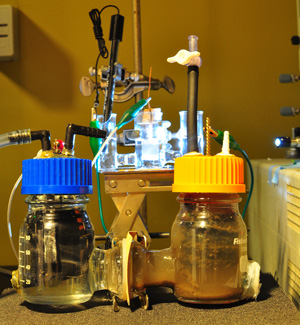
The PEC-MFC is a vast improvement over current technologies used to render hydrogen from water because the microbial fuel cell provides electricity continuously in a closed system. Current hydrogen generating technologies always require additional energy input from an external power source.
The bacteria used in the PEC-MFC is shewanella oneidensis, an anaerobic organism that usually is found in poorly aerated soils and sediments or the deep ocean. This bacteria has been used for bio-remediation to break down heavy metals from industrial waste. It is its electrochemically dynamic properties that make it an attractive choice for the device. Researchers noted that hydrogen production decreases after a period of time but by simply replenishing the wastewater the bioreactor starts pumping out more electricity and more hydrogen gas.
The current prototype (seen below) is running in the UC Santa Cruz lab but its inventors have ambitious plans to begin scaling it to industrial levels. They will start with a next generation 40-liter device which will be set up outside a water treatment plant so that it can use natural sunlight and will be fully integrated to continuously receive wastewater.