What the story described is the development of load-shifting power distribution on a microgrid scale where residential solar power represented a portion of the total power being generated. The real challenge that renewables like wind and solar have is one of variability. A good example is the variable nature of solar. Photovoltaic panels convert solar energy optimally when the Sun is directly overhead or aligned at 90 degrees to the panel surfaces. That usually means midday generates peak energy flow but in most places around the world user demand is not coincident with that peak. Typically in the summer peak demand occurs in the evenings. And in winter peak demand can be anywhere from early morning to evening.
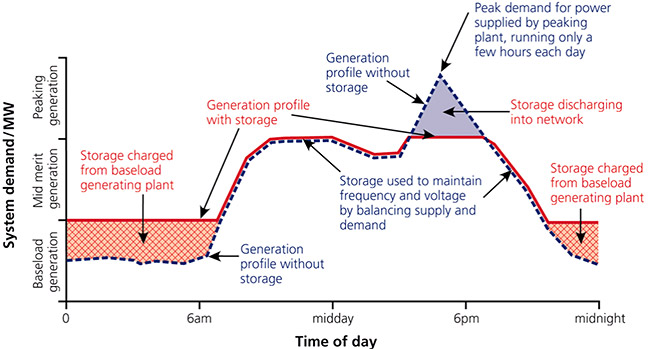
Researchers at Griffith University in Brisbane, Australia, will be publishing a paper in the journal Applied Energy this May in which they describe the development of a scheduling system that manages the energy variability from renewables in an effective way to do “peak shaving” and “valley filling” (see diagram above) to ensure load balancing in the distribution of solar power. The system consists of three modules:
The Griffith team, researcher Chris Bennett, Associate Professor Rodney Stewart and Professor Jun Wei Lu, combined a battery energy storage system containing stacks of lithium-ion batteries with a smart power control system plus the forecasting software and control algorithms to a South-East Queensland locality servicing 128 residential customers and it worked.
Bennett is quoted about their field test in EV News Report stating, “the low voltage network is a typical suburb of a few hundred homes where there is a single area transformer and ….. a substantial increase in the number of homes with installed residential solar PV….But because solar PV generation is dependent on incoming solar radiation, peak generation occurs during the middle of the day, typically when demand in the residential distribution network is low.”
With this new system the incongruity of variable energy production that challenges renewable wind and solar in a grid infrastructure goes away. Power fluctuations, those peaks and valleys, get smoothed out with surplus energy stored in the lithium-ion battery stacks to effect even distribution around the clock. Systems like this should make renewables compatible not just for local power distribution through microgrids but in larger regional and national grids, a game changer for energy utilities.
