It should be no surprise, therefore, that Polman in the last week called on all companies to do climate change reporting as a mandatory part of their business and that companies need to hold each other to account to ensure the goals of the Paris COP21 climate agreement are met.
Disclosing climate change risk has not come easily to many corporations. In the United States Boeing, General Electric, Procter & Gamble and many others disclose no or limited information on climate change in their regulatory filings. This is despite regulations that specify companies must provide details on significant risks to their operations. ExxonMobil is probably one of the most noteworthy of the companies choosing to mislead its shareholders about climate change risk. In recent disclosures the company has been cited by government prosecutors and attorneys general for hiding evidence of global warming’s anthropogenic cause allegedly known to the company since its own scientists reported it internally as early as the 1970s. Of the oil giants ExxonMobil doesn’t stand alone in ignoring its risk reporting responsibilities. Chevron, ConocoPhillips and others have been equally remiss in telling the truth in public filings.
Unilever under Polman’s leadership (he came to the company from Procter & Gamble in 2009) has set out in its strategy to use 100% renewable energy in its operations by 2030. Waste reduction to eliminate product contribution to landfill has become a company mission. Polman hasn’t completely transformed Unilever. The company’s legacy of Bhopal India in 1984, when 3,800 died and many thousands more succumbed later to the isocyantate gas leak at a pesticide plant, continues to linger.
Polman talks about corporate social license and that “companies must look to increase their positive social impact as integral part of their core business strategies.” He argues that, “the very essence of capitalism is under threat as business is now seen as a personal wealth accumulator. We have to bring this world back to sanity and put the greater good ahead of self-interest.” In his call for mandatory climate change risk reporting Polman is taking a business leadership role. It should be hard to ignore the CEO of a company with a market capitalization of $142 billion one would hope. The company is ranked 41st on Fortune’s annual list of most admired corporations.
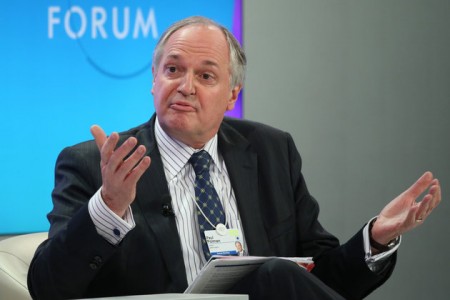
One of them, Miguel Veiga-Pestana, Vice President Sustainability Strategy and Global Advocacy at Unilever, in a recent comment urged all companies to “future proof their operations…..step off the sidelines and move into action.”
What was his subject? Climate change. He went further and stated, “if every major company affected by climate change – not only in the food and beverage sector, but other impacted sectors such as tourism, insurance and transport – were to address the issue as one of business survival, and step change their efforts for delivery, we could together make a significant impact.”
These comments by a senior manager of one of the top ten food companies in the world has implications for us all. Unilever is taking the subject of climate change and improving its ability to mitigate the risks throughout its entire organization and supply chain. It is, therefore, influencing the many other companies with which it does business.
At a recent meeting held in Abu Dhabi, the CEO of the company, Paul Polman spoke of t he growing support among businesses worldwide for action on climate change. He mentioned a groundswell of support with thousands of businesses representing 10% of global GDP who:
In his speech he stated that evidence is apparent to business that “the cost of inaction is now greater than the cost of action,” citing the $2.7 trillion U.S. spent in the last decade to deal with natural disasters, a much larger number than in past decades and much of the increase attributed to a warming atmosphere.
Words of encouragement included the following:
Why is business on board? It’s about survival. It’s about future proofing. Polman’s entire speech is well worth the read. It should be sent to the in-box of every CEO in every business on the planet. It should be sent to every government leader and representative. It should be a conversation in which we are all engaged with singular purpose. When Polman speaks of the things business needs from government, he is speaking for all of us when he says, “Business needs three things from the political community: Clarity, Confidence and perhaps most of all, Courage.”
