The post A Climate Change Wakeup Call – Part 2: The Problem We Created is Now Ours to Fix appeared first on Techso Mogro.
]]>Who has known about how we humans were changing the planet’s climate?
Scientists knew about the greenhouse gas (GHG) effect since the 19th century at the dawn of the Industrial Revolution.
Industrialists could witness the evidence for themselves every day as their foundries and factories spewed GHGs.
Utilities knew when they chose to burn fossil fuels to generate electricity, even with the knowledge of cleaner alternatives.
Of course, the fossil fuel industry knew, with their laboratory results showing the link between their industry and climate change since the 1950s.
Governments knew. Doctors and the healthcare community knew. Consumers even had an inkling.
All that knowing, and no one was doing anything to stop it.
The annual climate change rite of passage is called COP. COP stands for Conference of the Parties. This annual United Nations summit began in 1992 and has been going strong ever since. Nations around the world gather to talk about climate change, propose solutions, sign agreements, and then… nothing.
You may disagree with the last part, but look at a measure of the results to date. CO₂ concentrations in the atmosphere in 1992 were 356.5 parts per million. With 2026 not yet at an end, the latest July data show CO₂ concentrations at ~429 ppm. If you plot the trend based on observations from 1960 to the present, the graph looks like this: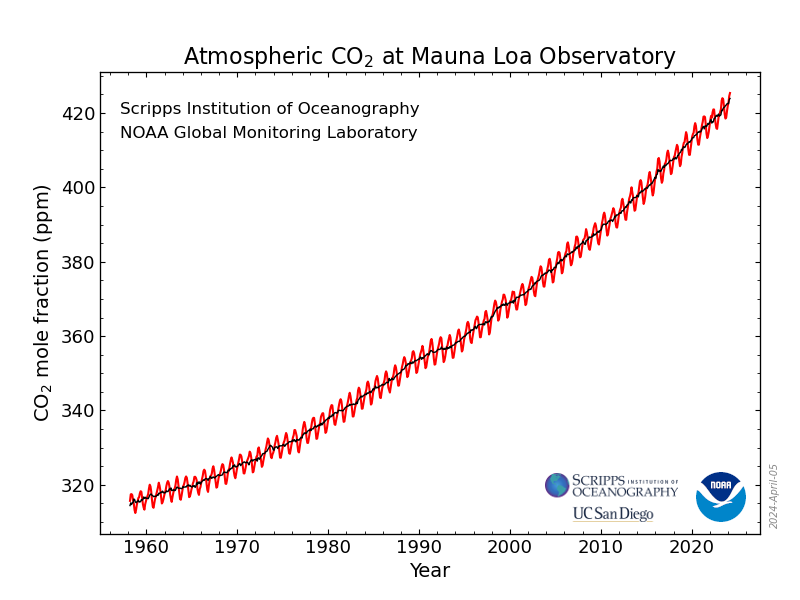
Does the upward-bending curve demonstrate that we collectively don’t know what we are doing about CO₂, the prime GHG associated with global atmospheric and ocean warming?
In 2015, a COP meeting produced the Paris Climate Agreement, with 195 countries agreeing to voluntarily tackle climate change by targeting GHG emissions. Since then, the number has dropped twice when the United States withdrew during both presidential terms of Donald Trump.
The Paris Agreement committed humanity to global behaviour modification. We were to limit global warming to 2°C (3.6°F) and ideally make best efforts to limit it to no more than a 1.5°C (2.7°F) rise above pre-Industrial Revolution atmospheric temperatures. To do this, countries were going to faithfully measure carbon outputs, called national stocktaking. They agreed to regularly report on progress to reduce carbon outputs.
Subsequent annual COP meetings have shown that using collective behaviour modification doesn’t work. The results indicate mitigation efforts have done little to slow down rising CO₂ levels and temperature rise.
Even the commitment by Global North and other rich countries to create an adaptation and mitigation fund to help Global South countries combat climate change has fallen well short of its financial target of US$ 100 billion annually beginning in 2020.
Why hasn’t behaviour modification worked? A sampling of national commitments and actions that appear to have failed or stalled includes:
Climatologists express concern that the upward-bending curve seen above will eventually lead to long-term climate disaster.
With behaviour modification’s failure as a collective strategy, we now appear to be falling back on technology rather than the natural options of ocean, forest, seagrass, peat bog, soil, and permafrost carbon sinks. Apparently, they can no longer cut the mustard.
Why? Natural carbon sinks appear to be nearing their maximum capacity to sequester CO₂. Oceans can only suck up so much before becoming warmer and more acidic. Planting more forests doesn’t appear to be offsetting forest loss from human exploitation and wildfires. Droughts are making peat bogs and soil untenable. Meanwhile, the Arctic is witnessing unprecedented permafrost melt, turning it into a net carbon emitter.
Technological wizardry is now our answer to failing to keep CO₂ in the bottle. Often talked about, carbon capture and sequestration (CCS) has become the rage. We have technologies that can suck CO₂ from chimney stacks and from ambient air. The problem is getting CO₂ polluters to pay to implement these technologies.
We are talking about fossil fuel and utility companies who for years have pumped out oil and natural gas, or burned these fuels and coal to generate electricity. They have put profits before social and environmental good.
Governments, meanwhile, have wanted the fossil fuel companies to pay for CCS and direct-air carbon (DAC) capture. The companies, which have benefited from fueling and feeding oil demand, making tens of billions of dollars, want the public to pay the lion’s share. Meanwhile, the fossil fuel industry and utilities show little remorse for dumping climate-change-causing pollutants into the commons: the air we all collectively breathe.
One such project represents a good example of the challenges we face. It is Canada’s Pathways Alliance. First announced in 2021, it involves a consortium of six fossil fuel producers constructing over 2,000 kilometres (1,240 miles) of pipeline to transport CO₂ from oil sands production sites to a location where the gas would be pumped underground.
Five years later, it is 2026. The Pathways project has yet to lay a kilometre of pipe. The companies aren’t even sure it will work. Who pays remains unresolved.
That we have reached this point, requiring tens of billions of dollars to begin to remove climate-changing pollutants, seems inexplicable. Yet, that is one of the nuclear options being touted to resolve the growing climate change crisis.
If we know excess CO₂ is the prime driver of climate change, we should be able to produce less of it. But our thirst for energy in the 21st century keeps throwing a monkey wrench into the works whenever we talk about learning to do with less.
Less would mean a rapid transition to 100% electrification. The electricity would come from renewable, nuclear and other low-to-net-zero sources.
Less would mean no more diesel- and gasoline-fuelled transportation, no more ships burning bunker fuel, and air transportation would replace jet fuel with hydrogen and batteries.
Needless to say, we aren’t even close to achieving any of the above at present.
The post A Climate Change Wakeup Call – Part 2: The Problem We Created is Now Ours to Fix appeared first on Techso Mogro.
]]>The post Carbon Capture News Bytes – Direct Air Capture, Cyanobacteria and Progress on the Pathways Alliance appeared first on Techso Mogro.
]]>This week’s stories include:

This month, the journal Nature describes a new material that can capture CO2. It is called a covalent organic framework (COF), and its hexagonal channel structure binds the gas to it. Developed at the University of California, Berkeley, it could become an important direct air capture (DAC) tool to reverse rising CO2 levels in the atmosphere.
States Omar Yaghi, Professor of Chemistry at UC Berkeley, “We took a powder of this material, put it in a tube, and we passed Berkeley air — just outdoor air — into the material to see how it would perform, and it was beautiful. It cleaned the air entirely of CO2. I am excited about it because there’s nothing like it out there in terms of performance. It breaks new ground in our efforts to address the climate problem.”
If put into existing carbon capture systems in refineries and power stations, COF materials weighing less than a quarter kilogram (0.5 pounds) would absorb 20 kilograms (44 pounds) of CO2 per year—as much CO2 as a mature tree sequesters.
Atmospheric levels of CO2 have surpassed 422 parts per million (ppm) this year. Capturing flue gas CO2 before it enters the atmosphere could slow the rise. The current technologies deployed at industrial and energy sites add extensive costs to these facilities. Short of shutting them down and rapidly building up renewable energy capacity and alternative manufacturing processes that don’t use fossil fuels, DAC technologies are seen as a panacea.
The Berkeley-developed COF material can be reused for 100 cycles without losing its CO2 absorption capacity. Further improvements could double the amount of CO2 the material captures.
If we want to get CO2 levels back to between 300 and 350 ppm then, sucking the gas out of the air may need us to deploy technology like this. How much it will cost to scale is not described in the UC Berkeley press release or the Nature article.

A cyanobacteria, a form of blue-green algae commonly found in freshwater, has been discovered at a marine volcanic seep and it appears to have a proven ability to sequester CO2 in large volumes. Called Chonkus, it was found near Sicily.
Its discovery is described in a paper appearing in the journal, Applied and Environmental Microbiology. Chonkus was isolated from volcanic vents in a marine environment where dissolved CO2 made it a good hunting ground for discovering organisms that sequester carbon.
Max Shubert, a Ph.D. at the Wyss Institute, Harvard University, states, “Dissolved carbon is relatively dilute compared to all the other molecules in the ocean, and that limits the growth of photosynthetic organisms that live there. We decided to investigate what happens when you alleviate that limiting factor by going to a place with plenty of carbon, where some organisms could have evolved the ability to use it to galvanize their growth.”
Shubert describes Chonkus as having “several traits that could be useful to humans, including highly dense growth and a natural tendency to sink in water.” Water samples collected from CO2-rich volcanic seeps were flown back to Boston for analysis. The researchers then replicated the conditions off the Sicilian coast in the laboratory and were able to isolate UTEX 3222 which they later named Chonkus. Why that name? Because it grew fast and big having absorbed lots of CO2 and then sank to the bottom of sample tubes making it easy to harvest.
Chonkus’ beneficial characteristics could help in biomanufacturing. Other microbes with similar capabilities are being studied for carbon capture, restoring coral reefs and carbon upcycling to create sustainable products.

Canada has the oil sands, the single largest carbon pollution emitter in the country. Canada has committed to reducing its national carbon footprint to net zero by 2050 while at the same time continuing to exploit oil sands resources. It is quite the tightrope for the country and has produced a rocky marriage among oil sands operators, and federal and provincial governments.
Six Canadian oil sands producers, representing 95% of production formed the Pathways Alliance in 2021. These include Canadian Natural Resources, Cenovus Energy, Imperial Oil (a subsidiary of Exxon-Mobil), ConocoPhillips Canada, MEG Energy, and Suncor Energy. The 2021 announcement described their intention to build a pipeline and carbon capture and storage network that would be made available to other oil producers and industries in Alberta and Saskatchewan to sequester CO2 emissions.
Since the announcement, the federal government has set national sectorial goals to reduce the country’s carbon emissions and passed anti-greenwashing provisions that have exposed the Pathways Alliance to criticism for its lack of commitment to put shovels in the ground.
What’s holding up the $16.5 billion project? Money. The Alliance seeks guaranteed public subsidies beyond existing tax credits and other incentives to cover built and operational costs for capturing and storing carbon emissions.
The latest small breakthrough, however, occurred with a recent face-to-face meeting involving members of the Alliance and senior federal government officials. The latter announced a plan to engage the Canada Growth Fund (CGF), a cleantech financing agency set up in 2022, to use some of its capitalized $15 billion to provide investment certainty for the project. Meetings are expected to continue with a hoped-for agreement early in 2025.
The post Carbon Capture News Bytes – Direct Air Capture, Cyanobacteria and Progress on the Pathways Alliance appeared first on Techso Mogro.
]]>The post New Canadian Legislation Shakes Oil Sands and Others “Greenwashing” Claims appeared first on Techso Mogro.
]]>Now, a site that used to have all kinds of information and maps about its planned network to remove tens of millions of tons of carbon dioxide (CO2) from oil sands production sites annually and pipe the gas to safe underground storage is a one-page disclaimer posting a three-paragraph statement which says:
“As part of late changes to the omnibus Bill C-59, imminent amendments to the Competition Act will create significant uncertainty for Canadian companies that want to communicate publicly about the work they are doing to improve their environmental performance, including to address climate change.
With uncertainty on how the new law will be interpreted and applied, any clarity the Competition Bureau can provide through specific guidance may help direct our communications approach in the future. For now, we have removed content from our website, social media and other public communications. This is a direct consequence of the new legislation and is not related to our belief in the truth and accuracy of our environmental communications.
To be clear, Pathways Alliance remains committed to the work we are doing. We believe our industry has a key role to play in reducing environmental impacts of oil sands production including helping Canada reduce its greenhouse gas emissions, while also supporting a vibrant economy and providing Canadians with secure access to affordable energy.”
Bill C-59 places obligations on companies to provide evidence to support environmental and climate-mitigation-supporting claims. How have other Canadian companies responded to the new legislation? Some are doing what the Pathways’ Alliance has done while others claim they can provide scientific evidence to support their green initiative statements.
Canada’s large banks which continue to invest in fossil fuel production while claiming they are fulfilling their transition to a low-carbon future in their business practices and operations, are reviewing the legislation and its implications. A recent report shows that Canada’s top banks including RBC, TD Bank, Scotiabank, BMO, and CIBC have pumped more than US $103 billion into fossil fuel projects in 2023 alone. So much for responsible investment that reflects the environment and sustainability.
Imperial Oil, an Exxon subsidiary, and one member of the Pathways Alliance, placed a disclaimer on its web page followed by a release stating its “ability to remain transparent has been significantly compromised as a result of Bill C-59.”
This is an interesting use of the word “transparent” when greenwashing is what the company has been presenting to Canadians going back to the 1970s when it first knew the science that showed its fossil fuel operations were contributing to global warming but buried the files and said nothing.
Now, Imperial claims that Bill C-59 which was known to be forthcoming since November 2023 has been sprung on it with “little or no consultation” to silence its business in “the important work we are doing to preserve and restore the environment and address climate change.” Three other members of the Alliance, Suncor, Cenovus and Canadian Natural Resources, as of earlier this week have made similar statements to that issued by Imperial.
Bill C-59 has hit a nerve with the fossil fuel industry in Canada and the provincial governments where oil sands operations exist. The Pathways Alliance members have removed their “greenwashing” statements and replaced them with “whitewashing.”
Right from the beginning, the Pathways Alliance has been a public relations gambit unlikely to ever be realized without getting provincial and federal governments to cough up more than $15 billion in promised subsidies before any action from its members to begin the project.
The Pathways Alliance argued it could continue expanding oil sands production while sequestering CO2. The International Energy Agency disputed such pie-in-the-sky claims noting in its reports that it was no longer an option to continue business-as-usual in the industry if the goal was to mitigate climate change. At the time that Bill C-59 was first being considered, the International Energy Agency (IEA) provided a report that stated CCS could not maintain the status quo. Fatih Birol, the IEA’s Executive Director stated then on X that: “Continuing with business-as-usual for oil & gas while hoping a vast deployment of carbon capture will cut the emissions is fantasy.”
The Canadian government now requires companies to provide solid proof that environmental claims they make can be backed up with defensible proof. No longer is the government and the Canadian public to be sold promises like that created by the Pathways Alliance which has spent very little of its own money to greenwash the public about a CO2 pipeline to carry emissions from oil sands production sites to permanent underground sites. The Pathways Alliance has never intended to spend $16 billion of its own to make the pipeline “pipedream” a reality. Instead, it has done little to move the project forward while holding out a hand to governments to pick up much of the tab.
The post New Canadian Legislation Shakes Oil Sands and Others “Greenwashing” Claims appeared first on Techso Mogro.
]]>The post The “Pore Space” Race Has Begun appeared first on Techso Mogro.
]]>Carbon Capture and Sequestration (CCS) is the technical fix. Proven CCS projects (Carbon Brief lists 22 at present) are few and far between at present. One of the reasons is safe, secure underground storage. Currently working CCS projects are pumping captured carbon dioxide (CO2) into depleted oil and gas reservoirs, sandstone and salt formations. The advantage of storing the CO2 in depleted oil and gas reservoirs is the proven retention that the site provides. After all, these are voids that harboured millions to billions of barrels of oil and equivalent natural gas volumes for hundreds of millions of years without significant leaks to the surface. There is no guarantee, however, that these depleted oil or gas reservoirs remain suitable after the hydrocarbons have been removed. So even these need to be assessed for suitability.
Underground sedimentary sandstone rock formations represent the best pore space. These large underground sedimentary formations feature an impermeable layer of rock above that serves as a bottle cap to keep the stored CO2 from leaking out. In sandstone, introduced CO2 combines with it to turn into limestone. The time scale for mineralization for this to occur could be hundreds to thousands of years. But before then, the bottle cap has to hold.
Underground saline sedimentary formations contain large amounts of water and are considered among the best pore spaces available. Their drawbacks are that sealed containment may not be as reliable as sandstone formations over-capped by impermeable rock. Their advantages, however, are their wide availability and large storage capacity.
Besides the race to find suitable pore spaces, the question of ownership looks to land rights laws. In the United States, ownership of pore space would be determined by who owns the land above it. That means, in seeking suitable pore spaces to implement CCS, surface owners need to be compensated. But in some cases, the person on the surface may have sold the mineral rights under the land. But do mineral rights cover pore space? Usually not, because pore space is geological and not mineral. This means we are dealing with emerging new ownership and rights laws in the U.S. and elsewhere.
In Western Canada, the government of Alberta after receiving 40 applications from companies announced 19 new pore space sites and projects. The accepted applications are from companies part of the Pathways Alliance, a group of oil sands producers who are committed to the target of net-zero emissions by 2050. Among them are Canadian Natural Resources Ltd., Cenovus Energy Inc., ConocoPhillips, Imperial Oil Ltd., MEG Energy Corp. and Suncor Energy Inc.
Kendall Dilling, President of the Pathways Alliance talked about their proposed carbon capture and storage hub with engineering work already underway. In an article appearing in The Globe and Mail, Dilling states, “With continued collaboration with both the provincial and federal governments on a fiscal and regulatory framework that supports a practical and realistic approach to emissions reduction, Pathways Alliance companies could begin safely injecting and storing captured CO2 from several oil sands facilities by late 2026.”
In the United States, the Inflation Reduction Act signed into law in August offers large tax credits of between $50 and $180 per metric ton for CCS projects. Project thresholds have been lowered, to begin with as little as 1,000 metric tons of captured CO2. And local governments and individuals can claim tax credits as cash for any projects they start. That should heat up the pore space race in America.
The post The “Pore Space” Race Has Begun appeared first on Techso Mogro.
]]>