In Canada, our Public Health Agency has developed guidelines for indoor ventilation health measures to stop the spread of COVID-19. In addition to social distancing, wearing masks in indoor spaces, good hand and respiratory hygiene, it talks about HEPA (High-Efficiency Particulate Air) filters which it states, when combined with all of the above can prove to be effective infection control measures. I leave you to read Uma’s words, and you can follow Uma on Twitter at @umajcampbell.
Air pollution is a top issue for The World Health Organization which sees it as a human health threat along with the pandemic and climate change.
As a society, we usually hear about the air quality of our outdoor environments and how the incorrect management of waste, industrial processes, energy generation, and other human activities contribute to our health. But what goes on outside (see image below) tends to get to the inside affecting closed environments in the same way or worse, creating long-term repercussions for our health and well-being.
 Why Indoor Air Quality Matters
IAQ stands for Indoor Air Quality a measure of the healthiness of indoor enclosed spaces. Indoors can harbor toxins with direct consequences for our health including headaches, and irritation of the eyes, nose, and throat. That’s why keeping the quality of the air inside our living spaces should be a priority to make sure that airborne pollution does not put us at risk of getting sick.
As well informed as we have become about the causes of outdoor pollution, it’s not clear we have the same level of awareness for indoor spaces which can be contaminated by:
Add to this viruses like COVID-19 and we have a recipe for dangerous indoor conditions. Where an airborne virus is less likely to be transmitted in outdoor spaces where its concentrations can be dispersed, inside is a whole different matter.
Indoor air pollution is nothing new. And we have strategies to deploy to combat it. These include:
 Ongoing Challenges
Filtering systems capable of removing viruses from indoor air
HVAC filters reduce contaminants found inside closed spaces, including viruses. But to be effective in fighting COVID-19, these filters need to trap 99.9% of particles within a size range of between 0.1-1 micrometres (um).
Filtering systems capable of removing particulate matter
The high-performance air filtering systems that eliminate viruses may also work to capture micron-sized particles responsible for chronic respiratory-related illness and deaths. To find the right type of filter it is important to identify the pollution source and type. HEPA medical-grade air purifiers are the type recommended for removing smoke, pet dander, and other pollutants, the ones most commonly associated with poor indoor air quality.
Where are filtering systems headed in light of ongoing challenges indoor air pollution challenges?
The market continues to grow for indoor filtration systems from annual sales of $13.75 billion in 2021 to $22.15 billion by 2028. It is being fed by our urban existence with the majority of the world’s population now living in cities with bad outside air that comes inside homes, businesses, and apartments. It is unavoidable whether it is smog from the burning of fossil fuels that creates high levels of particulate matter, ground-level ozone from tailpipe emissions, nitrous oxides, methane, or other carbon-based pollutants. That’s why governments at all levels are adopting rigorous environmental standards to deal with these airborne challenges which kill millions annually. And that’s why we may see in the near future filters like the one pictured below (a living filter) that uses organic matter and plants, wool and other naturally absorptive materials to clean indoor air.

Expect to see filters designed to fit into residential and office settings that won’t look like air purifiers, some even doubling as furniture made from absorptive materials. Expect wearable air purifiers as well that may be less conspicuous than the N95 masks recommended today to protect us from COVID-19. And lastly, as in all technological advances these days, expect to see apps for our smartphones that measure indoor air quality and use artificial intelligence algorithms to notify HVAC systems and purifiers to adjust filtration settings based on what is in the air.
]]>What is particulate matter? The Canadian government defines it as airborne particles that can be solid or liquid. Particulate matter comes from natural and human sources. The natural ones can be seen when volcanoes erupt spewing ash and other aerosols high into the atmosphere. But far more dangerous because of the sheer volume, is human-produced particulate matter coming from smokestacks, tailpipes, power plants, recently tilled fields, tires running across asphalt and concrete roads, and other human activities that release fine particles into the wind. The lighter and smaller the particle, the greater the threat. That’s because fine particulate matter is easier to inhale. It’s also easier to enter the pores of leaves in plants, and easier as liquid aerosols to bind to our buildings and bridges and other infrastructure where its acidic nature causes corrosion.
A particle of 2.5 micrometres (equivalent to 0.00009843 inches) or less is a public health threat. The U.S. Environmental Protection Agency tracks aerosol pollution at this size and on its site notes that particulate matter smaller than 2.5 micrometres has been declining for two decades. The Lancet study contradicts this finding noting that globally levels of airborne particulate matter have changed very little in twenty years. And where’s the greatest rise? In the cities of Southeast Asia.
The Lancet study notes that “85% of urban inhabitants globally lived in urban areas exceeding the 2005 WHO guideline in both 2000 (1·99 billion people) and 2019 (2·5 billion). Only 16% of all urban areas globally ever met 2005 WHO guidelines between 2000 and 2019.” Africa, the Americas, and Europe have been most successful in bringing down aerosol pollutants in cities. But particulate matter concentrations in urban areas globally are still averaging three times the safety threshold established by the WHO. That should have all of us living in cities sitting up and taking notice.
The most common strategy governments employ when urban pollution in the form of smog gets bad is to instruct people to limit outside activity, stay indoors, and keep windows and doors shut.
How effective is this? Not all that effective in the end considering that particulate matter 2.5 micrometres or smaller can find its way into indoor environments where it is as much a threat as it is in the air outside. But cities have the means to reduce dangerous particulate matter levels in the air by implementing a range of strategies that include:
Concerning the last point, an interesting BBC report last year looked at what were the best trees to plant to reduce air pollution. It turned out that botanists and climatologists agreed on evergreen conifers. Why? Because most conifers don’t go into winter hibernation and drop their leaves, the exception in this part of the world being the tamarack or larch. And also, the density of conifer needles makes for a more effective trap for airborne pollutants.
So if you are a city planner out to create new urban forests choose pine and fir over oak and maple. And if you must add deciduous trees to the mix, the BBC quotes one study that says London Plane, Silver Maple and Honey Locust are among the few that can help deal with urban pollutants by screening them from the atmosphere.
And one more bit of advice to city planners like the ones here in Toronto. If expanding our urban forest in the face of snow and ice in the winter, cut down on using road salt to melt things because the trees we need to clean the air are the ones most salt sensitive.
]]>
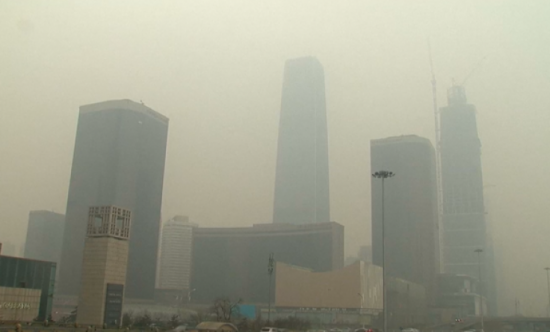
The city has been on its highest smog alert, coloured red. It has been under this alert for several days and the emergency measures remain in place until at least December 10. Schools are closed. Even indoor air is causing respiratory distress among children and the elderly. You can only drive your car every other day. Trucks and other heavy vehicles are banned.
Particulate matter levels, that is what makes Beijing’s air so visible, has reached 976 micrograms. Above 300 is considered hazardous. To see just how bad the air pollution has become check out the photograph at COP21: Thick smog veils Beijing during extreme pollution alert. The first photograph at this site has a slider to show you what you would see under normal air conditions and what you see now. It is frightening in the sense that this isn’t natural fog but rather totally human-made.
The picture of the two Air China aircraft at Beijing’s International Airport are a stark illustration of just how bad conditions are.

The particulate matter is so thick that the Sun can be mistaken for the Moon when ever it appears through the haze. And even during midday apartment dwellers have to keep their lights on.

China’s efforts to combat climate change are still in the future. The country has pledged to cap its carbon emissions by 2030 and then begin reductions. That means more particulate matter getting into the air and in urban centres, many more red alerts. Air pollution in China kills 4,000 people a day. That’s 1.6 million per year. The images seen here are human-created weather events. As one writer describes it “the demons of our own creation.”

]]>
Witness the recent headlines about the smog that enveloped Harbin, a city in northern China. If you are not familiar with the story, in October China shut down Harbin, a city of 11 million. Particulate matter (PM) readings in the air reached 1,000. The World Health Organization (WHO) standard is 20 and anything above 300 is considered hazardous to health. PM indices focus on particles with a diameter of 2.5 micrometers. Harbin’s air (see picture below) was so filled with this gritty soot that visibility was reduced to 10 meters (33 feet) and city buses were getting lost because they couldn’t see their routes. The smog was initially blamed on the beginning of the heating season but it persisted for days. If this were an isolated incident then maybe it could be considered tolerable. But last winter Beijing’s air reached a particulate matter reading of over 900 on one day in January.

Recently the WHO released a report that provided a statistical correlation between incidents of cancer associated with smog-filled air containing PM of 2.5 microns. In addition the report concluded that human lifespans were being shortened by air containg PM levels that today blanket so many of China’s cities.
Although the Chinese government has issued a carbon trading system in its major cities to begin to combat the problem of air pollution, it would seem that economic growth, the continuing mantra of the Communist government, runs counter to its anti-pollution initiative.
Currently the Ministry of Environmental Protection in China lists 4,189 factories and plants as the major contributors of air pollutants in the country. The Ministry claims that these facilities contribute 65% of China’s industrial smog. But what about the growing transportation sector in China and its contribution to pollution? And what about China’s many coal-fired power plants?
But can business as usual continue in China under such brutal environmental conditions? Not likely state the experts including those within China. If Harbin and Beijing’s recent experiences provide clues, business as usual is not possible. Harbin saw the government stop all construction and factory production. Cars and buses were forced off the street. People were told to stay in their homes. Economic paralysis was the result.
China is trying to cut coal use by heavily investing in renewable and nuclear energy. The country expects to double energy capacity by 2030 but how can it do this on renewables alone? At the same time China is considering putting restrictions in place for car ownership by charging congestion fees.
In a recent Massachusetts Institute of Technology study, the researchers concluded that high PM levels from pollutants were expected to reduce the life expectancy by 5.5 years for some 500 million living in Northern China. Michael Greenstone, one of the authors of the study was quoted, “We can now say with more confidence that long-run exposure to pollution, especially particulates, has dramatic consequences for life expectancy.” The study produced a metric that can be applied to any country. For every increased PM reading by 100 micrograms, life expectancy is lowered by 3 years. China between 1981 and 2001 consistently has had PM readings of 400. Compare that to the average in the U.S. during the same period at PM readings of 45. And shorter life spans from air pollution have been equated with reducing the Chinese workforce by one-eighth.

So the China we know today has to make fundamental choices about its future sustainability. Can the economy continue to be the central thrust of the Communist government’s policy? Or does the government have to rethink what is more important, unrestricted growth or the quality of life of its citizens? Greenstone states, “It’s not that the Chinese government set out to cause this….this was the unintended consequence of a policy that must have appeared quite sensible.” That quite sensible policy Greenstone refers to was the introduction of a great deal of private enterprise initiative into the Chinese economy and to develop the energy capacity to support a growing economy.
But back in July the government of China promised to invest $275 billion to combat air pollution. Will it be enough and will it be soon enough to reverse decades of environmental degradation not only to the air but also the land and water?
]]>