So that explains why the May 2013 400 ppm level was only temporary and seasonal. This May the annual oscillation in CO2 levels exceeded 404 ppm. But on November 1, 2015, CO2 levels had dropped to 399.06 ppm. Now compare those numbers with the same date in 2014 when CO2 levels were at 397.7 ppm. A year before that the level was 396.78 ppm. A decade ago it was 377.72 ppm. And for final comparison go back to 1750, before the Industrial Revolution got started, and look at CO2 levels from air trapped in ice cores taken from mountain and polar glaciers. The reading then was 278 ppm. We’ve gone up 122 ppm, an increase in CO2 concentrations of 42%.
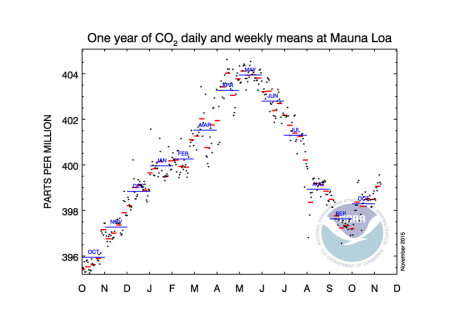 In the run up to COP21 in Paris where the nations of the world are hammering out a climate change agreement the hope is to limit further increases in CO2 to not exceed 450 ppm by mid-century. That’s an increase from 1750 levels of 62%, and 12.5% greater than current CO2 levels . At the 450 mark governments hope to keep global mean temperatures from rising no more than 2 Celsius (3.6 Fahrenheit). Scientists are quick to remind us that above 350 ppm we trigger global warming with 400 ppm already heading us into “uncharted waters.”
The second bit of science news “coincidentally” reported in the last week is that 2015 will be the hottest year on record for planet Earth if the remaining two months continue the trend of the first 10. According to climate scientists temperatures this year are beating past records “by a country mile” with 1 Celsius (1.8 Fahrenheit) the milestone being surpassed.
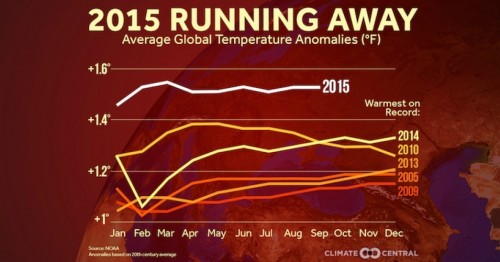
Now if you live in Eastern North America you may think this is nuts. After all didn’t we pass through a second frigid winter in a row? And this summer’s heat seemed unexceptional. So how can the scientists state this as the hottest year ever recorded? That’s because world mean temperatures are not governed solely by what happens in a single part of the world. The numbers being crunched are collected from all around the globe. In addition they reflect daytime highs and evening lows. And it is the lows that provide the biggest indicator of rising temperatures. We aren’t experiencing lows that are that low anymore. And so recorded temperatures are creeping up at rates previously unforeseen.
Then there are oscillations that we have witnessed for several decades. One of those is the mid-Pacific El Nino which this year is a further contributing factor to an exceptionally warm 2015. The impact on North and South America has been enormous and yet the El Nion has yet to peak which usually occurs just before Christmas.
Europe and Asia have not been spared the warmth. Having come back from a vacation in Central Europe, where my wife and I were witnesses to climate change first hand, we saw countries experiencing unprecedented warmth both day and night, evidence of extensive drought conditions with crops dead in the field, and a Danube River with water levels so low that our on the water cruise turned into a bus tour.
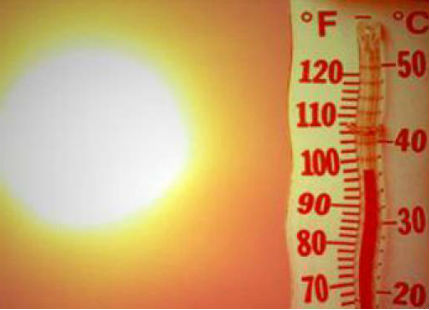
In India and Pakistan 2015 has proven unkind as well. Record heat in both day and night was described by the Indian weather services this summer, the 5th deadliest heatwave ever recorded. 2,300 died in India from the heat. In neighbouring Pakistan more than 1,000 deaths were recorded with scientists there describing it as the worst heatwave in three decades. Imagine daytime temperatures of 49 Celsius (120 Fahrenheit) in Karachi with nighttime temperatures dropping into the mid-30s (plus 90 Fahrenheit). Karachi is a city with little in the way of air conditioning.
Yes as our leaders convene in Paris we are heading into uncharted waters. And it is what we don’t know about future greenhouse gas concentrations that requires our focus because it is the one thing we humans can control if we make the effort and sacrifice.
]]>
Among the organizations attending the Paris conference are Moody’s, Mercer, Accenture, Standard & Poors, MSCI, Solactive, Kepler-Cheuvreux, Mirova, Credit Agricole, Carbon Tracker Initiative, Asset Owner Disclosure Project, Council on Economic Policies, Global Footprint Network, New Climate, CO Firm, Ecofys, Beyond Ratings, UNEP-Fi, WRI, and IIGCC.
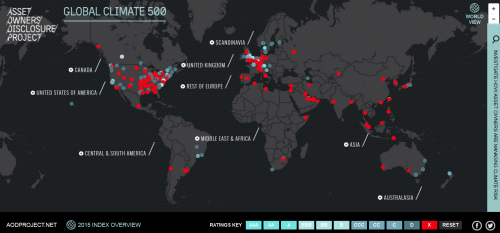
But these global low carbon leaders represent a small minority as many of the world’s largest investment firms continue to support high-carbon assets. In the most recent Asset Owners Disclosure Project (AODP), indexing the top 500 global asset owners managing $40 trillion U.S., 232 of them remained committed to high-carbon with no directive for investment into a low-carbon future.
As a retired person living off investment income I have been asking for full disclosure on my entire portfolio from my financial advisers. The bank to which my wife and I have entrusted our financial security is just beginning to address green and low-carbon businesses and this is happening to some degree because of social pressure from investors who read about climate change, stranded assets and the future.
AODP lists nine AAA best performers, all who measure climate change risk in portfolio decision making. These include by rank: Local Government Super (Australia); KLP (Norway); CalPERS (US), ABP (The Netherlands); Environment Agency Pension Fund (UK) New York State Common Retirement Fund (US); Australian Super; PZW (The Netherlands) and AP4 (Sweden). Note only one American and no Canadian asset managers make the list.
Julian Poulter, founder and CEO of AODP states, “People understand that governments will not regulate carbon properly but they now realise that these massive funds at the top our financial system have legal and financial responsibilities to manage climate risks.”
This third annual AODP report shows that business and the investment community still have a long way to go to make the paradigm shift to a sustainable low-carbon economic future. For example:
So it would appear that we, the public, and particularly those who rely on investment income, have an ongoing responsibility to make our investment and pension fund managers aware of our concerns related to climate change mitigation and adaptation. The adaptation includes a responsible transition to a low-carbon economy through green and sustainable investments.
The report contains more than 12,000 cited scientific references including journal papers, studies and metadata analyses. 1,729 experts in 84 countries, including natural and physical scientists, engineers, social scientists and others nominated by their governments, reviewed all drafts contributing more than 50,000 comments. Final acceptance involved a line-by-line review of the summary for policymakers from all 195 participating countries.
In addition to the formal document that included technical assessments and observations, plus the summary for policymakers, they included a section dedicated to FAQ, frequently asked questions. The questions are worth reading because they express some of the confusion that many have in trying to understand the difference between climate and weather, mitigation and adaptation, and other issues. Each answer in the FAQ section is cross referenced to content to be found in the technical assessments but the summary responses are insightful to read. One in particular stands out. It is a response to FAQ 5 which asks “Can science identify thresholds beyond which climate change is dangerous?”
I cite a portion of the response which states “while science can quantify climate change risks…based on the probability, magnitude and nature of the potential consequences of climate change, determining what is dangerous is ultimately a judgment that depends on values and objectives.”
Hence the question “what next?”
Are all nations committed to carbon reduction after all?
Governments like Australia, and Canada, seem to suffer from tunnel vision on the issue, more worried about extracting fossil fuels and shipping them to overseas markets, then the consequences of the burning of those fuels.
Are they alone in their indifference?
Some nations, like India, are put off by the latest assessment because developing nations are lumped in with the Developed World as net contributors to the carbon problem, not based on a per capita contribution but on the total amount of greenhouse gases which loads the dice against the former’s further development. India, right now has made a pledge to decrease emission intensity per population by 20 to 25% from 2005 levels by 2020. But overall emissions continue to climb.
Does that mean India will bug out or participate at Paris in December?
The Paris meeting is all about a global commitment to carbon reduction giving nations some leeway on putting their own spin on what that actually entails. Once a deal is concluded it will be important to know that a mechanism is in place to address “what next?”
Here are just a few of my immediate questions for the 195 country leaders who will gather in December.
If you have questions for your country’s leaders about carbon and how we can mitigate climate change impacts please share them here by commenting. I’ll be happy to publish them on this site, LinkedIn, Facebook and Twitter.
]]>