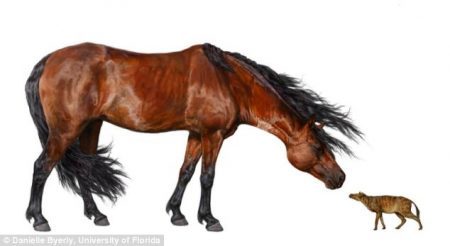
The geological record shows that smaller size is a consequence of global warming. During the Paleocene-Eocene Thermal Maximum (PETM), a hyperthermal event 56 million years ago, mammals shrank in size according to research done at University of New Hampshire and published on March 15, 2017, in Science Advances. The authors of the study describe perturbations in the global carbon cycle and rapid global warming at that time “analogous in many ways to present greenhouse warming.” So does that mean we may see dwarfing among mammalian species including ourselves as the world warms?
The research proposes that body mass responds to create more efficient ways to reduce body heat. Smaller bodies lose heat faster. Another advantage, smaller bodies need less food which may be vital in a world where food security may be compromised by climate change. The precipitation record during the PETM indicates extensive droughts which likely led to drier soil conditions and higher frequency of wildfires.
The hyperthermal lasted 180,000 years and is recognizable in both marine and terrestrial carbon isotopes. Temperatures increased over a 10,000 year period between 5 and 8 Celsius (9 and 14 Fahrenheit) degrees globally. In the Bighorn Basin of Wyoming, the record shows significant changes to mammals with rapid turnover in species and adaptation by survivors to smaller sizes.
The fossils found in sandstone and mudstone deposits give us a picture of dry floodplains and open-canopy forests. Fossils include reptiles, birds, amphibians, plants and mammals. Mena annual temperatures in the Bighorn reached between 19 and 26 Celsius (67 and 78 Fahrenheit) degrees. Analysis of fossil mammal tooth enamel including crown area of molars provides a high correlation to body size showing a decrease of at least 30% in mass during 130,000 of the 180,000 years the PETM lasted. Mammalian species studied include Arenahippus, an early horse, and Diacodexis, a small antelope herbivore.

Have we seen dwarfism in our own species caused by environmental change?
The closest analog is Homo Florensiensis, whose fossils were discovered on the island of Flores in Indonesia. Known affectionately as the hobbit, Florensiensis co-existed with modern humans from 50,000 to 12,000 years ago. A mere meter (3 feet, 3 inches) in height, Florensiensis may have been a population of Homo Erectus that shrunk in a process known as island dwarfism.

Island dwarfism has been seen in other mammalian species including:
The first story was about new permits for oil exploration. When President Obama committed the United States to reduce its carbon footprint by as much as 25% by 2025 he was targeting coal-fired power plants principally. At the same time the President expanded shale oil exploration throughout the continental United States and even issued permits for limited exploration on the Eastern seaboard. Now his latest pronouncement gives Shell and other energy exploration companies the go ahead to drill in the Arctic Ocean off Alaska.
Here are some relevant facts.
The United States isn’t reducing its carbon footprint at all. In fact 2013 data from the U.S. Environmental Protection Agency reported a rise in greenhouse gas emissions among major industrial emitters in that year. This likely reflects the return to growth in the American economy. The so-called progress in carbon reduction reported for several years by the government, therefore, speaks more to a contracted economy in recession than a carbon reduction strategy producing results.
Now with this Arctic drilling announcement, environmentalists are witnessing their worst nightmare scenario unfolding, an abandonment of principle by a President and administration they saw as green and committed to mitigating the causes of global warming. President Obama has never really been what environmentalists deemed him to be. He is pragmatic and conciliatory in nature on most issues seeking compromise. So the energy companies can see in him an advocate for “drill baby, drill” while environmentalists hold him up as a green President.
Well this “green” President has just awarded Royal Dutch Shell a tentative right to send rigs into the Arctic to find oil. This is the same company that survived a near disaster in the Chukchi Sea in 2012 when its last drilling platform, the Kulluk (see picture below), broke free in rough seas and ran aground. How ironic that they should be the first to get a green light. Expect BP and Exxon-Mobil to be given similar green lights in short order.

Then watch Canada follow suit with permits to international and Canadian energy exploration companies even though none have yet to fulfill the requirements designated by environmental regulators, to provide a guarantee to drill a relief well within the same season should a spill occur.
One of the little reported facts about the changing Arctic Ocean is a consequence of sea ice thinning and disappearing. When the sea froze more than it does today it had a calming effect on the water. Now with much more open water the Arctic winds are changing what was calm into an ocean like the others. Waves are getting higher and episodes of rogue waves have been reported. Imagine the potential impact that might have on a drilling rig outfitted for a different set of Arctic conditions and you can see disaster ahead.
And even more ironic is this. All of this new exploration that the President is authorizing comes in a period when the United States is already close to energy independence and the world is awash in petroleum with prices deflated.
So this was the first story that caught my eye. The second didn’t appear on the front page but rather near the back of the newspaper’s first section. It was entitled, “Canadian researchers help resolve ancient climate puzzle.” The article described research done at Canadian, U.S. and Australian universities into a period of accelerated climate change that happened 55 million years at the boundary between the Paleocene and Eocene. At that time the geological record shows global temperatures rose by 5 to 8 Celsius (9 to 14.4 Fahrenheit) degrees.
The warming evidence lies in the rocks that once were at the bottom of the ocean. Sediments containing radioactive carbon isotopes identify two pulses of carbon release leading to what is called the Paleocene-Eocene Thermal Maximum (PETM). One of those pulses lasted approximately 2,000 years in duration, and it was followed by a second of longer duration, possibly impacting a period of up to 10,000 years.
Explaining the carbon pulses was a bit of puzzle until researchers studied the geography of the world at that time. The oceans and continental configurations 55 million years ago bear a slight resemblance to what we see on our planet today (see world map below). A much narrower, deep North Atlantic Ocean, a wide open Tethys Sea where the Mediterranean is today, an Indian Ocean that could flow directly into to the North Atlantic through the Tethys rather than around Africa, and where the Isthmus of Panama is today, an enormous open channel for water to flow from the Atlantic to the Pacific.

The researchers believe from modeling the globe of that time that the North Atlantic’s peculiar geography explains the two pulses that led to the PETM. An underwater barrier or sill in the North Atlantic acted like a giant bathtub concentrating the initial pulse of carbon dioxide until it spilled over into the rest of the world ocean to create the second pulse. The carbon dioxide laden deep water currents moved like “a giant slime monster in slow motion,” states Kaitlin Alexander, PhD candidate, University of New South Wales, Australia, a lead author in the study.
The PETM event shows what happens when the Earth’s atmosphere becomes sensitive to increases in carbon dioxide. The initial pulse may have been absorbed by the natural carbon sinks of the planet – the ocean itself, the forests and other vegetation on land. But once these carbon sinks became saturated atmospheric carbon built up to cuases a significant rise in global temperatures lasting for thousands of years. The parallels to today in a world where natural carbon sinks are already becoming saturated and we are seeing the rise of atmospheric carbon dioxide, cannot be ignored. Yet it would seem that we choose to ignore the signs, having our cake and eating it too. That’s what we are doing when we continue to look for oil and gas when we know that extracting these fossil fuels will mean additional atmospheric carbon that will not go away for centuries if not millennia.
So that’s where these two stories intersect – one from the present and the other describing the geological record of Earth’s past.
We today are like a diabetic who craves sugar. We eat it knowing the consequences of what ingesting it will do. Does the diabetic need the sugar? Not without a countermeasure, insulin. Does the world need more oil? Not without a countermeasure sequestering the carbon it adds to the atmosphere.
That’s what we should learn from the record of the PETM event. None of us were around 55 million years ago to add to the Earth’s carbon footprint but we can see the evidence in the rocks. The Anthropocene, however, is where we are today and the carbon pulse we are experiencing of the last seventy years will be attributed to us. We can do something about carbon now to mitigate to some degree the damage already done. If we don’t we may be already experiencing it to some degree and certainly will be alive to experience even more of the consequences. For certain our descendants will live with them for centuries if not millennia.
The President of the United States and the rest of the world has to end the craving once and for all and rapidly initiate a transition to a low carbon future. That means stop the rigs from moving into the Arctic Ocean.
Related articles across the web
]]>