Those ideas have ebbed as the commercialization of outer space is taking hold first in the United States, and now in other nascent space programs in other countries. In particular, a number of private companies have become competitors to national space agencies and their previous monopoly in outer space. Space to be used for the benefit of all mankind, as first proposed in the 1960s, has now added a bottom line.
In 2015 the United States Congress passed legislation giving commercial companies the right to appropriate resources from space. Two laws, the Space Resource Exploration and Utilization Act, and the Commercial Space Launch Competitiveness Act, give American companies the right to exploit space resources including the mining and harvesting of minerals and water from the Moon, asteroids, and planets. The only exemption is the biology discovered. The latter of the two acts specifically states, “A U.S. citizen engaged in commercial recovery of an asteroid resource or a space resource shall be entitled to any asteroid resource or space resource obtained, including to possess, own, transport, use, and sell it according to applicable law, including U.S. international obligations.”
These laws reverse the American commitment to the Moon treaty of 1979 which forbade countries from exploiting our nearest space neighbour as well as planets and asteroids until an international agreement on common use was enacted. It would appear an international agreement is no longer likely, particularly in light of the rise of private companies focused on commercial space development. From commercial satellites in near-Earth to geostationary orbits around our planet, to robot miners of asteroids, it is not such a dramatic leap.
So it should be no surprise that America’s abandonment of space inviolability is being joined by others of which the first is the Grand Duchy of Luxembourg, the European Union’s tiniest member. This week Luxembourg enacted a new law with Article 1 stating, “Space resources are capable of being appropriated.” Responsibility for issuing permits comes from Ministries in charge of economic development and space activities. They are authorized to issue permits to any person requesting the right to explore and “use space resources for commercial purposes.” Rights will be granted to public companies, corporate partnerships, and private limited liability companies registered in Luxembourg.
One of those registered Luxembourg companies is Planetary Resources, founded in 2009. The government, along with the Société Nationale de Crédit et d’Investissement, a Luxembourg bank, has made a 12 million Euros investment and extended a 13 million Euros grant to this American company that now has its European headquarters in Luxembourg. Established in 2009, Planetary Resources describes asteroids as the resource that will “unlock the Solar System’s economy.”
The company intends to utilize space resources, particularly near-Earth asteroids, described as the “low-hanging fruit” of the Solar System. The focus will be on harvesting water and platinum. Water is seen as a space game changer for human presence in space. It can be drunk. It can serve as shielding for space habitations. In its molecular components, hydrogen can be exploited for fuel, while oxygen for life support.
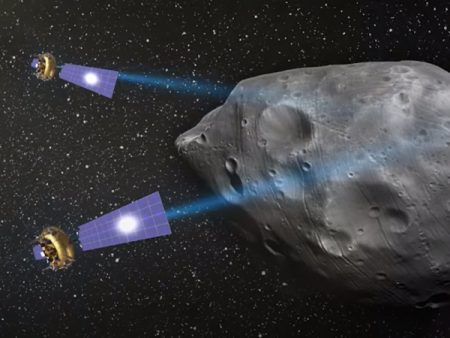
Planetary Resources is sending out robotic explorers to identify asteroids rich in minerals, particularly platinum, which on Earth is found at asteroid impact sites or is a product of volcanic eruptions. Platinum has many uses here on Earth and creating an almost unlimited supply will spur an era of innovation in advanced manufacturing.
So it would seem that Luxembourg’s new space appropriation law serves the country well. After all, they are creating a law to protect their investment.
]]>
But the Outer Space Treaty stressed that the “use of outer space should be carried on for the benefit of all peoples irrespective of the degree of their economic or scientific development…..desiring to contribute to broad international co-operation in the scientific as well as the legal aspects of the exploration and use of outer space for peaceful purposes….believing that such co-operation will contribute to the development of mutual understanding and to the strengthening of friendly relations between States and peoples.”
Article II of the Treaty, therefore, made it quite clear that no nation could appropriate any celestial body “by means of use or occupation.”
The Treaty largely modeled after a multinational treaty governing Antarctica, continues to be the standard by which we on Earth operate in space today. In 1983 China became a signatory to it, an important addition considering the ambitious program that country has announced with an ultimate goal to send taikonauts to the Moon and Mars in the coming decades, establishing a permanent colony on the former, and exploring the latter.
Which brings us to the question of commercial space operations and their counterclaims to ownership and operations in space. In a previous posting I wrote about the new space race, no longer involving just nations but also private companies. Planetary Resources has plans to mine asteroids for rare minerals and to build space infrastructure. NASA plans to capture an asteroid and tow it to a LaGrange Point in near Deep Space for study and practice with ambitions to send missions to Deeper Space. And companies like Bigelow Aerospace are in the throws of demonstrating space bubble accommodations with plans for hotels in orbit.
In the last week Robert Bigelow, founder of Bigelow Aerospace, has questioned the language of the 1967 treaty suggesting that in the light of the end of the Cold War, it be revised to reflect a new reality, the emergence of private enterprise in space. Bigelow envisions a Moon with operating mines engaged in extracting H3 and other resources scarce here on Earth. Bigelow, however, doesn’t want to be in the mining business. He is the hotel business and is the owner of Budget Suites, an American chain. So what he wants is to house and accommodate lunar miners in bubble domes of his creation modeled after his prototype Genesis I and II and the new habitat that will be deployed by NASA (see image below) as a module on the International Space Station in 2015.

It is interesting that the 1967 Treaty only prohibited declarations of national sovereignty over celestial objects in outer space. But it nowhere specifically stated that individuals could not own private property in space. I guess this was an oversight because the cost of getting into space was so prohibitive none of the Treaty signatories envisioned private enterprise ever getting involved without national backing.
But in 1979 a second treaty specifically governing the Moon did outlaw private property rights in space. The United States, however, was not a signatory. The lunar treaty attempted to establish a universal principle on ownership of any celestial body stating the the “Moon shall be the province of all mankind and shall be carried out for the benefit and int the interests of all countries, irrespective of their degree of economic or scientific development.” It appears that this latter treaty saw the Moon as a scientific preserve very much like Antarctica, to remain unexploited. But with the Americans non-participants in the lunar treaty Bigelow hopes that he and others may be able to establish title to property on the Moon and on other extraterrestrial bodies.
Bigelow has a point. The cost of putting payloads in low-Earth orbit is dropping as more private companies enter the space business. And the emergence of 3D printing presents a positively disruptive change to how we can build in space, making it possible to use materials we find there to create space infrastructure. The image below comes from the European Space Agency and is an artist’s rendering of an early lunar habitat concept entirely constructed using 3D printing technology. ESA states it has a printer that can construct a building at a rate of 2 meters (about 6.5 feet) per hour today with its next generation of 3D printers increasing output to 3.5 meters (11.5 feet) per hour allowing for complete construction of a habitat in a week.

So what is needed is a rethinking of ownership in outer space as suggested by the not-for-profit organization, The Space Settlement Institute, which argues that private ownership should be allowed to encourage settlement on the Moon and elsewhere in space. Ownership has always been a powerful driver for humans and it will considerably influence our activity in outer space as the rest of the 21st century unfolds.
