The discovery has been a closely guarded secret at JPL for several months. First the scientists wanted to make sure that any organic molecules found in the rock powder were not brought to Mars on Curiosity itself. Some are present inside the rover and their identity is known. Eliminating them still left unexplained organic compounds that could only be of Martian derivation.
A further complication in sampling Martian organic compounds comes from the presence of perchlorate minerals which have been found at the Phoenix and Curiosity landing sites. The perchlorate present in the organic samples when cooked in the on board laboratory alters their structures.
Multiple samplings at different places in Gale Crater and on Mount Sharp should verify that these earlier discoveries are no flukes. NASA published the results of the methane findings in the journal Science.
It is these methane findings that are most intriguing. Whereas organic compounds found in rocks may be evidence of past life, methane fluctuations in the Martian atmosphere speaks to something happening in the present.
The sampling done by Curiosity over 20 months measured four spikes in methane, rising from 0.7 parts per billion to 7.0. On Earth methane comes from living things and once live things. Termite mounds emit methane. Marshlands as well. Cows and other livestock are an enormous methane source. You and I just like livestock pass methane gas from our gut to the atmosphere. Man-made wetlands like rice paddies produce huge quantities of the gas. And even the oceans produce methane trapped in icy sediments (methane hydrates) or from decaying organic matter. Besides the ocean’s icy sediments we find methane produced from the mining and combustion of fossil fuels including coal, oil and natural gas. And finally, when we throw out the things we consume into landfill, we create another rich source of organic matter that emits methane.
There is one non-organic source for methane gas on Earth. It comes from the Earth’s mantle, the 2,900 kilometer thick semi-solid layer of rock beneath the Earth’s crust. In this subterranean area of our planet, where pressures are 50 to 100,000 times that of our atmosphere and temperatures exceed 2,500 Celsius (4,500 Fahrenheit) degrees, methane forms when iron oxide, calcite and water interact. This subterranean methane can be found at depths between 100 and 200 kilometers (62 to 124 miles).
Could a similar chemical interaction on Mars produce the results Curiosity has reported? The answer is no. An ongoing present source is the only explanation for the current methane spikes that the rover has detected. And the likely source, whether NASA is prepared to admit it or not, is organic.
Of course we still don’t have a living microorganism to show from the rover’s sojourn on the planet. But we sent Curiosity to Mars not to discover life but to look for evidence of organics and water. And now it has found both.

From its slightly skewed landing Philae’s Navcam took some pictures. One seen below shows a thin layer of regolith covering ice underneath. This ice was found to have the consistency and strength of sandstone partly because it is an ice-regolith slurry and because of low temperature at the comet surface.
The scientists even got Philae to deploy its sampling drill and were able to extend it to its full extent and then bring it back up. Preliminary results indicate the comet has a very porous interior with a hard icy and dusty outer layer, 10 to 20 centimeters (4 to 8 inches) thick.
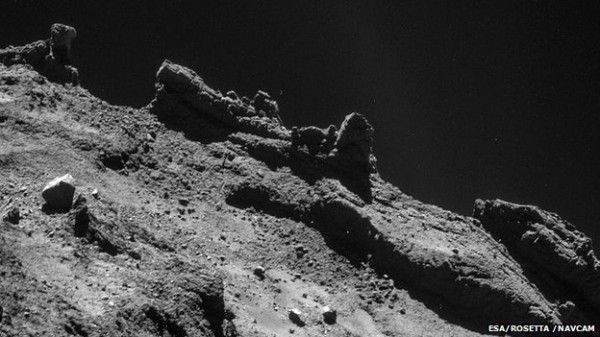
With its battery drained Philae is asleep now but the initial 60 hours of readings, still being analyzed by the European Space Agency team, should reveal more about the extent and nature of the comet and the organic molecules found there.
For cosmologists the finding of carbon and organic compounds is an affirmation of a theory that the elements of life can be found in abundance throughout the Universe and have been a part of the Solar System since its formation over 5 billion years ago. That theory, panspermia, was first proposed by a Greek philosopher, Anaxagoras, in the 5th century BCE. It reemerged in the 18th century when a natural historian, Benoit de Maillet, described the seeding of Earth from space leading to life.
Lord Kelvin, William Thomson, one of the 19th century’s prominent physicists and engineer, was a proponent of panspermia although a critic of Darwin’s theory of evolution. Kelvin was convinced that the Solar System was a mere 40 million years in age, and, therefore, Darwin’s natural selection, requiring a much greater amount of time to explain the evolution of species, couldn’t be right.
In 1871, however, Kelvin wrote “we must regard it as probable ….that there are countless seed-bearing meteoric stones moving through space…..one such stone falling upon [Earth] might by what we blindly call natural causes, lead to its becoming covered with vegetation.”
Fred Hoyle, the famous British cosmologist of the 20th century and author of the discredited steady state theory of the Universe, revived panspermia. But most scientists disagreed with his hypothesis. And then a meteorite found in Antarctica back in 1984 and analyzed in 1996, believed to have originated from Mars, was found to contain microscopic evidence of nanobacteria. Although controversial (was this life or a chemical reaction within the rock) the finding put more credence to the viability of panspermia. A lesser known discovery in 2001 by molecular biologists from the University of Naples found evidence of alien bacteria deep inside a meteorite determined to be 4.5 billion years in age. The DNA although similar to some modern bacillus bacteria was not a match for anything found to date on this planet. Even Stephen Hawking has speculated that in venturing into space we will find DNA adrift or coating the surface of primordial bodies like comets and asteroids. That will be humanity’s close encounter.
So with Philae finding carbon and other organic compounds on Comet 67P/Churyumov-Gerasimenko, it is affirming that panspermia may very well be the explanation for how life spread from space to Earth through the encounter of our planet with a comet, asteroid or meteorite.


