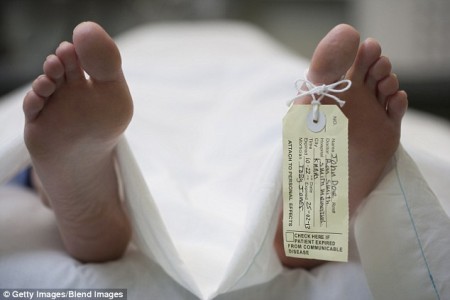
The genes in question have been given a name by the researchers. It is thanatotranscriptome. And in a paper appearing online in bioRxiv, the process is described. Apparently the gene response kicks in within 30 minutes after death, and some wait 24 to 48 hours before kicking in. Thanatotranscriptome genes are associated with stress, immunity, inflammation, apoptosis (the controlled death of cells during normal growth and development), transport development, epigenetic regulation, and cancer.
One newspaper in reporting this discovered phenomenon ran the headline, Could there be life after death? The research has been done at the University of Washington. What scientists discovered is that in both mice and zebrafish, the genes affected were those that sent instructions to proteins or were regulatory, indicating that in death energy was still being consumed. Many of the genes identified are associated with self-organizing, including embryonic development processes. So it is as if in death life attempts a restart. But other genes may be demonstrating another behavior after death, an orderly process of system shut down.
The discovery of cancer genes expressing themselves after death may give scientists answers to why organ transplants from deceased donors produce higher incidents of cancer in recipients.
And as a final note the other key beneficiary of this new knowledge is criminal science. Knowing that genes continue to express themselves after death will give forensic specialists a more accurate measure for calculating time of death in criminal cases. A parallel paper published in the same journal describes the implications of the new discovery for criminology.
What the Heck is the Higgs Boson and What Does it Mean for Us in the 21st Century?
When scientists get excited about a discovery like the one announced this week it is hard not to jump on the bandwagon and acknowledge the progress made to unlock the mysteries of the Big Bang, matter, antimatter, dark matter, energy, dark energy and the quantum sub-atomic realm.
But what does the Higgs Boson particle discovery mean practically speaking? To answer this question you have to appreciate what this particle means to other sub-atomic particles. The Higgs Boson is the attractor that makes sub-atomic particles associate with each other. It acts like an invisible force field giving other particles their mass. Without the Higgs Boson electrons wouldn’t exist, and without electrons atoms wouldn’t exist, and without atoms we wouldn’t exist.
Consider the importance of electrons to our technical society (all of our energy and power generation is based on what electrons do) then it’s good to know our understanding of how things work in the universe is confirmed by this discovery.
Billions of dollars have been spent searching for the Higgs Boson as nations cooperated to build the Large Hadron Collider. And now with it built the Collider can make important contributions to science, and feed technology innovation in a number of fields from biomedicine, to manufacturing, to energy, computing and space science.
It’s hard not to argue that advances we have made in scientific discovery in the past have always led to new technology. So hats off to the scientists at CERN and to future discoveries from the Large Hadron Collider. And before I end this topic I leave you with the following:

Biomedicine Update: Move Over Higgs Boson as Researchers Discover Holy Grail of Tissue Engineering
Newts and other amphibians can regenerate lost limbs. Some reptiles can regenerate lost tails. Even humans can regenerate bone to heal fractures. But regenerating lost brain cells, heart muscle, or insulin-producing pancreatic cells has been only a dream until now.
Well according to the Journal, Comptes Rendus Biologies, scientists at the University of Paris Descartes and University of Maryland, adult bone marrow stem cells harvested from mice were used to generate multiple tissue types for use in cell replacement therapy.
If the mouse study can be replicated in humans we will have the ability to replace damaged organs without transplants and the need for immune suppressants.

Energy Update: Paint on Batteries
What if you could spray paint batteries on to any surface from a ceramic tile to a piece of paper? That’s exactly what researchers at Rice University, in Texas, hope to achieve. They have developed technology to spray-paint battery structures on surfaces. The anode and cathode, that is the negative and positive halves of the battery are kept apart using poly-methyl methacrylate. A sequence of five separate paint layers, each no more than 0.5 millimeters in thickness, makes a battery with efficiencies equivalent to the traditional lithium-ion batteries we use today in portable electronics. The flexibility these batteries provide should make them attractive to consumer-electronics and industrial manufacturers.

Materials Science Update: New Adhesives Created from Barnacles
Current adhesives are typically made from petroleum byproducts. But nature demonstrates adhesives with remarkable bonding capability, almost impossible to break. The Buoy Barnacle, Dosima Fascicularis, produces an adhesive that allows it to stick almost anywhere in the marine environment. Naturally its adhesive can cure under water.
So a research team at the Fraunhofer Institute for Environmental, Safety and Energy Technology in Bremen, Germany, is studying the barnacle to isolate the amino acids and proteins that constitute the properties of the adhesive with the goal to use it in medical applications such as closing surgical incisions, and supporting pins and screws in repairing bone fractures.

Space Science Update: Could We Build the U.S.S. Enterprise Today?
An engineer has proposed that much of the technology needed to build a starship like Enterprise exists today not including warp engine technology and transporters. For example we have technology today that was seen as futuristic in the 1960s when Star Trek first appeared on television. Touch screens, communicators, sliding doors, talking computers, and replicators (think 3D printers) are available to us today. Even impulse engines represent technology currently under development in NASA’s Advanced Propulsion Physics Laboratory.
Unlike the TV Enterprise, the one proposed would use a rotating structure in the saucer section of the spacecraft to create artificial gravity.
You can check out the website at BuildtheEnterprise.org.

Our human population globally shares 4 major blood types. In some countries these types are referred to with different classifications (in Russia, for example, they are referred to as 1, 2, 3 and 4) but generally through most of the world they are defined as A, B, AB and O. Blood that is classified as A contains an antigen or protein that makes it compatible only with other people with A or AB blood types. Blood that is classified as B contains another antigen that works only with B and AB blood types. Those with AB blood contain two antigens that makes it possible only to receive blood from another with AB blood. Those with O blood have no antigen and can therefore be compatible with any other blood type. When blood isn’t properly type matched the presence of an antigen can lead to a dangerous reaction in the person receiving the blood.
Rhesus monkeys share many of our biological characteristics. The Rh protein is named after them and when present in blood is referred to as a positive, or Rh+. The absence of Rh protein is negative or Rh-. So all blood types are a combination of these four different types plus the existence or non-existence of Rhesus proteins. Hence we have A+, A-, B+, B-, AB+, AB-, O+ and O-. This has been our general understanding of the major blood groups since Karl Landsteiner, an Austrian, first made the discovery in the 1890s, and since our discovery of the Rhesus protein in the first half of the 20th century.

But the science of blood typing has led to further refinements since the mid-20th century and up until a few months ago we had identified 30 variable proteins. Some of these go by such interesting names as Duffy, Kidd, Diego and Lutheran. Now we can add two more named Langereis (Lan for short) and Junior discovered by the combined work of researchers at the Japanese Red Cross Osaka and Hokkaido Blood Centers, the University of Vermont and the French National Institute for Blood Transfusion in Paris. Right now both of these new blood group proteins are considered very rare but with their identification routine screening for the proteins can become a global standard.
Matching blood proteins is extremely important for ensuring successful organ transplants. Any one of these blood proteins in the donor could, if incompatible with the recipient, lead to organ rejection as the body automatically creates antibodies to defend against what is seen as a foreign invader.
Currently populations most susceptible can be found in Japan and among European Roma who are at higher risk because they do not have the Lan and Junior proteins. Scientists believe there are more unknown blood types, as many as 10 to 15, still to be discovered.
]]>