Opportunity uses flash and RAM memory. The flash memory stores information relayed from Earth as well as data that the rover collects as it rolls along. But over a decade that flash memory, divided into seven banks, has been overwritten so often that it is beginning to fail. The problem has been isolated to the seventh bank.
Keeping a ten-year old rover operational is an amazing feat of technical skill. The engineers have been using the RAM memory which is temporary to send instructions every few days to the rover. But each time the rover’s memory freezes, it has to reboot and that means the instructions in RAM get wiped out. So now the team on Earth is prepping to do a partial lobotomy on the rover’s seventh flash memory bank. Talk about a long distance operation. But it will be worth it if they succeed because Opportunity should then be ready to continue the mission.
Why is that so important considering the Curiosity rover is going full tilt in the Gale Crater? Because Opportunity is in a different location and continues to make interesting discoveries. Some of the past ones include:
And now the engineers want Opportunity to keep going because a little more than 650 meters (approximately 2,100 feet) from where it is at present is an exciting area on the planet surface that NASA has called Marathon Valley. This valley contains clay deposits which may date back 3.5 billion years.
At its present speed when in motion of 3.75 centimeters (approximately 1.48 inches) per second the rover if continually on the go could reach Marathon Valley in approximately 12 Earth days. But Opportunity will make course corrections as well as find things along the way to distract it and its Earth operators, so I suspect it is probably going to be a month or more before it reaches its next milestone location. With the Martian winter approaching Opportunity will have to find a good place to lay over ensuring it maintains a good angle to the Sun for collecting energy through its solar array.
The composite image taken on Sol 3,861 (December 2014) courtesy of NASA, the Jet Propulsion Laboratory at Caltech, Cornell and Arizona State Universities shows you what lies ahead for the little rover whose 90-day original mission has exceeded the distance of a marathon over a decade, a remarkable achievement.
Postscript at the end of 2014
I want to thank all of my faithful readers who continue to make the writing of this blog a fulfilling task. I don’t do this for money. I do this because I remain going into my 66th year of life relentlessly curious about life and this amazing Universe. We humans are privileged riding on our “pale blue dot” in the midst of a vast ocean of space. Let’s hope that in 2015 we become better stewards of its largesse. To all of you who keep coming back here, a healthy, safe and prosperous New Year.


Opportunity (its self portrait seen in the image above) has been showing signs of senility at age ten. That’s because the outdated processor and flash memory contained in its computer has been well used with the memory overwritten many times. This is leading to many failed sectors in the flash memory and these need to be isolated and avoided in the future.
As evidence the JPL team has had to perform dozens of resets of the rover’s main computer system for gathering data and pictures from Mars, and every reset occupies a day or two making Opportunity less useful as a research outpost, and more a tottering patient enduring continuous health maintenance and monitoring.
So NASA and JPL have decided to wipe Opportunity’s flash memory clean and reformat it. Now I have reformatted my hard drives (not flash memory) here in my home office, but never have I had to try doing this to a drive 200 million kilometers (125 million miles) away. Reassuringly John Callas of JPL points out that “the flash reformatting is a low-risk process, as critical sequences and flight software are stored elsewhere in other non-volatile memory on the rover.”
Reformatting is planned for this month with the JPL team currently downloading all useful data from the rover to save it. JPL slowed data transmission rates to ensure accurate information transfer. All this is being performed on a system that we would consider positively archaic today. The onboard computer’s main chip is an IBM 20 Megaherz RAD6000 RISC processor. This would be state-of-the-art for the mid 1990s, not 2014.
Flash memory is small, a piddly 256 Megabytes. I have an SD memory card that I took out of my two-year old digital camera last week with 1 Gigabyte of storage. A 40 Gigabyte SD memory card sells for as little as $40 Canadian in stores today. Too bad we can’t FedEx or UPS one up to the remarkable rover to keep it doing its thing. But this JPL operation is at least an opportunity to keep Opportunity going possibly for many more years to come.

So far Opportunity and its now lifeless sister rover, Spirit, have made some amazing discoveries including:
Seems fitting, therefore, to talk about this on Labour Day with a team working hard here on Earth to help a tiny robot sent to the surface of Mars.
Well when I read NASA’s initial releases I never saw any mention of the actual size of this mystery rock. Turns out it is just under 4 centimeters (1.5 inches) in diameter. So the analogy to a jelly doughnut which appeared in many media outlets seems inappropriate, more likely no bigger than a Timbit (for those not Canadian, Timbits are the mini doughnuts made by a Canadian food chain from excess dough carved out of the doughnut hole).
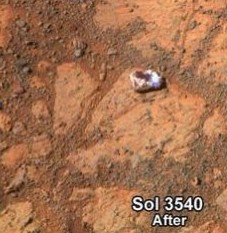
So how did a rock fragment suddenly appear in a picture when it wasn’t there several weeks earlier? One of the theories speculated that Opportunity‘s wheels dislodged the rock fragment during transit. So NASA panned the camera on Opportunity to look around and lo and behold discovered that the theory was correct.
The mystery rock came from a parent rock located a few centimeters away. In the picture below you can see the parent at the top of the frame and the mystery rock in the bottom left corner. Those tracks are not footprints but the tread of one of Opportunity‘s wheels.
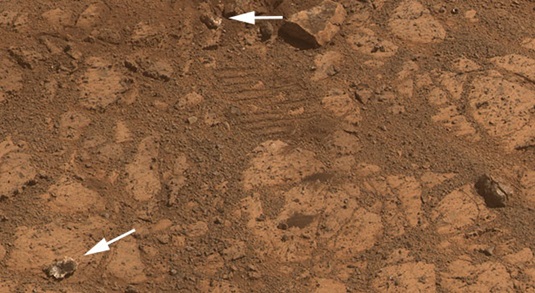
Opportunity gave both rocks the once over with its alpha particle x-ray spectrometer and microscope. Turns out why the rock looks so different from the surrounding regolith is because it contains very high concentrations of manganese and sulphur. These likely suggest the rock was exposed to water at some point in the past. This could have happened recently or in Mars’ ancient past.
More importantly, Opportunity is still the little rover that can. With Martian summer arriving in its vicinity it is off to study a nearby boulder-studded ridge which shows multiple layers of rock laid down sometime in the last billion years.
In the latest findings reported in an article entitled, Ancient Aqueous Environments at Endeavour Crater, Mars, appearing in the journal Science, we read about a Mars whose geochemistry indicates extensive surface freshwater some 3.8 billion years ago. In the area known as the Meridiani Plains, Opportunity‘s investigations indicate the existence of extensive freshwater rivers and streams suitable to microbial life here on Earth. That doesn’t mean Mars supported microbial life at the time but the conditions were certainly hospitable in this region of the planet seen in the map below. The history also shows that an asteroid impact ended this Eden, subjecting the area to a rain of destruction that turned the freshwater as acidic as vinegar.

The scientists can discern this by studying the different minerals that formed in the sediments of these freshwater streams and rivers. Analysis of the minerals in a geological feature called the Matijevic formation, rich in clay minerals, shows that these mudstone deposits were laid down by water formed in life-favorable conditions. Above the Matijevic formation a younger deposit indicates much harsher conditions with mineral deposits showing evidence of highly-acidic water.
Meanwhile Opportunity has just survived another Martian winter and compliments of a wind storm had a solar panel cleaning to give it a fresh start for its 11th year on the surface of the planet.
Seen below are the mudstone deposits discovered by Opportunity on the rim of Endeavour Crater.

The Opportunity discovery follows on similar discoveries by Curiosity at Gale Crater where the latter has detected evidence of freshwater rivers and lakes in Mars’ geological record. Back in December of 2013 a paper published in Science Magazine described rock samples that were evidence of a freshwater lake in the vicinity of Yellowknife Bay. The mineral deposits, like the ones found by Opportunity indicate water with a neutral pH, very suitable for life. The size of this ancient lake – approximately 50 kilometers (31 miles) long and 5 kilometers (3 miles) in width. The scientists who reported the evidence state that any microbes from Earth could easily have survived in this ancient body of water which appears to have endured for at least 100,000 years.
What we can conclude from both rovers is that Mars in its ancient past was far more Earthlike and in these conditions which lasted several hundred million years was highly suitable for the emergence of life. Although no past life has been detected (neither rover was designed to search for fossil evidence), the future rover that NASA plans for 2020 may include instrumentation capable of finding that evidence. What would be great is if we could bring back those experiments first done on the Viking landers and repeat them with the future rover. Then we could determine if life not only existed in the past but continues to thrive in the present.
Using Opportunity’s robotic arm the Jet Propulsion Laboratory (JPL) team has been studying what they have called a “jelly-doughnut” rock and found that its unlike any of the rocks around it. It has high sulfur, magnesium and manganese content and the chief scientist at JPL is quoted as saying it is unlike “anything we’ve seen on Mars.” He goes on to say “I don’t know what any of this means. We’re completely confused, we’re having a wonderful time.”
The team is convinced that one of Opportunity’s wheels dislodged the rock although the rover never traversed the surface that appears in the two pictures.
In colour images you can see just how different the rock is from its surroundings, much brighter in appearance and looking strangely out of place.
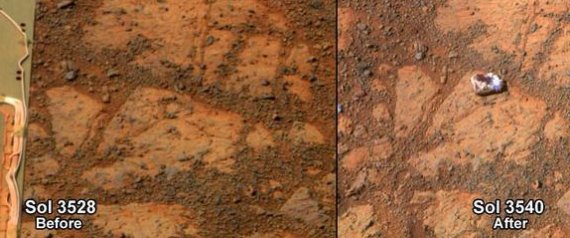

The lead scientist for NASA’s Mars Exploration Rover is Steve Squyres of Cornell University. The explanation for this errant rock’s appearance – debris from a nearby meteorite strike that became dislodged and deposited within Opportunity’s field of view, or debris kicked up by one of Opportunity’s six wheels as it rolled across the Martian landscape.
In any event it certainly adds to the evidence already that Mars is far from a static environment. For those of you who are fascinated by the ten-year journey of Opportunity, the little rover that continues to demonstrate great resilience, check out “10 years on Mars.”
Today it is continuing to explore the edge of 22 kilometer wide (14 mile) Endeavour Crater (see image showing Opportunity‘s travels below). It plans to winter there at a good Sun angle to allow it to continue to recharge its batteries. But before it stops it will travel another 2.2 kilometers (1.4 miles) to its winter destination, Solander Point on Endeavour’s rim. Opportunity should arrive at Solander Point sometime in August.
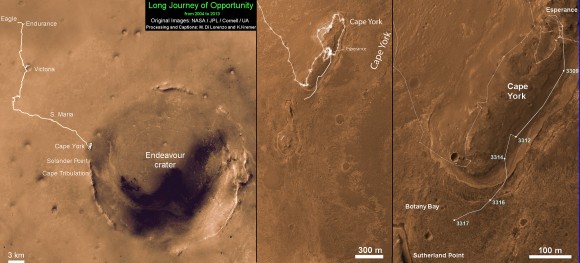
Over the ten Earth years and more than 3,300 Sols (Martian days) we have learned a lot from this robotic rover. Most recently it made an exciting discovery — that Mars at one time had water running through seams in rocks, and that the water had favorable pH levels conducive to living organisms. This discovery was made by Opportunity as it used its still functioning rock abrasion tool to expose clay minerals which it then studied with its microscopic camera and x-ray spectrometer. The rock that it examined has been named Esperance. It contains higher levels of aluminum and silica than other rocks the rover has examined in its over nine year sojourn on the planet’s surface.
Up until now the rocks Opportunity found would have formed in environments with highly acidic water not conducive to life. This was its second discovery of clay mineral deposits which could only be created through active water flow.
So happy anniversary to Opportunity, the Martian rover that continues to unfold the mysteries of Mars while exceeding the wildest expectations of NASA scientists. And watch NASA’s latest science news cast about Opportunity‘s ten years of travel on YouTube.
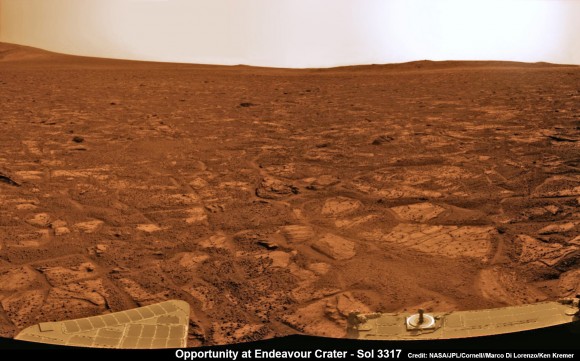
]]>
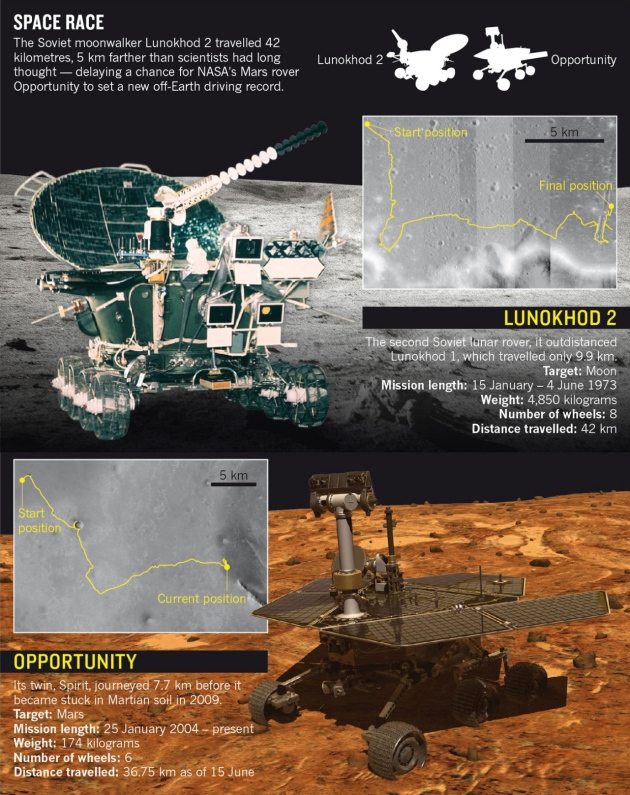
In my blog posting of June 6 I had stated that Lunokhod 2 held the record at 37 kilometers and Opportunity was still at 35.76 and approaching Lunokhod’s feat. But it turns out that revised calculations done by Moscow State University based on imagery from the Lunokhod 2 landing site puts the record at between 42.1 and 42.2 kilometers. The confusion on the actual record is blamed on a ninth wheel that dragged rather than spun around creating false readings.
By the way Opportunity passed 36.75 kilometers on June 15. So under 6 kilometers to go before the Mars rover takes away the Soviet mark set over 40 years ago.
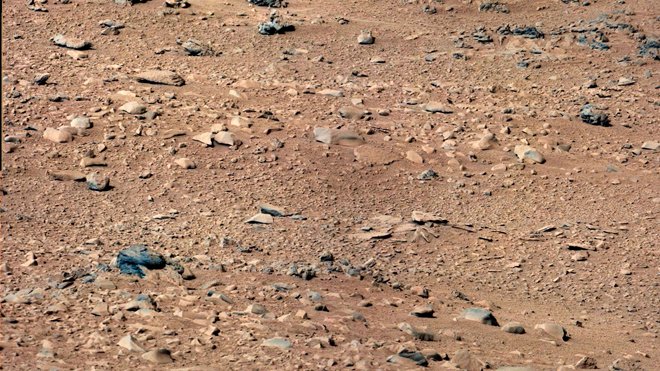
Today I focus on three Mars’ stories. One involves a Curiosity image of a rock that looks like a rat scurrying about on the surface of Mars. First reported by a Japanese blogger with an active imagination, the story soon showed up in major news media and made the rounds for about 24 hours. All I can say is that lighting and shadows can do so amazing things in a photograph.
Judge for yourselves what Curiosity saw. The likeness of a rat appears sandwiched between two rocks roughly two-thirds from the bottom of the picture below on the left side. If you look closely there is a rock below the rat that looks like a severed fish tail. I wonder if the rat caught the fish.
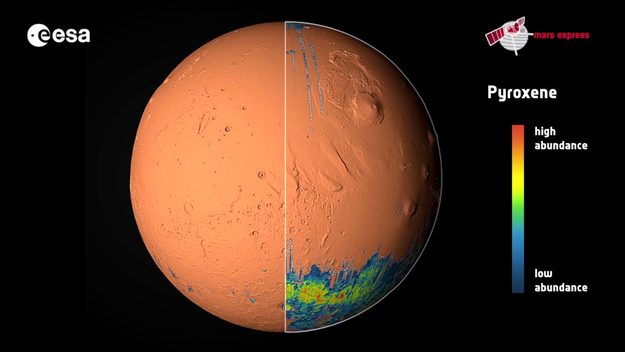
On to more serious Martian announcements. Of greater importance in the last week, a Martian spacecraft celebrated a decade in orbit around the planet – the European Space Agency’s (ESA) Mars Express. In celebration ESA released a video atlas of the planet featuring a map showing the planet’s complex geography and geology, and highlighting mineral distribution in deposits produced through vulcanism, past water events and ongoing wind and dust storm activity.
An added bonus from Mars Express‘ ten year coverage of the planet are its many close encounters with Phobos, the Martian moon. One of those encounters in 2010 took the spacecraft to within 67 kilometers (less than 40 miles) of this captured asteroid. The video by Mars Express in another Phobos encounter dramatically shows the moon passing in the foreground with the planet Jupiter behind, a truly remarkable piece of footage.
For a mission that upon its arrival near Mars began with its lander, the Beagle 2, crashing to the surface, Mars Express has since been a ringing success. It is expected to operate for many years into the future giving us an unparalleled view of the planet surface while keeping an eye on Curiosity and NASA’s nine year wonder, Opportunity. Last month the latter achieved a new milestone surpassing 35.76 kilometers in travel distance since arriving on the planet. Only Lunokhod 2, the Soviet rover of 1973 has outdistanced it having achieved 37 kilometers on its lunar mission.
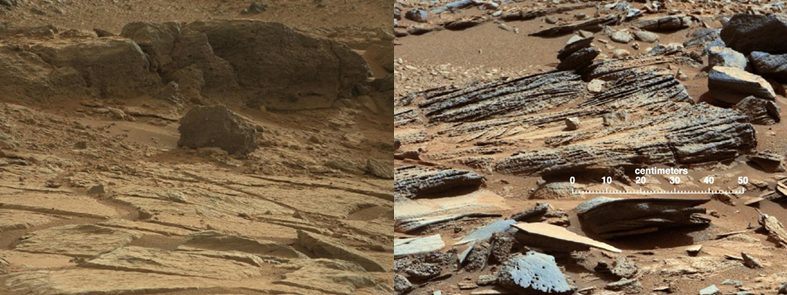
And speaking of Curiosity, it has experienced ups and downs of late with a number of shutdowns and reboots to shakeout some of the bugs that seem to have plagued it. It has drilled into two rocks and extensively photographed what appears to be ancient stream beds. In total it has traveled less than a kilometer to date (about half a mile). But now it is ready to start doing some real long distance driving across the bottom of Gale Crater and on to Mount Sharp at the crater’s centre. The route has been mapped and it is expected to take about ten months to travel the 8 kilometers (5 miles). Why so long? Because Curiosity will make stops along the way. For example it has a planned stop to examine the remains of some of the landing gear that got it to Mars. It will do more drilling of interesting rock samples. Plans include checking out two rock formations, one called Point Lake (seen below on the left), the other given the name Shaler (seen on the right). Both appear to be remains of rocks formed by chemical or wind-induced weathering.
And that’s the real news from Mars. And now back to unpacking here on Earth.
Thanks for dropping by.
]]>


