In our building, the pre-Christmas rush of online shopping deliveries was overwhelming last year. The building had to empty an office and designate it for the overflow of parcels that came through the lobby. Every day, UPS, FedEx, CanadaPost and other couriers marched through our doors.
It is no wonder that “bricks & mortar” small businesses have suffered as well as large department store chains. Only those who have adopted a mixed model of both “bricks & clicks” may survive this paradigm shift in consumer preference.
Buying online isn’t just disruptive to existing business. It is also an environmental threat, increasing greenhouse gas (GHG) emissions while creating tons of unnecessary waste that clutters recycling and landfill sites.
In a recent United Kingdom research study it compared three types of shopping experiences:
The first option produced 0.1 kilograms of GHGs per unit purchased. The second produced 0.07 kilograms. And the last produced 0.18 kilograms.
Why was the second option the lowest producer of GHG emissions? Because the tendency to order more than one item with a local supplier brings down the per-unit GHG contribution. And the GHG contribution is shared with other purchasers when the store optimizes its deliveries using a single vehicle for the job.
We are living in the age of fast-moving consumer goods (FMCGs). Ordering from Amazon is a case in point particularly if you are a Prime subscriber. But this sell-and-distribute-quickly model is environmentally dangerous. The global reach of an operation like Amazon sources its products from the entire planet. The item you order online could come from China, or Vietnam, and be put into containers and freighted to a North American distribution centre for reshipment. The accumulated GHGs from these types of orders cannot be underestimated.
The study which was published in Environmental Science & Technology recognizes that FMCGs have become attractive to consumers because of convenience, low prices, and quick delivery. The model isn’t set up to be environmentally sustainable.
The researchers, however, have some suggestions on ways to bring down GHGs from pure-online purchases. Here are some of them.
A final observance from the study: online shopping doesn’t necessarily substitute for traditional local shopping. Instead, it appears to be a stimulus to shop and appeals to impulse buying behaviours. So the net result is we end up with GHGs from both the pure-online as well as local-shopping experience.
My conclusion is we would all be far better off if we shopped less and made do with what we have.

Last year, 3.8 billion people were connected online. By 2024, thanks to 5G, stratospheric and space-based satellites, we will grow to 8 billion people online, each with megabit to gigabit connection speeds. These 4.2 billion new digital consumers will begin buying things online, a potential bonanza for the e-commerce world. Entrepreneurs seeking to service these 4-billion+ new consumers will be able to skip the costly steps of procuring retail space and hiring sales clerks.
That’s because today, thanks to global connectivity, contract production, and turnkey pack-and-ship logistics, an entrepreneur can go from an idea, to building and scaling a multimillion-dollar business anywhere in the world in record time.
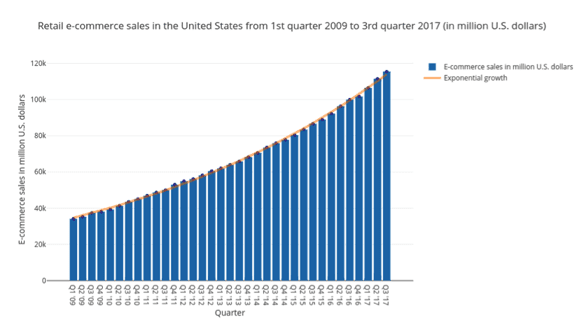
And while e-commerce sales have been exploding (growing from $34 billion in Q1-2009 to $115 billion in Q3-2017), e-commerce only accounted for 10 percent of total retail sales in 2017.
In 2016, global online sales totaled $1.8 trillion. Remarkably, this $1.8 trillion was spent by only 1.5 billion people – a mere 20% of the Earth’s population that year.
There’s plenty more room for digital disruption.
For business owners
Artificial Intelligence (AI) is about to demonetize e-commerce operations by automating customer service, creating ultra-accurate supply chains, and through marketing content generation and advertising.
AI-Customer Services: Imagine an AI that is trained by every customer interaction, learning how to answer any consumer question perfectly, and offering feedback to product designers and company owners.
Facebook’s Handover Protocol allows live customer service representatives and language-learning bots to work within the same Facebook Messenger conversation.
Taking it one step further, imagine an AI that demonstrates empathy in dealing with a consumer’s frustration, that takes any amount of abuse and comes back with a smile every time.
Meet Ava. States Greg Cross, CEO of Soul Machines and the technology creator, “Ava is a virtual customer service agent, to bring a whole new level of personalization and brand experience to that customer experience on a day-to-day basis.”
Optimized Supply-Chain: Predictive modeling and machine learning are optimizing product ordering and supply chain processes.
Skubana, a platform for online sellers, is a good example. This AI leverages data analytics to provide entrepreneurs constant product performance feedback and to maintain optimal warehouse stock levels.
The Blockchain is set to follow suit in the retail space. ShipChain and Ambrosius plan to introduce transparency and trust into shipping and production, further reducing costs for entrepreneurs and consumers.
For consumers
Personal shopping assistants are changing the standard shopping experience. Amazon’s Alexa is part of that change. In its infancy the voice assistant that provides online search, as well as the ability to interface with smart home devices, is graduating to become a portal to Amazon.com and online purchasing. To illustrate the impact, households with Alexa purchase more than standard Amazon Prime customers who don’t have the home assistant. The difference is $1,700 versus $1,400 annually.
And as I’ve discussed in previous blogs, where the future combination of virtual reality shopping, coupled with a personalized, AI-enabled fashion advisor will make finding, selecting and ordering products fast and painless for consumers, we can go a step further. Imagine a future where your personal AI shopper knows your desires better than you do. Possible? I think so. After all, future AIs will follow us, watch us, and observe our interactions, including how long we glance at objects, our facial expressions and much more. In this future, shopping might be as easy as, “Buy me a new outfit for Saturday night’s dinner party.”
This future world of AI-enabled shopping will have even more earthshaking impacts. Advertising as we know it will be dead. In a world where an AI buys my stuff, and I’m no longer a part of the decision-making process, why would any brand waste money on SuperBowl advertising? This is just the beginning of the dematerialization, demonetization, and democratization of personalized shopping.
In 2017, over 6,700 brick-and-mortar stores closed their doors, surpassing the former record year for store closures set in 2008 during the financial crisis. Regardless, business is still booming because bricks & mortar stores are tapping into the power of the experiential economy with their own technology play.
The Internet of Things (IoT), AI, and computation are exponentially improving the in-person consumer experience. As AI dominates curated online shopping, AI and data analytics tools will also empower store owners helping them to optimize staffing, to develop marketing strategies, to improve customer relationship management and to better manage inventory.
The Retail Short term:
Physical store locations will serve as the next big user interface for production using 3D printers, for virtual and augmented reality, and for IoT.
The Retail Long term:
We will see how our desire for enhanced productivity and seamless consumption balances with our preference for enjoyable in-store real-life consumer experiences which will be driven by exponential technologies.
One thing is certain. The existing shopping experience is on the verge of a major transformation.
The convergence of exponential technologies has already revamped how and where we shop, how we use our time, and how much we pay. Twenty years ago, Amazon showed us how the web could offer each of us the long tail of available reading material, and since then, the world of e-commerce has exploded. And yet we still haven’t experienced the cost savings coming our way from drone delivery, IoT, tokenized ecosystems, powerful AI, or other major applications such as 3D printing and AR/VR.
Perhaps nothing on Earth will be more transformed than today’s $20 trillion retail business sector.