The war Russia started in Ukraine in 2022 has caused a surge in operational costs with a new budget pegged at $129 million. Donor nations, private companies, and the public have contributed $95 million so far leaving a shortfall of $34 million. The UN has found a tanker to do the offloading of the contents of the FSO Safer. It can be ready to sail in the next month. So once again the UN is asking for contributions from members and the public to cover the balance of the operational costs. There is a current crowdfunder on the UN site.
YemenOnline on the weekend ran a story with the following headline: Yemen’s abandoned 1976-model super tanker carrying gallons of oil likely to sink or explode at any time. The article calls the FSO Safer an abandoned ship in danger of breaking apart. Off Yemen’s Red Sea coast, the fear is an oil spill will create an environmental disaster should there be a 1.1 million barrel spill. David Gressly of the UN states, “We don’t want the Red Sea to turn into the Black Sea…It’s a certainty, according to those who are familiar with the ship, including the former captain.”
The journal Nature Sustainability published an October 2021 paper with contributors from Stanford, UC Berkeley, UC San Francisco, Harvard, Imperial College London, University of Toronto and Heidelberg University that analyzed the public health impacts of a hull breach. Their simulations (see illustration below) showed the extent of the environmental impacts on the Red Sea and the nations along its shores. The article noted the danger that a build-up of volatile gasses posed, or the consequences should the parties embroiled in Yemen’s civil war attack the abandoned vessel. Seawater is already penetrating the ship. The fire suppression equipment on board no longer works.
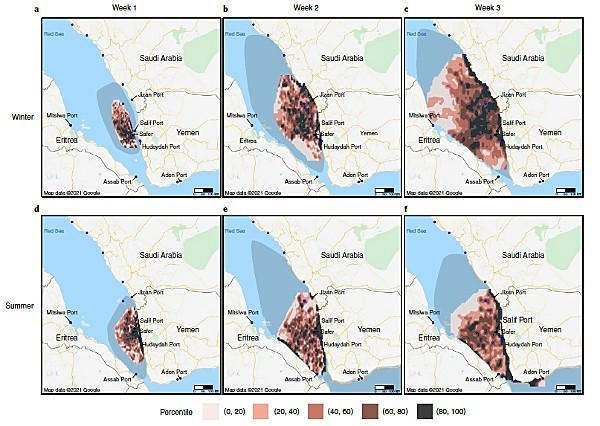
Atmospheric impact modelling shows the extent of slow and fast releases of pollution in winter and summer scenarios.

The YemenOnline article reports that the oil spill will make the country’s Red Sea ports unusable. Approximately 6 million people dependent on food aid imported through those ports into the country because of famine and civil war will go unfed. The country’s Red Sea desalination plants will become inoperable leading to freshwater scarcity for more than 2 million. Yemen’s commercial fishery will stop with fish stocks dead within three weeks.
When I first wrote about the FSO Safer, I noted that Canadian environmental groups were asking Canada’s Parliament to pony up $10 million for the UN rescue project. In September 2022, the federal government provided $2.5 million CDN. Now with the cost for the project having risen to $129 million USD, will Canada and other nations, wealthy philanthropists, and the public come up with the needed funds to stop both an environmental and humanitarian crisis that could erupt at any moment?
]]>Since then the ones I remember include:
At the time of the Torrey Canyon the operator, British Petroleum, had just invented dispersant detergents which were liberally dumped onto the wreck, and even rolled off the Welsh cliffs onto the polluted beaches and rocky shore. Since then fossil fuel and marine shipping companies have come up with all kinds of technology to attempt to break up oil spills on the surface of our oceans. The industry’s oil spill response documents include the latest in dispersants, booms, and skimmers and what works best in cold or warm water, in rough seas, and in windy conditions or calm.
Conventional thinking today says that when an oil spill occurs, it spreads fast with some of the discharge evaporating, and microbes digesting the rest. There is no reference to the role sunlight plays. That is an oversight.
New research published in the last week from, the Woods Hole Oceanographic Institute, Cape Cod, Massachusetts, suggests that oil spills need to be treated differently in the presence of sunlight. The multi-authored article entitled, Partial Photochemical Oxidation was a Dominant Fate of Deepwater Horizon Surface Oil, describes a previously unknown phenomenon.
Sunlight exposure over several days chemically altered 50% of the oil contained within the Deepwater Horizon slick making chemical dispersants less effective. The sunlight played no part in evaporation and so the oil remained on the surface unresponsive to the dispersants that were being dumped into the Gulf. In the end, the oil had to be skimmed up but not before it damaged the biodiversity along the Louisiana coast and in the Gulf.
It appears no one in the fossil fuel and chemical industry had observed this phenomenon before, that sunlight photo-oxidizes compounds to the molecules contained in oil, and binding more oxygen to them altering their makeup. And the longer the oil sat on the surface the greater degree of oxidation.
Within the over three months from the Deepwater oil spill start to the well being capped, almost 500 million barrels entered the water of the Gulf with most of it floating to the surface. There the oxygen contained within oil molecules reacted to sunlight in less than five days.
So why is this important?
Today oil spill response teams prepare and practice using fresh, not weathered oil. They don’t look at how they need to alter their response based on sunlight conditions. But looking back at the Deepwater Horizon case, it is clear that dispersants used today are largely ineffective on photo-oxidized oil. That means we need to invent new dispersants or develop new oil cleanup techniques. And during training crews need to test photo-oxidized oil with boom, skimmer and absorption technology to see if these tools are impacted negatively. Still to be done is an accurate calculation of the photo-oxidizing process subject to different environments, whether cold or warm water or in rough seas.
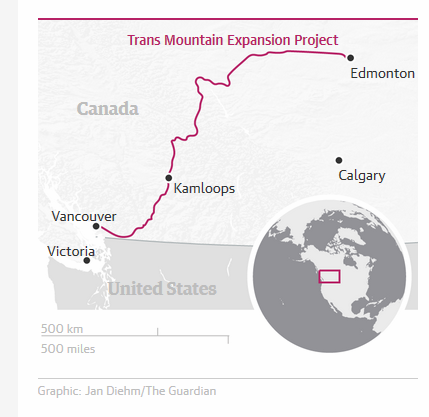
For Canada, which hopes to build a pipeline from Alberta’s oil sands to a cold water port on the British Columbia coast, testing of the photo-oxidizing effect on heavy synthetic crude, the product being shipped to Asian markets, needs to be done to update spill response standards. This should be part of the environmental due diligence currently underway, and before we witness tanker traffic increases from 5 to 34 per month in the narrow channels linked to the Burnaby. British Columbia, oil terminal.

Other carbon policies were announced in the last two months with a national price on carbon pollution to begin at $10 CDN per ton and rise to $50 over the next five years. That price on carbon has been set whether a province or territory implements its own carbon reduction strategy or not. With the majority of provinces by population already pricing carbon the federal government is now asking or compelling the rest of the country to come aboard the carbon reduction train. That train is committed federally to reduce greenhouse gas (GHG) emissions by 30% from 2005 levels by the year 2030.
So the country will more than double its capacity in terms of delivering oil to U.S. and world markets. Every barrel of oil in production will add to Canada’s carbon deficit. What will offset this increased Canadian carbon contribution? Policies and climate action plans have been announced. Alberta, the heart of Canada’s oil country, plans to eliminate all coal-fired power plants and put a hard cap on oil sands emissions by 2030. Other provinces like Nova Scotia have sought and received waivers giving them the right to continue producing energy using coal providing they make offsetting investments in renewable energy and energy conservation. In Ontario and Quebec cap and trade will use market rules to reduce carbon pollution. In British Columbia a $30 per ton carbon tax will remain in force. It is indeed a patchwork of GHG reduction programs in Canada that is beginning to resemble a plate full of spaghetti. To this add the news south of the border with the President Elect, Donald Trump, planing to approve the Keystone XL pipeline from Alberta’s oil sands to U.S. refiners on the Texas coast, meaning even more production capacity for Alberta’s oil sands and a greater carbon deficit.
It is understandable that the Canadian government sees the necessity to build a pipeline to a port within Canada giving Alberta’s energy industry the opportunity to no longer be limited to the United States as a customer for its products and allowing the province to reverse its deep economic slump. The approval of Trans-Mountain means the United States will no longer be the sole customer for Alberta oil which is sold to the Americans at considerable discount. Trans-Mountain means 900,000 barrels of oil per day will be sold to Asian and other global markets at world price.
In the weeks prior to the pipeline approval the federal government announced billions in funding for increased environmental protection for the Pacific coastline to deal with oil spill readiness. That was a pretty good hint that Trans-Mountain was going to be approved. But putting money into oil spill cleanup readiness doesn’t address global warming, and the environmental consequences of increased tanker traffic could become catastrophic.
Opposition within Canada to expansion of our country’s pipeline infrastructure comes from those who see any increase in oil sands production as an environmental disaster and the death knell for combating climate change because:
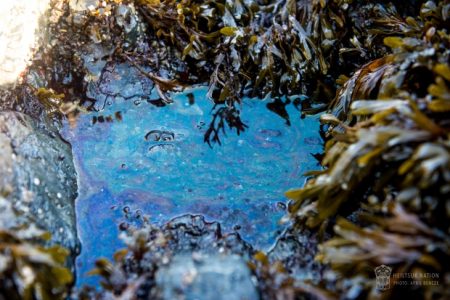
Considering point two it should be noted that Canada is dealing with an existing oil spill currently on its west coast, and not very well I might add. An American tugboat, the Nathan E. Stewart, sank in early October with 200,000 liters of diesel fuel on board. Half was safely removed from the vessel. The rest however has escaped or continues to leak from the wreck into the Pacific Ocean and onto the British Columbia coast (see image below). All efforts to recover the fuel have largely gone for naught.
Now consider the spill from a tugboat with a mere fraction of the diesel fuel recovered, and imagine that tugboat is an oil tanker run aground or sunk and you have an exponentially larger environmental problem on hand.
The problem of oil and fuel spills in the world’s oceans is a global concern. No technology created to date has the means to effectively deal with spills and environmental restoration. The Deepwater Horizon spill in the Gulf of Mexico, the worst in U.S. history, continues to cause environmental damage. And since that 2010 spill the Gulf has seen 11,700 morein. The rate of spills in 2012 was 245 per month. In October of this year the spill rate had declined to 80 for the month.
The aggregated amount of reported oil spills in the Gulf of Mexico amounts to 3.8 million liters (1,000,000 gallons) annually. That sounds like a lot but when compared to the total amount of crude extracted (75.7 billion liters or 20 billion gallons) in the Gulf region, it’s not. In fact these annual spills may be no more than what leaks from natural oil seeps from the Gulf’s seafloor and may have very little environmental impact.What we do know, however, is that the big spills like Deepwater Horizon do matter and they cause long-term environmental damage. It’s not just the oil that presents a problem. It is also the technology we apply to the spill that has environmental consequences. Because along with the oil comes other chemicals that were used to extract it and the surfactants, detergents, and chemical dispersants used in clean up.
Now transfer what we have learned from the Gulf of Mexico to the Pacific coast of British Columbia and we should have reason to be concerned. When triple the volume of oil flows into shipping terminals in the lower mainland with seven times the tanker traffic there is a likelihood we will see spills. An accident at the terminal or in harbor may be 50% containable, but an accident in the Strait of Juan de Fuca, (the water that separates British Columbia from the state of Washington), could turn into an environmental nightmare. Oil spills and cold water don’t make for an easy formula for clean up or environmental recovery.
The industry average rate of oil spill clean up success to date is not promising. As I mentioned above in a harbor you might be able to recover or clean 50% of a spill, but even in optimal ocean conditions with the latest skimmers and booms spill rates of recovery vary between 5 and 15%. Consider the average tanker storage range these days from 17 million liters (4.5 million gallons) to 317 million liters (84 million gallons) and you can imagine the environmental consequences. And compare those numbers to the 200,000 liters spilled by the Nathan E. Stewart, a spill that has proved problematic for those trying to clean up, and you get a very sorry picture of what may lie ahead in the near future. Ask yourself, do you think throwing a couple of billion dollars at oil spill clean up will make the likelihood of a catastrophic accident impossible? Hardly.
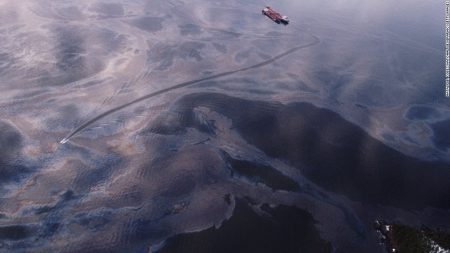
Remember the Exxon Valdez oil spill in 1989 off the Pacific coast (see image below) spilled 41 million liters (11 million gallons) of oil. Twenty-seven years later, Prince William Sound, where the spill occurred, still hasn’t recovered. There is still oil in the water and on the sea floor.
I fully understand the reasons for wanting to help Alberta solve its economic malaise. The province is an important part of my country and the fossil fuel industry has contributed much to our national development. But in a time when we are committed as a nation to fight the impacts of climate change and global warming, when we have other technology options available to us to produce energy, and when we can reinvent the Alberta economy to become a global leader in dealing with carbon through capture and sequestration, and renewable energy, why have we chosen the course we are about to undertake?
]]>In July, a pipeline leak near Maidstone, Saskatchewan, spilled about 250,000 liters of diluted oil sands bitumen into the North Saskatchewan River, killing wildlife and compromising drinking water for nearby communities, including Prince Albert. It was one of 11 spills in the province over the previous year.
In October, a tugboat pulling an empty fuel barge ran aground near Bella Bella on the Great Bear Rainforest coastline, spilling diesel into the water. Stormy weather caused some of the containment booms to break. Shellfish operations and clam beds were put at risk and wildlife contaminated.
Governments and industry promoting fossil fuel infrastructure often talk about “world class” spill response. It’s one of the conditions B.C.’s government has imposed for approval of new oil pipelines. But we’re either not there or the term has little meaning. “This ‘world-class marine response’ did not happen here in Bella Bella,” Heiltsuk Chief Councillor Marilyn Slett told Metro News.
If authorities have this much trouble responding to a relatively minor spill from a tugboat, how can they expect to adequately deal with a spill from a pipeline or a tanker full of diluted bitumen? The simple and disturbing truth is that it’s impossible to adequately clean up a large oil spill. A 2015 report commissioned by the City of Vancouver and the Tsleil-Waututh and Tsawout First Nations concluded that “collecting and removing oil from the sea surface is a challenging, time-sensitive, and often ineffective process, even under the most favourable conditions.”
What the oil and gas industry touts as “world class spill response” boils down to four methods: booms, skimmers, burning and chemical dispersants. An article at Smithsonian.com notes, “For small spills these technologies can sometimes make a difference, but only in sheltered waters. None has ever been effective in containing large spills.” Booms don’t work well in rough or icy waters, as was clear at the Bella Bella spill; skimmers merely clean the surface and often not effectively; burning causes pollution and greenhouse gas emissions; and dispersants just spread contaminants around, when they work at all.
Researchers have also found that cleaning oil-soaked birds rarely if ever increases their chances of survival. A tiny spot of oil can kill a seabird.
After the 1989 Exxon Valdez spill off the Alaska coast, industry only recovered about 14% of the oil — which is about average — at a cost of $2 billion. The 2011 BP oil spill in the Gulf of Mexico has cost more than $42 billion so far, and has not been overly effective. In that case, industry bombed the area with the dispersant Corexit, which killed bacteria that eat oil! Record numbers of bottlenose dolphins died.
We’re not going to stop transporting oil and gas overnight, so improving responses to spills on water and land is absolutely necessary. And increasing the safety of pipelines, tankers and trains that carry these dangerous products is also critical, as is stepping up monitoring and enforcement. With the Saskatchewan spill, the provincial government deemed an environmental assessment of a pipeline expansion connected to the one that leaked as unnecessary because the Environment Ministry did not consider it a “development.” University of Regina geography professor Emily Eaton, who has studied oil development, told the National Observer that Saskatchewan “gives a pass” to most pipelines it regulates.
Beyond better response capability and technologies, and increased monitoring and enforcement, we have to stop shipping so much fossil fuel. The mad rush to exploit and sell as much oil, gas and coal as possible before markets dry up in the face of growing scarcity, climate change and ever-increasing and improving renewable energy options has led to a huge spike in the amount of fossil fuels shipped through pipelines, and by train and tanker — often with disastrous consequences, from the Gulf of Mexico BP spill to the tragic 2013 Lac-Mégantic rail car explosion.
Spills and disasters illustrate the immediate negative impacts of our over reliance on fossil fuels. Climate change shows we can’t continue to burn coal, oil and gas, that we have to leave much of it in the ground. If we get on with it, we may still have time to manage the transition without catastrophic consequences. But the longer we delay, the more difficult it will become.
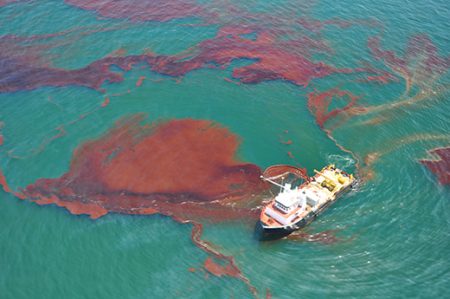

These are heterotrophic dinoflagellates. This particular species is nocturnal. But dinoflagellates and diatoms dominate zooplankton that along with phytoplankton, represent the bottom of the ocean food chain. Everything in the ocean is ultimately nourished by them. So they are very important to ocean ecosystems.
But more alarmingly interesting is what happens to them when an oil spill occurs such as the Deepwater Horizon disaster of 2010 in the Gulf of Mexico. Shortly after that spill, articles appeared indicating the contribution of oil-spill eating bacteria to clean the site. Referred to as nature’s janitors, it was commonly thought that biology could help fight a disaster of this magnitude. But what if biology could spread the toxicity of the spill even further?
In a paper appearing in the journal, Nature, published December 19th and authored by scientists from University of Texas Austin and Technical University of Denmark, the researchers cast serious doubt on our previous assumptions. They note that even oil spills treated with chemical dispersant suspend the hydrocarbon as small droplets in the water column, and those droplets are small enough to be ingested by creatures like the one you see above because they cannot distinguish the oil from real food. That’s because the droplets mimic the size of their normal food.
Initially of course at the site of a spill oil concentrations are so high that much of the zooplankton and phytoplankton dies. But as dispersant is applied the oil breaks up into finer droplets with secondary implications for surviving and new blooms of dinoflagellates. Thinking this is food the creatures gobble up the oil. This ingestion leads to many consequences one of which is the entry of microscopic hydrocarbons into the entire ocean food chain.
The authors note, “dinoflagellate cells containing crude oil can be prey for consumers, such as crustacean zooplankton and fish larvae which would enhance biotransfer of highly toxic, low-solubility petroleum hydrocarbons through marine food webs during crude oil spills.”
In other words dinoflagellates in making the mistake of thinking oil droplets are food unwittingly spread the oil throughout the food chain.
But it doesn’t end there. The authors of the study calculate that a single bloom of dinoflagellates like the ones seen above “has the potential to ingest, in one day, most of the dispersed crude oil droplets in the area covered by the bloom when oil concentrations are ~1-2 ppm [parts per million].”
What happens to that ingested oil? Well it appears that dinoflagellates have a fairly high tolerance to crude oil and dispersant once the levels of concentration decline. They can digest some of it but in processing it they also defecate the oil. These eliminated fecal pellets contain insoluble portions of the crude oil and it is not fully understood how its composition is altered by dinoflagellate digestion. The researchers suggest further study is needed. But one thing was noted by the researchers. The fecal pellets do not remain suspended in the water column because in digestion the oil loses its buoyancy. So the material sinks further into the water column bearing its toxic oil load.
Why is this significant? In the past scientists saw the digestion of oil by zooplankton as a natural means of eliminating oil spills. But contaminated fecal pellets descending to the depths was not considered as a source of secondary oil pollution in the marine environment.
In their conclusions, the researchers state, “our study highlights that ingestion of crude oil by heterotrophic dinoflagellates is a significant path by which crude oil pollution enters marine food webs and an important mechanism affecting the fate of dispersed crude oil in the sea after oil spills. Our results emphasize the need to understand and quantify crude oil ingestion and defecation by zooplankton, both protozoans and metazoans, to determine the fate and impact of petroleum pollution in marine environments.”
In other words, we don’t know, in the aftermath of an oil spill, after cleanup and after natural biological processes have worked on the oil, what is the full extent and duration of the environmental damage.
]]>
Recent sampling of ocean-floor sediments done by University of California-Santa Barbara geochemists have been published in the Proceedings of the National Academy of Sciences. A 3,200 square kilometer (1,235 squre miles) area around the site shows the distribution of the plume of oil leaking from the blowout as it permeated the water and then began to settle on the seafloor. The implications for animal and plant life in the water column and seafloor sediments remains unknown.
So what has happened to the remaining unaccounted for 1.4 million barrels? Some may remain suspended in the water column. Some may have eventually reached the surface and evaporated. And some may have been gobbled up by bacteria. But the remaining glop of oil covers a vast area on the ocean floor and current technology makes it virtually impossible to clean it up or recover it.
What a testament to our fossil fuel addiction.

Of course there has always been a recognizable downside to fossil fuels – spills. But with so much of fuel around spills have always taken a back seat to drilling and exploiting the resource. But an unrecognized downside, carbon emissions, is altering our dependence on fossil fuels. And because fossil fuels are being found today in less accessible places, the technologies we bring to bear to find and extract them come with increasing risk. That risk was no more obvious with Deepwater Horizon and the BP oil spill which began on April 20, 2010, capped almost three months later, and responsible for spilling 4.9 million barrels of oil into the Gulf of Mexico. The response to this spill is our first story today.
Dispersants from Deepwater Horizon Remain in the Environment Four Years Later
Did you know that in attempting to clean up the oil from Deepwater Horizon, besides the skimmers and booms and other technologies deployed, more than 6.8 million liters (1.8 million gallons) of dispersants were released to break up the slicks that coated the Gulf? And residue from those dispersants, chemicals that contain ingredients found in laxatives, is still being found in the tar balls that wash up on Gulf Coast beaches.
BP and the U.S. Environmental Protection Agency had reported that chemical dispersants evaporate leaving little to no residue. But the scientists at Woods Hole Oceanographic Institute and Haverford College in Pennsylvania, have proof that is not the case. Their report appears in Environment Sicence & Technology Letters and states that samples from corals, sediments and beach sites continue to contain the dispersant, dioctyl sodium sulfosuccinate or DOSS, although in low quantities. The long term impact from the chemical on the biology of the Gulf remains an unknown. A BP spokesperson when asked about the report stated the residual dispersant poses no risk just like deep water drilling poses none as well.
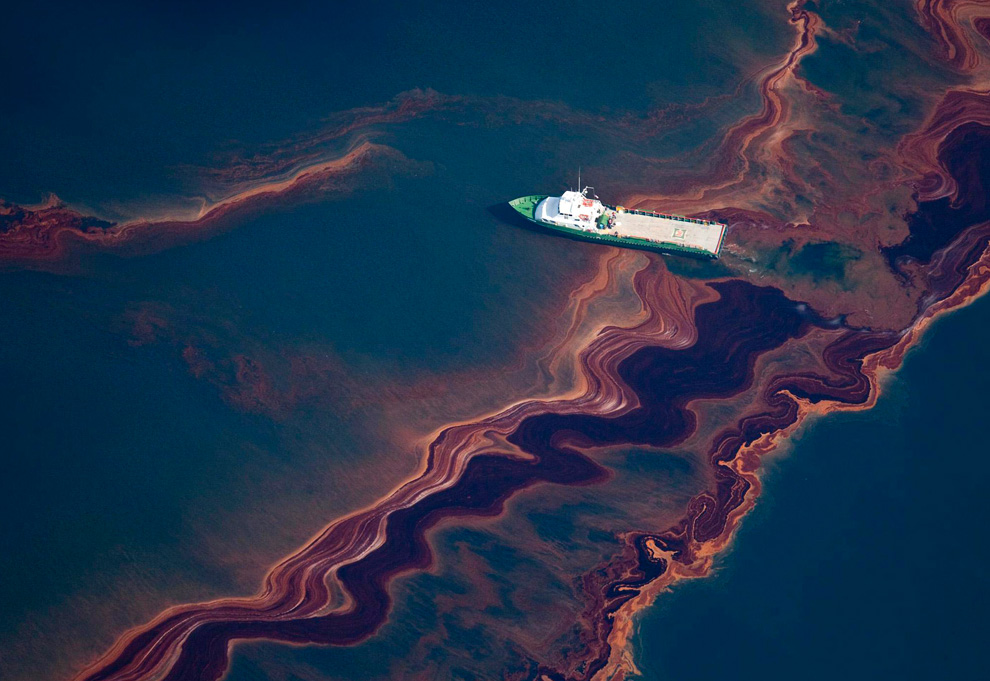
Steam Injection Ruled the Cause of Northern Alberta Oil Sands Spills
A form of fracking using injected steam is named as the cause for the Northern Alberta bitumen leak reported in July of 2013 by this blog site. The spill described as an underground blowout began in April 2013. The oil sands operator, Canadian Natural Resources Ltd. (CNRL) repeatedly assured the Alberta Energy Regulator that the spill was contained. But it was not and is to this day not.
And now we find out from a review panel report that the method employed in steam injection caused five fractures (one as early as 2009) with the bitumen erupting in areas as much as 12 kilometers from the original fracking site. It appears the fractures penetrated what was considered to be an impermeable layer of shale leading to the bitumen dispersing into groundwater and erupting as much as a half kilometer (more than a quarter mile) from the targeted position.
This operation has spilled more than 12,000 barrels of bitumen to-date into an area that is difficult to clean up because of its remoteness and the multiple locations where the bitumen has seeped to the surface. Some of it is leaking into a lake.
Cost so far is $50 million.

Fermilab Physicist Invents Oil Spill Cleanup Technology
Arden Warner (seen in the photograph below taken by Hanae Armitage) says he gets crazy ideas all the time. A physicist at the Fermilab in Illinois Warner tried a garage experiment taking metal shavings from a old shovel, and mixing them with some motor oil and water. He then used a magnet to attract the oil in which the iron shavings were suspended.
Warner has since received a patent for what may prove to be a breakthrough in oil clean up technology. He has tested his method on more than 100 types of oil and it works with all of them.
In a more refined state than the garage experiment his process involves using magnetite dust dispersed over a spill/ A magnetic field is then applied. The colloid suspension of oil and filings, defined as a magnetorheological fluid, can be pooled to a single location and then removed.
Warner is experimenting with hydrophobic iron filings to improve the extraction efficiency. This type of iron sink into oil right away and doesn’t interact with the water, hence hydrophobic, which makes it convenient when a magnetic field is applied. A magnetic conveyor can be used to pick up the suspension and recover the oil. The oil is then cleaned of the suspended filings and can be fully recovered. And so can the filings which are dried and reused. Want to see a 30-second demonstration? Watch the video.

That wasn’t the only headline. From the Albuquerque Journal I read about a crude oil producer using a rail spur line near the town of Bernalillo, New Mexico, and not notifying any local officials about their trucking and oil transhipment operation. This immediately brought to mind the Lac Megantic rail disaster that killed almost 50 and engulfed in flame a small Quebec town. When discovered the company, NuDeveCo, began the application process to get permission to transship up to 1,200 barrels of oil from a field in northwestern New Mexico. But when the town raised concerns the application process stopped. It turns out similar transshipping operations are popping up all over the U.S. Mid and Far West and raising the same fears raised by Bernalillo. What would happen if their town experience a nearby spill? Could there be a fire? Could groundwater become contaminated? Could farm and wildlife let alone humans be victims of the environmental impact?
In Nunavut in the Canadian Arctic, another published study, entitled Oil Spill Detection and Modeling Report in the Hudson and Davis Straits, commissioned by the Nunavut Planning Commission, in anticipation of Arctic oil exploration in its waters, reported in the last few weeks that “there is very limited knowledge of how to respond to an oil spill in waters off Nunavut or how to predict how far spilled oil could travel under sea ice.” The concern is about the impact on the livelihood of Nunavut’s population which relies on hunting and fishing for a high percentage of the local diet. Alarmingly the research on oil spillls that this study compiled “found that sea ice is not considered in most oil spill models.” Complications to any oil spill would be determined by the timing of the spill. If it occurred during the period of winter freeze then the oil would be trapped under ice until the spring thaw and would travel with ice floes in the break up. How do you contain and clean up a spill then?
My further reading found a list of most recent oil spills including a break in a pipeline in Los Angeles last May, and in March spills from a refinery on the shore of Lake Michigan, a spill in the Houston Ship Channel, and a North Dakota pipeline spill. That led me to look at North Dakota alone, the site of the Bakken oil shales. Since 2012 in that state there have been 300 spills from 28,160 kilometers (17,500 miles) of pipeline. The regulators, however, under North Dakota law, are not obliged to inform the public.
We know it isn’t getting easier to find oil these days. And where and when we do it appears we are not sufficiently prepared to handle it with any assurance that we will not cause environmental catastrophes from small to large. One accident at a drilling platform in the Arctic could create a nightmare legacy of destruction lasting a century or more because we have insufficient technology to contain and clean up after such an event. And where we do find oil in places like the Bakken developers and shippers continue to repeat mistakes that could conceivably lead to another tragedy like Lac Megantic, let alone to spills unreported to the public that have long-term environmental consequences for wildlife, agriculture and groundwater.
So what to do? We remain addicted to fossil fuels but there should be going forward much tighter regulation on where we go and find the stuff. The days of “drill baby drill” have to come to an end. And obviously the less we need oil the better off the planet will be. So we should be hell bent on developing alternative energy technologies while implementing conservation practices for oil we do use.
In the case of the latter, we have a smattering of regulation from local state and provincial governments in North America, and in other jurisdictions around the world. But no global agreement on oil conservation which should be included in any environmental agreement such as the one coming out of the next climate change summit taking place in Paris in 2015. Why should oil conservation be a part of that conversation? Because conservation will reduce oil’s contribution to greenhouse gas emissions. And the less oil we use the better off our planet will be.

“Marine spills can have both positive and negative effects on local and regional economies over the short and long-term….spill response and clean-up creates business and employment opportunities for affected communities,regions, and clean-up service providers, particularly in those communities where spill response equipment is, or would be, staged.”
When someone ferreted out these two sentences from Kinder Morgan’s application you can imagine the media and public response the company received. A spokesperson for the company pointed out that to single out this content within the application’s 15,000 pages was “ludicrous.”
The explanation from a senior director at Kinder Morgan:
“It was not written to be a standalone piece and in no way reflects any sort of appetite or acceptance for spills….the piece from this large, thorough application is pulled out, out of context, and is being used to suggest we might have some tolerance or acceptance for spills…..that borders on ridiculous.”
What actually is ridiculous is the inclusion of any such statements in an application to get approval to build a new pipeline.
Imagine promoting oil spills as a job creator? Because that’s what was stated…not implied. And no one in the $94 billion company had the brains to edit this out of the application.
Kinder Morgan is an American company that owns and operates almost 130,000 kilometers (80,000 miles) of pipeline. In operation since 1997 it has a history that includes more than 1,800 noted violations of which 500 involve pipeline operations. Not all have been oil and chemical spills. Some have been attributed to operator failures and accidents. Is it worse than other pipeline providers? No. Like most of the other operators of pipelines, oil spills and it needs to be reported and remediated. But remediation should not be described as a job creator.
In 2005 Kinder Morgan purchased Trans Mountain, the pipeline of concern that is at the centre of this 15,000 page application. As new owners that year the current pipeline ruptured dumping 210,000 liters (over 55,000 U.S. gallons) of crude oil into a local creek. In 2007 a road crew ruptured a section of the same pipeline causing a 250,000 liter (66,000 gallons) leak into a local storm sewer and eventually into the Burrard Inlet, an arm of the Pacific Ocean (see picture below taken by Gerry Kahrmann). In 2009, 200,000 liters (almost 53,000 gallons) leaked from a Kinder Morgan storage tank farm along the route. And in 2012 110,000 liters (29,000 gallons) of oil leaked from a Kinder Morgan holding tank because of a frozen gasket. I am sure that the company employed many people in all these incidents to clean up as best they could the mess of their own making. But I don’t think this type of employment would be considered by any reasonably acute individual to be of benefit to the local and regional economies.
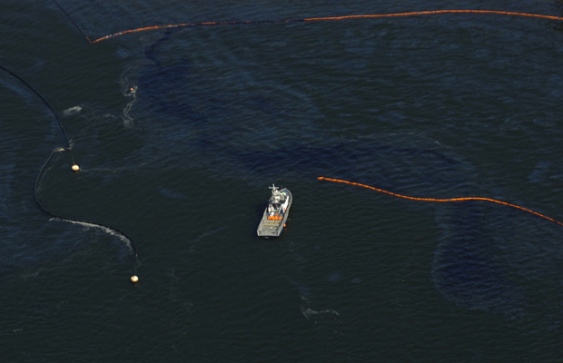
That’s like saying tornadoes are job creators because after they destroy a town look at all the reconstruction opportunities. Or Hurricane Katrina and Sandy, what great job creators.
Kinder Morgan’s President, Ian Anderson acknowledges that spills do happen and that they are “not good for anyone…period.” But the company is sticking to its story that the reference from the 15,000-page application is taken out of context. Anderson goes on to say “spills are not part of our economic benefits analysis, nor do we in any way say that money spent on spill response would be justification for our project.”
Now don’t we all feel better!

A researcher at the University of Wisconsin in Madison, Shaoqin Gong, along with two graduate students of the USDA Forest Products Laboratory recently announced that they had developed an aerogel that attracts oil absorbing up to 100 times its own weight. A sheet of aerogel cast on oil-filled surface water could conceivably clean up a spill quite rapidly. And better yet, once the aerogel becomes oil saturated it can be lifted out of the water and squeezed to recover the spilled oil. It’s good for a couple of cleanups before it needs to be replaced.
Aerogels are among the lightest materials in existence. They are highly porous. Today they are used for insulation, in aerospace construction, and as thickening agents in paints. The aerogel created by the University of Wisconsin team using a freeze-dry process is made from wood nano-fibers and a polymer that is described as environmentally friendly. The aerogel is further treated with silane, an inorganic compound, which gives it enhanced water-repelling, oil-absorbing capability. The aerogel displays extraordinary flexibility making it easy to store and deploy. If it can be brought from the laboratory to commercial production this may prove to be required equipment on board ships, in marinas, and on seaborne and land-based oil rigs and platforms.


