All of this meltwater contributes to the rise of sea levels around the world. The Southeastern United States from Tidewater Virginia to the Texas coastline on the Gulf of Mexico bears evidence of how much the seas are rising. Chesapeake Bay provides an interesting example of the dynamic changes caused by continental ice sheets dating from 20,000 years ago, at the penultimate Pleistocene maximum, to 11,700 years ago when North America’s land ice vanished, to the present day.
The phenomenon is known as isostatic rebound or isostatic adjustment. The interior of the continent where the ice sheets lay before melting has been rising for more than 11,000 years and deforming those areas along the edge. That means where some parts of the continent rise, other parts get distorted and fall. This is the same phenomenon we observe when we leave our beds in the morning and our mattresses readjust to not being weighed down by us.
The sections of the North American continent where ice sheets existed including the Northeast and Great Lakes regions are seeing a rise in elevation. The areas on their fringes are experiencing the opposite. In the case of Chesapeake Bay and Norfolk, the continental edge and shelf upon which they sit is tilting downward. That means the land around Chesapeake Bay including the Delmarva peninsula and Tidewater Virginia to the south is subsiding. Combined with ocean thermal expansion and meltwater produced by diminishing sea ice in the Arctic and the thinning of Greenland’s ice sheet, it spells trouble for places like Norfolk and further inland, Washington, DC. Norfolk is home to America’s largest East Coast naval base. Measuring sea level rise there shows it is happening faster than anywhere else on the U.S. Eastern Seaboard. Since 1992, the rise has been twice the global average.
At some point, once the isostatic rebound ends for the areas once under ice, the continent should see a levelling out. But we are talking in terms of geological time which involves thousands to tens of thousands of years. Until then the deformation will continue.
Studying this phenomenon and sea level rise from melting polar, alpine and sea ice is producing some interesting hypotheses. A study undertaken by scientists at Ohio State University published on August 2, 2024, in the journal, Science Advances, has looked at isostatic rebound and global sea level changes into the next few centuries. It concludes that the relatively rapid uplift of Antarctica as its ice sheets melt needs to be accounted for if we are to continue to do a managed retreat from coastlines facing rising seas.
The study begins by stating:
“With nearly 700 million people living in coastal areas and estimates of the cost of sea-level rise reaching ~14 trillion dollars by the end of the century, understanding the future contribution of the polar ice sheets to global sea levels in coming years is of critical societal importance.”
It then looks at what the melting of the Antarctic ice sheets causing isostatic rebound in Antarctica could do to sea levels. The study notes that as the ice starts melting and rebound begins, the uplift can act to preserve the remaining ice and reduce the southern continent’s contribution to rising oceans by as much as 40% over current climate model predictions.
The study further notes that Antarctica’s changing shape could prove to speed up isostatic rebound so that uplifted surfaces from reduced ice volumes happen in decades and not in centuries or thousands of years. In other words, we are no longer working at the snail’s pace of geological time as in the Pleistocene, the Ice Age that preceded the Holocene.
GPS data from the Antarctic ice sheets and North America shows that the isostatic rebound of the former is currently five times faster at 5 centimetres (nearly 2 inches) compared to the latter at 1 centimetre (0.4 inches) per year. Literally, in Antarctica, once the weight of the ice is removed, the continent bobs back up. This rebound is lowering sea levels adjacent to where the ice is melting and may have unforeseen impacts elsewhere on sea levels around the world.
In other studies that look at the combination of melt and rebound another effect has been noted. The two are altering Earth’s gravitational field. A paper previously discussed appearing in Geophysical Research Letters in September 2017, described findings that showed Antarctic ice melt was causing gravitational changes elsewhere while producing enormous volumes of water that were ending up impacting shorelines far removed from the southern continent. It correlated with a 52% faster rate of sea level rise off California and Florida’s coasts equating the cause being gravitational changes occurring from the melting ice and upward bounce of Antarctica’s landmass.
The current research described here includes an expression of the need to do much more research to better understand the complex relationships between the Earth’s crust and the impact climate change has atop it. Scientists need to do more data gathering and research to help us better understand the wide-ranging influences that rising greenhouse gas emissions are having on our world for both the short and long term.
]]>
Developed at The Ohio State University, the plan is to license the hybrid device for commercial development and distribution. Yiying Wu, Mingzhe You and Xiaodi Ren describe their invention as “a unique strategy” that integrates solar photovoltaic cells with a battery. The device improves solar energy performance by 25% over current technology, capturing nearly 100% of all the electrons emerging from the photovoltaic cell.
The design uses a titanium dye-sensitized mesh coated with iron oxide (rust) upon which titanium dioxide blades are grown. The dye sensitized mesh is tuned to capture a broad spectrum of light. Air passes through the mesh but light is captured. Beneath the mesh are a number of additional layers of material. One is a sheet of porous carbon and another is a lithium peroxide plate. The mesh, carbon and lithium form three electrodes. Between each the inventors put layers of electrolytes containing an iodide additive to provide a highly efficient method of transport for electrons.
The composite image below shows the solar cells to the right and two microscopic views , the larger one, of the blades of titanium dioxide and the smaller inset the gauze mesh.

When sunlight strikes the gauze mesh and titanium blades, electrons get produced. They in turn interact with the carbon and lithium peroxide. The chemical reaction creates ions and oxygen and converts the lithium peroxide plate into lithium metal storing the electrons in the process. Oxygen, the byproduct, is released. When the device discharges the lithium metal interacts with oxygen to reform lithium peroxide and free the electrons and voila, you have a solar cell that doubles as a solar battery.
Is this a big deal? You bet. For solar energy it could be the answer to continuous power generation day and night, 24 x 7. When the sun is shining the energy produced will power homes and businesses. And when the sun is not the battery will discharge the excess electrons to power those same structures.
The race to create more efficient solar energy conversion technology has never gotten more interesting. A number of companies and universities are beginning to reveal significant innovation with breakthroughs announced, it seems, every other month. The advances in thin-film deposition and nanotechnology plus our better understanding of the electrolytic properties of various materials is helping to move us closer to harvesting the energy that powers the Earth, our Sun.
The developers at Ohio State are among those leading the pack. They recently won a $100,000 US clean energy prize for inventing a high-efficiency air-powered battery using chemically treated potassium with oxygen. Now with their solar battery they have upped the game and created a technology that may soon spread to rooftops everywhere on the planet.
Today’s power plants using coal as the primary fuel combine air and a coal powder to create the energy to drive steam turbines. The process pollutes. Scrubbers capture the particulate matter in the outflow gases but do not reduce the CO2 and nitrogen oxide enough to impact greenhouse gas emissions. The pilot plant developed by Ohio State, however, uses a process called chemical looping which doesn’t expose the coal to air. Instead coal interacts with iron oxide producing CO2, iron and ferrous oxide in an artificial form called wustite (seen in an image below).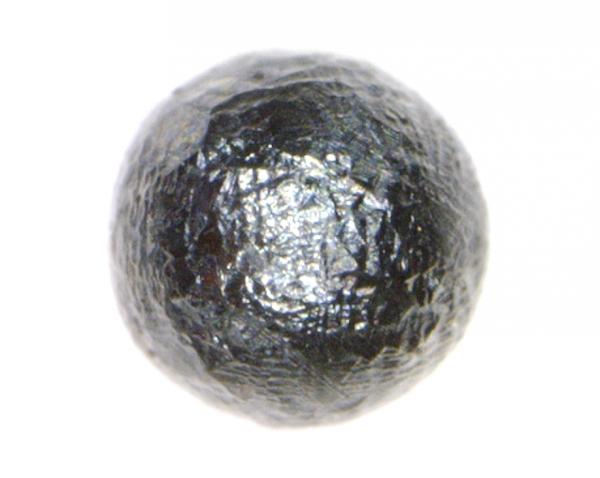
The burning of iron in air produces the energy that then gets converted into electricity. The process produces no nitrogen oxide, so no smog. And the chief byproduct of the process is pure CO2 which can be captured and sequestered.
Ohio State is also experimenting with a variation on this chemical looping process. This one involves gasifying the coal to create syngas, a combination of carbon monoxide (CO) and hydrogen. Iron oxide (rust) is introduced and reacts with the syngas to release oxygen and wustite. The oxygen combines with the CO to form CO2, and the hydrogen to form steam. The CO2 is streamed, captured and sequestered. The wustite then gets exposed to air and forms iron oxide (rust) and heat which then can be used to drive steam turbines. If the iron is exposed to steam it can separate out the hydrogen in the vapour and capture it as a fuel for fuel cells.
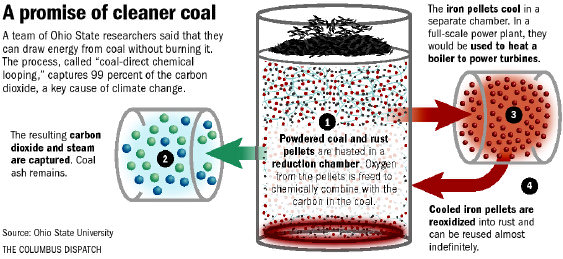
In another chemical looping test, calcium oxide from limestone is used to extract oxygen for use in burning coal. The process allows for the capture of pure CO2 while generating the energy needed to power steam turbines.
Although I have consistently ascribed oxymoron to the words “clean coal” it is encouraging to see that we may have answers that legitimately can allow us to continue to rely on coal as a primary energy source. Of course, that means retrofitting old coal powered plants or building new ones that used chemical looping technology. And it still doesn’t resolve the issue that we will have to sequester the CO2 byproduct produced by these power plants. That means finding a way to permanently trap the CO2 either deep in the Earth’s crust or in the deep ocean where it cannot emerge and further exacerbate the greenhouse effect.
]]>


