This distributed power generation model is far different than the technological infrastructure that enables the massive North American grid. And although the current power generated by these off-the-grid installations is minor when compared to total electric power generation capacity, it is the most rapidly growing segment.
For utilities who have become accustomed to building greater capacity, the trend to distributed power generation is reducing centrally distributed electricity demand. And distributed power isn’t just coming from solar roof panels. Fuel cells, small wind, rechargeable battery, solar thermal and geothermal are all in the mix.
Go back one hundred years to farms, before rural electrification and you would find windmills operating water pumps. Now we are returning to that paradigm except the windmills have company in the form of other renewable energy sources. And much of these are not producing power that is sold to a local utility. This is power generated and consumed locally.
In previous postings I’ve talked about Feldheim, a town in Germany that has become energy independent. This is a growing trend. The reason why is the falling cost of solar photovoltaics and other renewable energy technology. A typical rooftop solar array consisting of 4, 560 watt panels can cost as little as $2,000 USD today. And the panels if exposed to 5 full hours of the Sun a day can generate up to 75 Kilowatt hours of power monthly. That’s enough power to heat all the water needs of a family of four living in that house. Put more panels up and battery storage as backup and the entire house can run off the grid. A business could install an array capable of generating 2,035 Kilowatt hours monthly based on the same parameters and at a cost of under $34,000. It too can operate off the grid.
In an article in the January 13, 2015 edition of the Financial Times, the author, Ed Crooks, describes the findings of a recent paper produced for the Edison Electric Institute warning utilities that they are facing the same disruptive change that telephone companies faced as wireless mobile phone use increased. When customers start generating their own power it means utilities start losing income while still having to bear the cost of providing power through a massive electric grid.
That happened to the phone companies. They saw their wireline business enter a death spiral as people cut the cord. Yet they still had to maintain the wireline phone network. So how did they respond? They found a way out by embracing wireless mobile technology and making it a secondary income source.
Electric utilities don’t have as easy an option as setting up a parallel secondary business. What they can do is buy the excess power from homeowners and businesses with rooftop solar panels and other renewable sources. But that isn’t as simple as putting up a network of cell towers as in the case of the phone companies. The electrical utilities will need to build the connections that will allow them to both send and receive power from tens of thousands of private distributed energy sources. This is far more problematic than what phone companies have had to face.
Crooks, in his article, provides an example of just how problematic the future may be for utility companies. The Brooklyn branch of Whole Foods, a grocery chain recently installed solar panels, wind turbines and battery storage with enough capacity to operate the lighting for its car park. They even built a margin of safety into the installation to ensure they could stay off the grid for five consecutive bad weather days. So far Whole Foods is saving 20% of its energy costs not connecting to the grid.
By 2014 almost 600,000 homes and 45,000 businesses in the United States had installed solar panels. That represented a fourfold increase for the former and threefold increase for the latter over the previous four years. And although solar power efficiency lessened from the Southwest to the Northeast, the trend to solar appeared to be distributed pretty evenly across the country. Why? Because the systems are now paying for themselves in four years. It used to be much longer, as much as double or more.
Interestingly, to-date hardly any distributed energy producers have cut the cord to the grid. There remains a fear that at some point their renewable investment will not provide enough energy for their needs. So they remain attached. But this may soon come to an end as the cost to implement renewable energy continues to drop and the mix of technologies ensures a higher degree of energy self reliance.
Once this happens the unintended consequences will be a two-tier system. The more homes and businesses that buy into renewable energy and cut the cord, the greater the burden will fall on those who are poor and cannot afford to buy and install renewables. The poor will pay for the ubiquitous power grid and as in the rising cost of land lines provided by wireline phone companies, the costs will climb per unit as the customer base shrinks. That doesn’t bode well for electric utilities.
But there may be a saving grace, widespread adoptiong of the electric vehicle (EV). As more people transition from diesel and gasoline-powered vehicles to EVs electricity demand will rise. Some of this electricity will come from distributed power generation, but to ensure a network infrastructure as deep as the one today that lets car and truck users pull into a gas station almost anywhere, a power grid will be a must.
]]>
Sterile instruments are critical for lots of medical uses from obstetrics and gynecology to treatment of wounds, to dental work and surgical procedures. For 50% of clinics in rural settings that serve 3 billion of the people on our planet sterile medical instruments is a luxury. Without access to electricity these remote clinics have no adequate method of ensuring sterilization. Boiling instruments is not enough. Dipping instruments in alcohol doesn’t do the trick either. That’s why 25% of patients undergoing surgical procedures in rural settings end up with post-operative infections.
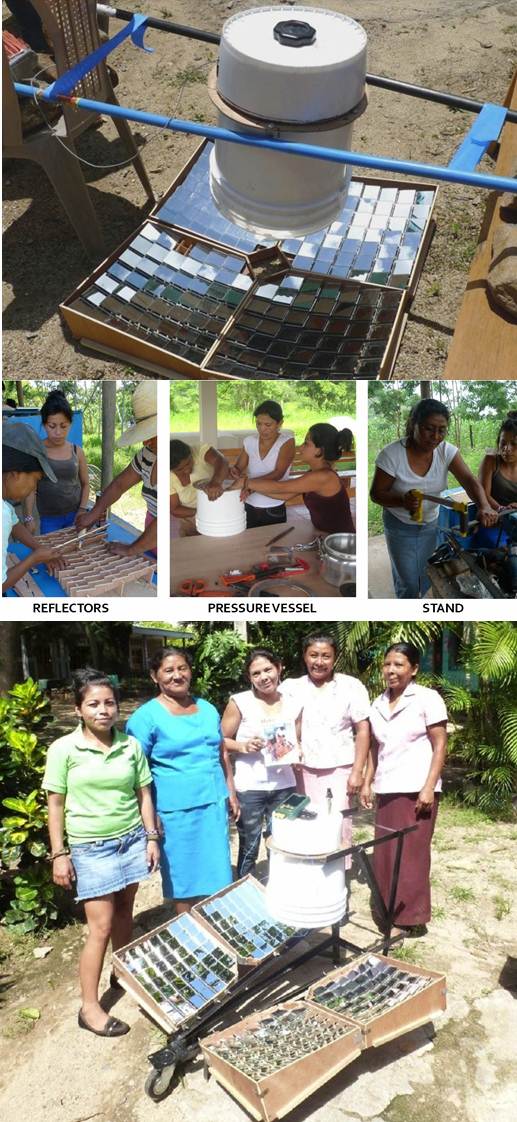
That’s why a team of Massachusetts Institute of Technology researchers decided to develop a way to sterilize medical instruments using sunlight. They call their invention the Solarclave. The device can be assembled from local materials and is portable. The heat is generated by focusing sunlight at a closed, pressurized container using 140 mirrors, each 7.62 centimeters square (3 by 3 inches). It takes 90 minutes for the solar reflectors to raise the interior temperature of the container to 121 Celsius.
As seen in the images below, the Solarclave largely uses locally-sourced materials and commonly available technology to manufacture it. Total cost of materials is less than $200 US.
The manufacturing components include:
The Solarclave can be scaled up by 50% to serve larger health centres and hospitals. And it has other uses as well. Locals can build separate units to as solar ovens for cooking, or solar water distillers to create clean drinking water.