And where CO2 is present in greater concentrations, we create thermal convection which may explain why wind speeds over our oceans across the globe are increasing. And with wind speeds rising we are witnessing a rise in average wave height which has implications for low-lying coastal floodplains and wetlands.
In the first detailed study of its kind, researchers at the University of Melbourne, in Australia, have looked at data from 31 satellites and 80 ocean buoys from 1985 to 2018, yielding 4 billion data points. And what they show is that winds in the Southern Ocean that circles Antarctica have sped up by 1.5 meters (4.92 feet) per second in the last 30 years, while at the same time wave height has risen by 30 centimeters (1 foot).
Ocean wind speeds and wave heights serve to control “the flux of energy from the atmosphere to the ocean,” and thus “substantially influence the mechanisms of air-sea interaction,” state the authors of the study entitled “Multiplatform evaluation of global trends in wind speed and wave height,” which follows a decade earlier summation of similar data sources. And although regional variations in wind and wave height can be explained by phenomenon such as the North Atlantic Oscillation, the satellite data from both the earlier and present study continues to show a disturbing global trend.
Ground-based radar gives us some of the data that shows altimeter readings of wave heights. But it is satellites that since 1985 have given oceanographers and climatologists a near-continuous record of both wind and wave phenomena. From the 4 billion data points observed the research concludes “a clear global increase in wind speed.” The two world maps that follow show the results of the mapping of these billions of data points over almost two decades for wind speed trends, and 23 years for wave height. Colour coded with yellow to red indicating increases shows how for both there have been dramatic changes.

The answer, of course, is no as can be seen in the maps. But the authors of the study point out a consistent trend of increasing wind speeds globally, less so with wave heights, but notably, with more extreme conditions for both in higher latitudes, and less near the equator.
It should be acknowledged that the trends described in these two papers based on compiling enormous amounts of data over more than 30 years include some wiggle room for margin of error based on less extensive measuring in the earlier time period. But having stated that openly there is no doubt that the second data series covering more than the last decade trends towards a rising expectation that, in particular, the southern half of the planet is witnessing a future of far more treacherous ocean conditions than have been seen in the past. For global shipping on the South Atlantic, South Pacific, Indian, and Southern Oceans, these conditions mean any storms will be even more dangerous. And because what happens in the southern half of the globe eventually impacts the rest of the oceans north of the equator, one can predict that global shipping overall will be negatively impacted.
And as for coastal erosion, danger to flood plains, potential threats to offshore structures such as wind farms and drilling rigs, there is no doubt that increasing wind and wave height changes will pose a rising threat.

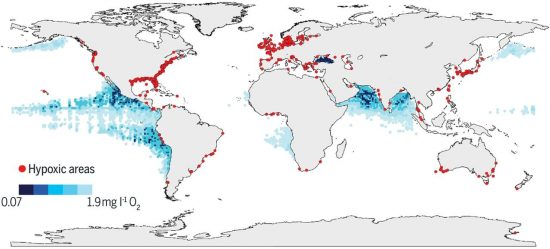
Oxygen is essential to ocean life and the chemical processes that occur there. But measurements at sites along coasts and in the mid-ocean are showing that several million square kilometers and hundreds of coastal sites show oxygen concentrations that are significantly lower than they should be to support abundant marine life.
Global warming is playing its part. Greenhouse gases, particularly carbon dioxide (CO2) are getting absorbed by ocean surface waters increasing acidity. Other gases like nitrous and sulfur dioxide are changing the biochemistry as well. And then there is fertilizer runoff injecting phosphorus and even more nitrogen into coastal ocean waters. And finally, there is the effluent from coastal cities and from communities along rivers that continue to pollute.
Today the ocean is a carbon sink, absorbing the CO2 we put into the atmosphere. In the near future, the ocean may turn into a net emitter of nitrous oxides contributing to atmospheric warming.
The map below illustrates coastal hypoxic areas seen in red as well as levels of deoxygenation along coastlines and in open ocean areas. It is a troubling picture.
The solution is staring humanity in the face. To fix the ocean we have to do the same things we need to do to fix the air: reduce greenhouse gas emissions and other air pollution. And in addition, we have to stop using the ocean as a giant sewer for our activities.
]]>