In a recent study appearing in the journal Science, scientists measuring the cumulative impact of CO2 on the ocean predict by 2100 that pH levels will have fallen by 0.4, a 150% increase in ocean acidity since the mid-19th century when we first began keeping comprehensive records. For marine animals from corals to shellfish, and from fish to whales, acidification at this rate of change will have a negative impact. Animals dependent on shells and exoskeletons (crustaceans) when exposed to increasing acidification will likely become extinct. For other marine species acidification combined with ocean warming will alter seasonal behavior changing when spawning occurs and fertility rates. With extinction of crustaceans and zooplankton food sources will be impacted putting additional pressure on many marine species. Warmer oceans will alter migration patterns something already being observed off California where 43 fish species have been studied for almost six decades.
Extinction is the greatest threat posed by ocean acidification. The geological record supports this. The end of the Permian marks the greatest extinction event in the geological record. What caused it? Volcanic eruptions in Siberia 252 million years ago released CO2 in sufficient quantity to alter ocean pH levels. Known as the Siberian Traps, this catastrophic event unfolded over 60,000 years. The end of the Permian saw 95% die off of ocean species and 70% of species on land.
Will anthropogenic contributions of CO2 over two centuries produce the same results as found in the geological record?
A number of scientists think so. Some are calling for a “plan B,” using technology to get the CO2 out of the ocean and atmosphere. Sir Richard Branson is offering a $25 million U.S. prize to anyone who can demonstrate a method to suck CO2 out of the atmosphere and thereby to halt progressive ocean acidification.
Three years ago I wrote about an American businessman, Russ George, who dumped 100 tons of iron sulphate off the British Columbia coast in a personal geoengineering experiment. The end result was a temporary algae bloom that George argued would reduce ocean acidity. He believed if ramped up globally such a seeding effort would work. George is not alone in suggesting a technological fix. In addition to iron fertilization, some have proposed nitrogen fertilization. In both cases the geoengineers hope that resulting algae blooms will serve two purposes.
The seeding experiments such as the one George tried do not necessarily produce the intended results. Two such experiments to date have shown that expected phytoplankton growth is suboptimal with less than 30% of the ocean a suitable target. In addition the biomass created largely recycles the CO2 which gets re-released into the surface water and atmosphere.
Unintended consequences of this type seeding include:
In a new publication, Climate Intervention: Carbon Dioxide Removal and Reliable Sequestration, scientists writing on behalf of the National Research Council have looked at a range of ocean geoengineering schemes and concluded that any attempt to add alkalinity to the ocean will have deleterious impacts.
States Sabine Mathesius, a lead author in a study published in the journal Nature Climate Change, “even if the CO2 in the atmosphere would later be reduced to the pre-industrial concentration, the acidity in the oceans could still be more than four times higher than the preindustrial level. It would take many centuries to get back into balance with the atmosphere.”
So what can be done?
Some scientists and engineers argue that removing CO2 from the air is the ocean’s panacea. But a recent computer simulation with a target removal rate of 5 gigatons of CO2 each year showed a marginal change in ocean acidity over 150 years. The exact number, a reduction in surface pH of 0.05. Of course such technology does not currently exist. Theoretically however if we were to develop it we would have to deploy thousands of units at a cost of as much as a trillion U.S. dollars.
Twenty marine scientists approaching the upcoming COP2015 meetings in Paris have come together to talk to policymakers so that they understand the consequences of not addressing ocean acidity in addition to climate change. They want to add ocean to atmospheric CO2 reduction targets. They argue that the 2 Celsius (3.6 Fahrenheit) atmospheric target limit needs to be accompanied by a sea surface temperature target of no more than 1.2 Celsius (2.16 Fahrenheit). They haven’t established a pH target because the science indicates the impact of current CO2 levels is already irreversible for the next several centuries. That means adaptation is the only strategy of choice.

]]>
Revolutionary Display Technology to Alter Gaming and Augmented Reality
The first 3D picture I saw was Avatar. I enjoyed it but I think I would have with or without 3D. Today’s 3D gives depth to two-dimensional images on the big screen and on television, but what if you could move your head and look at a projected object from the side or from below. Wouldn’t that be incredible?
That’s exactly what Infinite Z, a California company, has created with zSpace, a revolutionary, immersive, interactive 3D environment it describes as virtual holographic 3D. zSpace combines computer hardware and software to create this true 3D user experience where it it is impossible to differentiate between virtual objects and real ones just like the experience on the Holodeck in StarTrek.
Participants using zSpace technology wear very lightweight eye wear and manipulate a stylus to move and examine 3D objects. To get the zSpace display and software you pay $3,995 U.S. unless you are developer. Joining the developer’s program brings the cost down to $1,500.

Wastewater Disposal After Fracking Causing Earthquakes
Hydraulic fracturing or fracking is unlocking vast amounts of natural gas and oil tightly bonded with shale rock formations. Fracking has altered the energy balance on the planet opening up vast new reserves for an energy hungry world. But there are unforeseen consequences that are now being realized. One of them is earthquakes. Where fracking is happening so is a rising number of seismic events. That’s because fracking involves injecting water and chemicals into rock to get the gas and oil out. A typical operation can produce up to 3.8 million liters (one million gallons) of wastewater discharge in the first thirty days of operation. All that wastewater needs to be disposed of and the industry’s method of choice to date involves injecting it into the ground using deep wells.
At this year’s meeting in San Francisco of the American Geophysical Union, scientists reported a correlation between earthquakes dating back to 2001 with fracking wastewater injection. Quakes ranged from 3.0 to 5.7 on the Richter scale and were felt from New Mexico and Texas to the Dakotas to Ohio. This is not the first time human underground activity has been associated with earthquakes. Back in the 1960s the Army Corps of Engineers triggered an earthquake that caused damage to buildings and homes in Denver.
Are there alternatives for fracking wastewater disposal ? Osorb, a nanomaterial, recently discovered by researchers at Wooster College in Ohio, may prove to be a solution for treating wastewater from fracking. In trials so far it has shown that it can absorb oil and surfactants from the wastewater expanding up to eight times its original size. The Osorb can then be drained and reused.
Seeding the Ocean with Iron – Not a Carbon Sequestration Solution After All
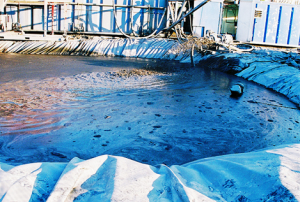
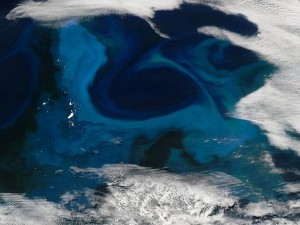
Back in October I wrote about Russ George dumping 100 tons of iron sulphate off the British Columbia coast and the 10,000 square kilometer (3,861 square mile) algae bloom that his actions created. Why did Mr. George do it? As a way to manipulate climate through geo-engineering of the gases in the Earth’s atmosphere. There theory was that iron would encourage phytoplankton to bloom and all that algae would absorb CO2. When the plankton died it would sink to the bottom of the ocean and with it would go the trapped carbon.
Well a researcher at the University of Sydney in Australia worked out the cost benefit of iron dumping and it turns out to be more expensive than carbon capture and storage (CCS). Why? Because the cost of making the iron and delivering it is high and the carbon burned in the manufacture and transportation offsets the benefit that may be derived. In fact iron fertilization of the ocean may turn out to contribute more to greenhouse gases than what is sequestered.
A Microscale Actuator with Muscle
Actuators are motors that move or control devices or systems. Micro-scale actuators are nano size, smaller than a human hair but a thousand times more powerful than an equivalent human muscle or cell by weight. The Berkeley Lab at the University of California, are the inventors. Their micro-actuator is composed of vanadium dioxide and chromium and responds to a small electric charge or laser light which bends its tiny arms like little fingers. Fine motor control is possible making this a suitable technology for doing medical applications such as drug delivery.
The degree of flex displayed by the micro-actuator is much greater than anything current and as a result the Berkeley team believes the tiny motor will find its way into the development of artificial muscles and micro-robotics. A promising and immediate opportunity has been identified to use the micro-actuator for radiation-detection in hazardous environments.

3D Printing, Software and Medicine are Combining in Partnership to Build Replacement Parts
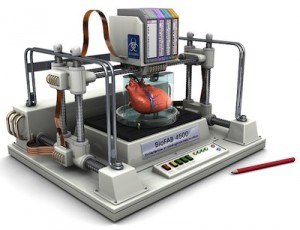
Organovo Holdings makes human tissue using its NovoGen MMX Bioprinter. Now with Autodesk, the software computer-aided design and drawing company best known for AutoCad, the two are combining forces to develop bio printing of three dimensional biological structures.
The premise is, if an organ and its infrastructure of capillaries, nerves and blood vessels can be plotted using CAD software tools, then using a 3D printer and stem cells as raw material, livers, kidneys, hearts, lungs and other body parts can be manufactured. The Bio/Nano/Programmable Matter Group at Autodesk wants to be able to create a design paradigm for programmable matter. Carlos Olguin, its head states, “Biological printing involves the self-assembly of things like stem cells. It’s a different design paradigm that could have a big effect on things like massive prototyping.”
The partnership expects results within the decade.
A Postscript
This is our second last weekly headline for 2012 and barring any catastrophic outcome based on the so called end of the world Mayan calendar myth I trust you will be back reading these postings while I continue to write them as 2013 unfolds. I thank all of you who visit and encourage you to let others know about this blog site. After all we are all collectively on a voyage to the future.
I wish you, my readers, the best of the Holiday Season.
– Len Rosen
]]>