A new study from researchers at Florida State and Nanjing Universities reveals our ocean surfaces are continuously being coated by oil slicks, city blocks in length. Remote sensing and imagery from Europe’s Sentinel satellites detected the occurrence of these repeated oil slicks from human sources and natural seeps. The human contribution outweighed the natural by nearly 10 to 1.
The oceans of our world cover 360 million square kilometres (139 million square miles). How much of their surfaces are covered by oil from maritime traffic, leaks and accidents from ocean rigs, and spills from fishers and boating enthusiasts?
The satellite imagery compiled between 2014 and 2019 shows that an area twice the size of France, that’s 1.29 million square kilometres (around 500,000 square miles) is polluted on the surface with the vast majority a result of human activity. A small percentage can be attributed to natural seeps which were the original focus of the research project.
It should be noted that the pollution recorded by the researchers doesn’t extend to the water column below the surface. If you recall the aftermath of the Deepwater Horizon spill in the Gulf of Mexico, what appeared on the surface was just a small percentage of what that accident produced. As the oil broke down to molecular size it polluted every part of the water column and blanketed the seafloor over hundreds of square kilometres.
The city-block length oil slicks revealed by this new study were found to cover 80% of the global ocean surface. The biggest slicks appeared off the Indonesian coast, in the Mediterranean, and in the South Cina Sea. Oil slicks weren’t just confined to the oceans. For example, 20% of the Caspian Sea, in Central Asia was found to be covered by oil.
Ian MacDonald, a Department of Earth Ocean and Atmospheric Science Professor at Florida State University is a co-author of the paper that was published in the journal Science. In a Florida State presser, he states, “What’s compelling about these results is just how frequently we detected these floating oil slicks, from small releases, from ships, from pipelines, from natural sources such as seeps in the ocean floor and then also from areas where industry or populations are producing runoff that contains floating oil.” And even though the surface pollution is short-lived, the amounts even when small impact the ocean food chain by first affecting plankton. And for air-breathing sea life like turtles and whales, surface contact with oil slicks remains an ongoing health threat.
Differentiating between natural occurrences and human-caused was fairly easy. Natural seeps always appeared in the same places. But the researchers found slicks on shipping routes, near pipelines, and drilling platforms, and these were in far greater numbers than anything nature was producing. Almost all were located within 160 kilometres (100 miles) of coastlines. The cause for much of these coastal oil slicks included runoff sources from land and road surfaces. Maritime shipping contributed 1.4 million square kilometres (550,000 square miles) to the total.
]]>Things You Should Know About Fort Bragg, California
For a century the people living in Fort Bragg used a local beach as their city dump. Residents would take glass, appliances, old cars and other household materials and chuck them over the cliff on to the beach where the tides would work their magic over time. Today Glass Beach, as it is known, is part of MacKerricher State Park with no dumping allowed. But the end result of unrestricted human behaviour can be seen in the picture below.

This unnatural beauty required considerable effort to reach the condition it is in today. In 1967 the beach was closed. In 1998 the California Coastal Conservancy got the private owners of the site to sell it to the California State Park system. Now cleaned up of all of the non-glass and ceramic trash what remains is a beautiful outcome from a ghastly human habit of treating the ocean as an unlimited place to dump garbage.
Things You Should Know About Port Orford, Oregon
The local Starbucks and other coffee shops may be playing a role in changing the chemistry of the ocean off Port Orford, Oregon. A study published in July 2012 shows that caffeine is polluting seawater off the Oregon coast. The caffeine isn’t just coming from coffee shops. In fact the research shows that sewer and septic runoff are the principal causes of the pollution. Despite sewage and wastewater treatment plants in place any time a heavy rainstorm occurs the capacity to manage the water volumes is inadequate. The result, an increasingly caffeinated coastal ocean.
Many plants are natural caffeine producers but none of the caffeine found in oceans of the Pacific Northwest appears to be naturally derived. It is coming from caffeine in our beverages, foods and pharmaceuticals. And if caffeine is showing up in coastal waters then what other human produced chemicals are accompanying it?

]]>
Less than 10% of the plastic we create gets recycled. So it is no surprise that plastic gets into our oceans and has become a major pollutant. Plastic pollution comes in all forms from microscopic fragments to large pieces.
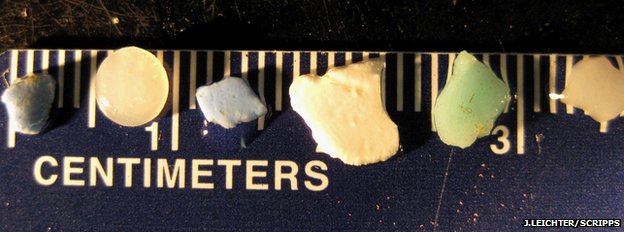
What you see on the ocean surface today represents 1/17th of what is actually in the ocean. Small plastic particles are almost indistinguishable from zoo and phytoplankton. Marine animals from small fish to baleen whales ingest it. A recent Scripps Institute study reported that 9% of Pacific Ocean fish have plastic content in their stomachs. Plastic pollutants contribute to the death of hundreds of thousands of birds, fish, turtles and sea mammals annually. Small particles of plastic become breeding grounds for algae blooms and bacterial concentrations that contribute to ocean dead zones. Floating plastic combines with other debris to create mats that continue to grow in areas of the Pacific, Atlantic and Indian Oceans.
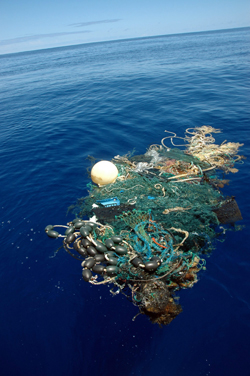
Plastic water bottles, bottle caps, plastic bags and cellophane wrap are floating platforms for barnacles and other sea life. A Scripps Institute of Oceanography 2012 report found an insect species flourishing in mid-ocean that more often finds its habitat along marine coastlines. That insect, the Pacific Pelagic Water Strider, is thriving in ever increasing numbers in mid-ocean because the garbage patches we have created offer it a stable floating platform for survival.

Plastic takes centuries to breakdown into chemical polymers. It does this when exposed to sunlight for a prolonged period, up to 500 years. So at best during our lifetime the plastic we throw away may break down in sunlight into small pieces. No creatures intentionally will eat plastic because it is indigestible. So over time in the ocean it just becomes a bunch of small fragments floating in a soup of debris.
Some would argue that the plastic serves the same purpose as floating rafts of seaweed. They point to natural occurring gyres such as in the North Atlantic where the Sargasso Sea features an accumulation of floating seaweed that is teaming with zoo-plankton, phytoplankton, crabs, crustaceans and fish. Because the North Pacific doesn’t have an equivalent to the Sargasso Sea, these same folks would argue that we, through our actions, have created an artificial equivalent in the North Pacific as well as the other zones in mid-ocean areas of the planet (see map below).
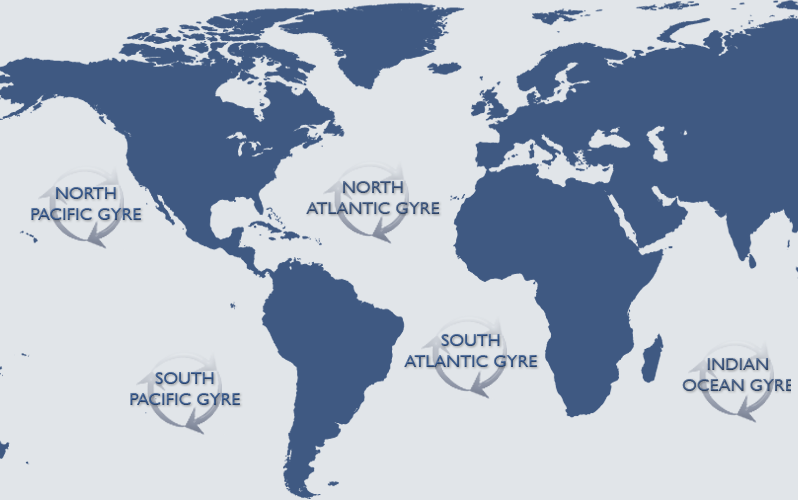
The argument of course is baseless. Yes lots of life finds its way to the floating plastic and debris in these gyres but so does death because plastic is a toxin in so many ways.
What Can We Do About It?
Humans have to act in two ways if we are to end the threat to our oceans from plastic and other floating debris. First we must reduce, reuse, recycle or repurpose all of the plastic we currently use in our modern world. Second, and much more challenging, we must develop technology capable of removing plastic and floating debris from the ocean.
Reduce, Reuse, Recycle, Repurpose
Humans respond better to carrots than sticks. If the phrase is unfamiliar to you then let me explain. When you want a mule to pull a cart you can offer him a carrot by waving it in front of his face so that he moves forward to grab and eat it. Or you can get behind the mule and whack it with a stick and accomplish the same result.
Recycling programs today are more sticks than carrots. Reducing plastic use is more a stick policy than a carrot. And because the political will to create carrot policies seems non-existent we end up with weak sticks and poor programs for tackling our plastic waste problem.
I’ll give you an example. In Toronto where I live we get charged a nickel (5 cents) for every plastic bag we request from a store for carrying the things we buy. Is this a sufficient deterrent to reduce the use of plastic? Initially there was a small drop in plastic bag volume. But the nickel charge has hardly made a dent. People pay the nickel and bring the bags home to use them in garbage receptacles. So the plastic ends up in landfill and dumps. And some of it ends up in our rivers and lakes and finds its way out to sea.
What would be a more effective policy? A bigger stick! This could be accomplished by charging much more than a nickel to discourage use of plastic bags. For those still inclined to purchase plastic bags a carrot would be assigning the money collected to environmental cleanup projects. But the best policy would be banning plastic bag usage entirely.
But plastic bags are just one of many plastic products that make their way into our recycling bins and garbage. In Toronto as in many North American cities homeowners are encouraged to recycle plastic as an environmental responsibility. The carrot here is the good feeling that comes from making a dent in what we end up throwing away. The city tries to make it easy by issuing a special rolling bin where we can dump all of the recyclable plastic, aluminum, metal cans, and paper that we would normally put in the trash. Our city picks up these items, sorts and sells them, a very big carrot. But much of what is recycled turns out to have no recyclable value and ends up in landfill. That’s because people recycle plastic that is not commercially reusable today or because the city collects so much that its ends up with a surplus and no current buyer or place to store the recyclables.
How can we repurpose the plastic we cannot recycle? Plastic is a polymer. It is an oil-based product. If we can reuse it by melting it to form new plastic items why can’t we use it by turning it into other products such as gasoline and diesel? Since it is oil-based why can’t we use non-recyclable plastic as a fuel for generating energy? The technology to do this exists today but there seems to be a lack of political will to do it, or the economics just don’t add up. This is where we need to apply both sticks and carrots.
We need to apply the stick to our governments. Governments that don’t advance the cause of environmental best practices should be voted out and replaced by those who have the political will to legislate. And we need our governments to create carrots that reward those who build innovative technologies to repurpose plastic.
Cleaning Up the Oceans of Plastic
Project Kaisei is a not-for-profit organization dedicated to cleaning up the North Pacific Gyre. Funded by other not-for-profits, private companies, associations, universities and charitable donations, the organization is developing and testing methods for marine debris retrieval with the goal of converting what is recovered into fuel or other plastic products.
The Clean Oceans Project is another not-for-profit focused on developing technologies to assess plastic debris concentrations and test technologies that can harvest the debris for plastic-to-fuel conversion.
But not-for-profit efforts won’t cut it in the long term. Governments have to get involved and provide sticks to plastic makers and carrots to innovators who develop technologies that recover the plastic debris and find a useful purpose for it.
Governments have to initiate carrot and stick policies that keep new plastic on land where it cannot get into the ocean. Government has to incent the plastics industry to find ways to make the plastic they produce rapidly biodegrade after usage.
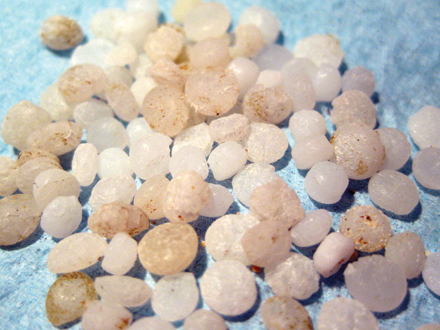
The merchant fleets of the world, manufacturers and government need to stop the use of plastic pellets for filler in the packaging and shipping of goods. Called nurdles, billions of kilos are manufactured annually ending up in the growing mass of floating debris that characterizes our oceans today.