Karen Christman, one of the many authors of the article, told UC San Diego Today, “Preventing heart failure after a heart attack is still a major unmet clinical need.” With this therapy, however, early intervention after an attack encourages tissue repair and helps to heal the heart muscle.
Nathan Gianneschi, at Northwestern University, describes the broader potential of this therapy “for several diseases, including everything from macular degeneration to multiple sclerosis and kidney disease.”
The injectable is a protein-like polymer (PLP) that gets activated by stress or inflammation. The protein is Nrf2. It stops heart cells from degrading after an attack. KEAP1, another stress-activated protein, binds with Nrf2, making it less effective. Creating the PLP Nrf2 mimic confuses KEAP1, acting as a decoy and allowing the Nrf2 protein to promote tissue repair and reduce inflammation.
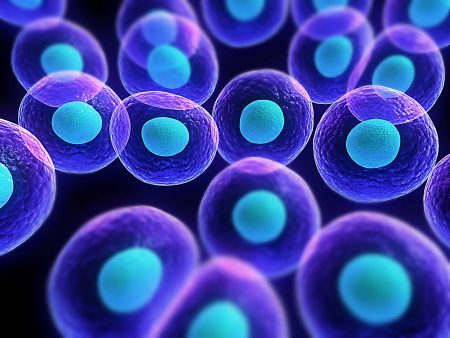
In laboratory rat blind studies, some animals received the polymer after a heart attack while others didn’t. Up to five weeks after injection, the sedated rodents received MRIs that showed better cardiac function and the healing of heart muscle tissue in those who received the polymer treatment. The image at the beginning of this posting shows the dramatic difference between heart muscle cells treated with the PLP from those without treatment.
States Gianneschi, “Proteins are the molecular machines that drive all essential cellular function, and dysregulated intracellular protein-protein interactions are the cause of many human diseases. Existing drug modalities are either unable to penetrate cells or cannot effectively engage these large disease target domains. We are looking at these challenges through a new lens.”
What makes the PLP different from other heart attack treatments?
So, the PLP’s ability to reprogram gene expression, target intercellular pathways, and the body’s natural autoimmune and stress response represents a significant treatment breakthrough that may do more than just heal broken hearts, including the following:
While still proof of concept, further studies will help optimize the polymer material design and dosage for treating heart attacks, with plans to begin larger animal model studies before human clinical trials.
]]>The engineers at Northwestern University have invented a pacemaker smaller than a grain of rice. This device can be injected by syringe into a neonate for temporary pacing when treating several CHDs.
Putting pacemakers in infants is tricky business. One reason is their size. The heart, lungs, and circulatory systems are small, so there is not a lot of room to implant a device. The leads that connect the pacemaker to the heart can often fail.
My daughter’s defect was structural, Tetralogy of Fallot with Absent Pulmonary Valve (TOF/APV) and not electrical. It, therefore, didn’t affect heart rhythm and didn’t require a pacemaker.
What CHDs detected at or before birth, therefore, are best served by a device like this ultra-miniature one?
These are some of the conditions that immediately come to mind:
The Northwestern device is paired with a wireless wearable that can be applied as an adhesive patch to a child’s chest. The pacemaker is delivered to the surface of the heart by syringe injection. The device is thermostatic and responds to infrared light. When an irregular heartbeat is detected, the wireless wearable on the chest surface emits light pulses that penetrate through skin, muscle and bone to activate pacing.
The pacemaker itself is so tiny that several can be implanted at a time, and using different colours of lights could treat multiple conditions. Designed for temporary use, about a week or so, its biocompatible parts dissolve and are excreted. No surgical extraction is needed.
The journal Nature has published an article on April 2, 2025, describing the technology, and in the abstract it notes that the device “can be readily adapted for a broad range of additional applications in electrotherapy, such as nerve and bone regeneration, wound therapy and pain management.”
John A. Rogers, a bioelectronics engineer at Northwestern, who led the development, told Amanda Morris at Northwestern Now, that the device is designed for pediatric cardiology because it is tiny and minimally invasive for small bodies. He describes how the device works without battery storage, noting, “When the pacemaker is implanted into the body, the surrounding biofluids act as the conducting electrolyte that electrically joins those two metal pads to form the battery. A very tiny light-activated switch on the opposite side from the battery allows us to turn the device from its ‘off’ state to an ‘on’ state upon delivery of light that passes through the patient’s body from the skin-mounted patch.”
His colleague, Igor Efimov, told Amanda Morris at Northwestern Now, “About 1% of children are born with congenital heart defects — regardless of whether they live in a low-resource or high-resource country. The good news is that these children only need temporary pacing after a surgery. In about seven days or so, most patients’ hearts will self-repair. But those seven days are absolutely critical. Now, we can place this tiny pacemaker on a child’s heart and stimulate it with a soft, gentle, wearable device. And no additional surgery is necessary to remove it.”
Although this remarkable new pacemaker represents a significant advancement in treating congenital heart defects, for my daughter as a neonate, her complications were structural, leading to breathing problems, not arrhythmias. It is encouraging to know, however, for the many families with children with CHD that my wife and I met and commiserated with back in the 1980s, that parents in the future will see their children served by groundbreaking devices like this.
]]>An article appearing on August 22, 2024, in the journal Communications Earth & Environment, describes electrochemical laboratory experiments on seawater-soaked sand calcareous mineral precipitates forming calcium carbonate (limestone), and magnesium hydroxide (hydromagnesite). The researchers propose passing low-voltage electricity through shoreline beach areas to turn them into solid rock to resist rising seas. It argues that this method is more effective and cheaper than building seawalls.
The use of electricity with seawater to promote electrodeposition is not new. It is used today to protect built shoreside infrastructure to make them more resistant to corrosion and cracks. It is used as well to cement marine materials to metal structures along shorelines. In some experiments, it is being used to restore the integrity of damaged coral reefs.
What hasn’t been done before is using the electrodeposition of marine soils of varying density and composition to create barriers to rising seas. The Northwestern research team, therefore, decided to run experiments to determine if they could electrify marine sediments to solidify them. The team tested suitable soils, different seawater chemistry and levels of applied voltage to determine what would yield the best electro-solidification. In laboratory tests, a low-voltage electric current passing through marine sand produced electro-cohesive bonding and soil cementation.
Northwestern’s Professor Alessandro Rotta Loria, is in the Department of Civil and Environmental Engineering, Subsurface Opportunities and Innovations Laboratory. He told Amanda Morris in an August 22, 2024 interview published in Northwestern Now why the team decided to investigate this line of research. He noted that “Over 40% of the world’s population lives in coastal areas. Because of climate change and sea-level rise, erosion is an enormous threat to these communities.”
The researchers were inspired by how marine life uses the natural chemistry in seawater to create protective shells. Could the sand and soil in shorelines be stimulated through an electrochemical process to produce a cement-like barrier to hold back rising seas? The team, Rotta Loria said, hoped to “develop an approach capable of changing the status quo in coastal protection — one that didn’t require the construction of protection structures and could cement marine substrates without using actual cement.” He went on to describe the method chosen. “By applying a mild electric stimulation to marine soils, we systematically and mechanistically proved that it is possible to cement them by turning naturally dissolved minerals in seawater into solid mineral binders — a natural cement.”
The success of this experiment may prove a timely solution for American seaside communities like Norfolk, Virginia which is experiencing faster-than-average sea level rise. Norfolk has been building berms and seawalls to hold back the Atlantic Ocean. Conventional seawalls however are not proving to be lasting solutions.
In my travels, I have witnessed seawall failures. One that comes to mind happened in Fort Lauderdale a few years ago. The city had spent $11.8 million in 2015 to build a wave wall barrier to mitigate against future hurricanes and “storms of the century.” Even during construction, however, the wall was breached by higher-than-normal seasonal tides, not even a hurricane.
Why are seawalls a poor solution to address sea level rise and storm surges? They customarily are built using rebar-reinforced concrete. Reinforced concrete and seawater don’t mix. A good example of this happened in Surfside, Florida, where a building with primary weight-load structures built of reinforced concrete collapsed in 2021. Reinforced concrete in the presence of seawater erodes. The force of tides and storm surges accelerates the process. Internally, as seawater seeps in through cracks, carbonation from carbonic acid forming causes the rebar to rust further accelerating the disintegration from the inside out. Build a seawall out of this material and like the building in Surfside, the wall will inevitably fail.
Alternative strategies being used by coastal towns involve pumping cement directly into the ground along shorelines. This method has proven to be no more effective than seawalls when addressing high tides and storm surges.
A hybrid strategy for coastal communities with existing seawalls could, if lying atop the right soil or sand foundation, apply a 2 to 3-volt current beneath the wall to produce cementation that reinforces and binds the wall to it making a more resilient impermeable barrier to a rising ocean and high tides.
In the event no seawall is present, then the low-voltage solution when applied to marine sand and soil could produce a barrier stronger than concrete, more formidable and lasting. That’s because, in the laboratory, Rotta Loria has observed that treated sand does not need further interventions and produces “remarkable outcomes from just a few days of stimulations.”
If you are concerned about getting shocked by the electricity beneath the sand, Rotta Loria notes that the voltage is too mild to feel and would have no negative impact on wildlife. So what erosion-threatened beachside town in the United States wants to be Northwestern’s first guinea pig?
]]>We are not there yet but we are at a point where we are getting the details right, printing tissue with blood vessels as small as capillaries, creating microvascular scaffolds where human tissue can grow and survive. This is no easy task since tissue on its own without an adequate blood, oxygen and nutrient supply cannot survive for very long. No more than 30 minutes states Melanie Matheu, CEO, and co-founder of Prellis Biologics, a San Francisco-based bioprinting company.
Prellis has perfected holographic 3D printing with a resolution that is microscopic in size, as small as 0.5 microns (capillaries are 5 to 10 microns in diameter). And the company can do it at speeds up to 1,000 times faster than previous high-resolution bioprinting efforts. States Matheu, “our ultimate goal is to print the entire vascular system of a kidney in 12 hours or less.”
Another American bioprinting company, United Therapeutics, a company that develops and sells drugs to treat lung diseases, is perfecting a technique to print lungs in “unlimited quantities.” In a June 28, 2018 article appearing in the MIT Technology Review, Antonio Regalado writes about his recent visit to the company’s Manchester, New Hampshire facility, where he was given the opportunity to hold the upper part of a human airway including trachea and two bronchi. The structure had been 3D printed and represents the company’s first step in manufacturing an entire lung “including all 23 descending branches of the airway, the gas-exchanging alveoli, and a delicate network of capillaries.” How close is the company to its ultimate goal? Martine Rothblatt, CEO, predicts that fully-bioprinted lungs will be on the market by 2030.
Meanwhile, at Northwestern University, researchers are printing mini bile ducts using bioinks consisting of cells and growth factors. As published in the science journal Biofabrication, last month in a paper entitled, “Tailoring nanostructure and bioactivity of 3D-printable hydrogels with self-assemble peptides amphiphile (PA) for promoting bile duct formation,” the researchers hope to use these printed bile ducts to better understand the biochemistry and functional tubular structures of the human liver, and in addition to create a living laboratory for modeling liver diseases including cancer, and finally as a testbed for new drugs and liver treatment protocols.
There are several key technology hurdles to overcome in turning the promise described above into a biomedical reality in the next decade.
The first is miniaturization, developing scaffolds and bioinks that can print complex structures a mere few microns in size. With Prellis it appears we are well on the way to accomplishing this.
The second is improving our understanding of the detail in human body parts down to the sub-cellular level. If we cannot master how all of these intricate components play a part in the vitality of human tissue, then we will not be able to produce a liver that will function as well as the one our body has grown for us.
The third is ensuring that our technology doesn’t come with unintended consequences. Bioprinted organs will revolutionize our management of many diseases. Imagine by mid-century, every organ in our body, even parts of our brain if not the whole brain will be something this technology will be able to reproduce.
The key material: sulphur. When this idea was first explored for building habitations on the lunar surface it was quickly abandoned. In the presence of a vacuum (the lunar environment) sulphur sublimates. But on Mars, although the atmosphere is tenuous, there’s enough of it to allow sulphur to bind aggregated materiel from the surface to produce durable concrete as seen in the microscopic image below.

What is in the soil that the Northwestern team used?
Largely silicon and aluminum oxide with a dash of iron, titanium, magnesium, calcium, sodium, potassium, and manganese oxides plus a hint of diphosphorus pentoxide.
To this they add heated sulphur at a temperature of 240 degrees Celsius (464 Fahrenheit). At that temperature sulphur becomes liquid.
Combined and allowed to cool the end product forms a solid concrete. The researchers experimented with different sizes of aggregate particles and found using smaller aggregate subject to compression yields the best results. Martian concrete exceeds Earth-based concrete’s tensile strength by 2.5 times.
Here is the secret recipe:
In the image below from their published paper you can see the results of one of the numerous tests done to determine the bendable and break characteristics of the end product.

One additional benefit. Concrete made from Martian soil using sulphur can be reheated to make the sulphur melt. Once you do this you can reshape and reuse the product. Try that with the stuff we produce here on Earth. Not possible!
Read the details of the research in the article, A Novel Material for In Situ Construction on Mars: Experiments and Numerical Simulations.
So all we have to do now is get there and start building with the stuff.
]]>No bigger than a band-aid this wireless patch can transmit to a smartphone app for continuous monitoring. Other uses include stress tests, sleep studies, monitoring newborn vital signs, fitness tracking, early detection of diseases like Parkinson’s, just to name a few.
The patch is stretchable and contains off-the-shelf microcircuitry. The chip technology is suspended in a thin elastic fluid-filled envelope. Stretchable wires connect the electronic components which include a radio transmitter, power inductors and an array of sensors.
The device is designed to be worn continuously without interfering with the wearer’s daily activities. According to Professor John A. Rogers, one of the team that developed it “It is as soft as human skin and can move with your body, but at the same time it has many different monitoring functions…..and can send high-quality data about the human body to a computer, in real time.”
Ultimately this wearable device could be produced cheaply so that anyone could incorporate it into his or her personal wellness management to catch early onset of a health condition that could be nipped in the bud because of early detection.


