
The Nordica, an 116-meter (380-foot) ship, took on the voyage after completing a charter for ice breaking services off Sakhalin Island in the North Pacific. In looking for a convenient route home to Finland the crew decided to attempt an early crossing of the Northwest Passage. They invited reporters and researchers to come on board with accommodation for up to 47 guests.
Captain David Snider who keeps a blog about traversing Arctic waters writes “voyaging through the Northwest Passage is not for someone on a tight timeline….we are at the mercy of the sea, and the sea ice.” But it seems that the technology of the 21st century is making the “mercy of the sea” less daunting these days, far different from the time of Franklin. Today navigators have raw satellite images, high-resolution synthetic aperture radar, thermosensitive imagery, global positioning systems, and on board telecommunications.
The Nordica also features the ENFOTEC IceNav(TM) software system providing:
The Nordica’s traverse of the passage was from west to east. Another ship, the MV Polar Prince, a 67-meter (220 foot) icebreaker, since June 1, 2017, is making the journey from east to west, but it is taking 150 days for the voyage in celebration of Canada’s 150th birthday. Dubbed the Canada C3 expedition, the ship is currently on the 7th leg of the journey near Iqaluit, the capital of the Nunavut territory in Canada. Upon completion, the Polar Prince will have traveled 23,000 kilometers (almost 14,300 miles) starting in Toronto, Ontario and ending in Victoria, British Columbia.

Last year I wrote about the Crystal Serenity, a luxury cruise ship that traversed the passage in August in 32 days traveling from Seward, Alaska, to New York City. The ship required an icebreaker escort. The voyage, however, demonstrated how much the Arctic is changing opening the passage to marine traffic. The Nordica’s 24-day crossing at such an early date is a further illustration of the impact global warming is having on the Arctic Ocean. The normal period of low sea ice occurs in late August and September. But apparently not anymore.
The Nordica’s 24-day crossing (see the map of its route below) and its earliness further illustrates how global warming is changing the Arctic Ocean. Where the normal period of low sea ice has always occurred in late August and September, today it appears that is not the case.

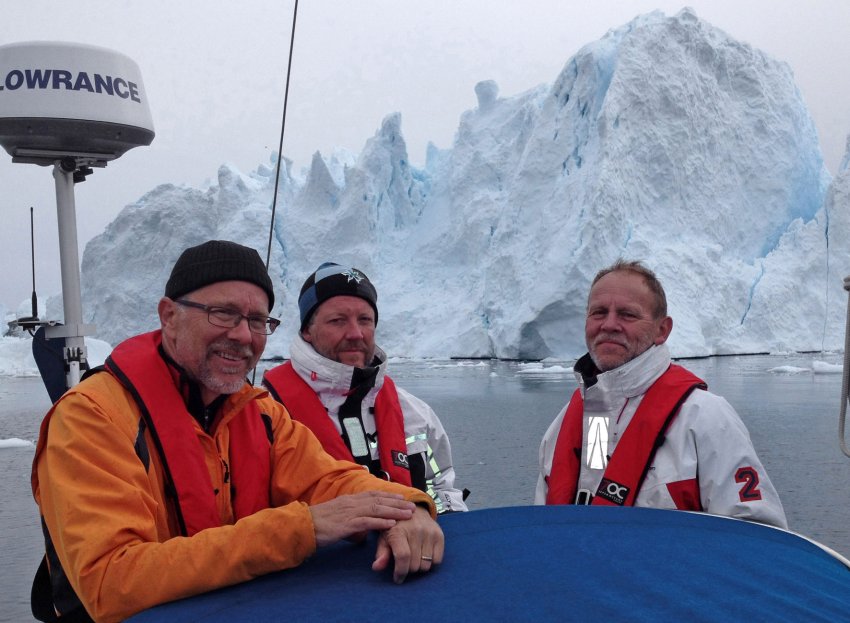
The picture Tegner describes is one seen through the eyes of those he meets who live and study the changes happening in the North. He encounters many who descend from the longest permanent inhabitants of the Arctic, the Inuit and Inuvialuit. For the native residents of Greenland, Canada and Alaska he encounters the stories are largely the same. They describe an Arctic under rapid change.
In Greenland locals comment on the speeding up of the flow of glaciers and increased calving feeding more ice bergs to the Davis Strait and North Atlantic. In Arctic Canadian settlements local residents describe the arrival of new species of birds never seen before and the march northward of new vegetation replacing the traditional tundra biome. He interviews scientists who describe the slumping and erosion of Arctic landscapes as permafrost melts. And others tell him how Arctic ruminants like caribou and muskoxen are dying as their food sources disappear and new opportunistic poleward marching diseases take hold.
One scientist he speaks to describes the unique dynamics of the Arctic atmosphere where the seasonal fluctuations of Canada and Siberia’s boreal forests impact carbon dioxide (CO2) levels near the poles. In summer CO2 levels drop. In winter the boreal forests release CO2 concentrating the gas at higher levels in the Arctic than anywhere else on the planet. He notes that CO2 at 400 parts per million was first observed in the Arctic in 2012 and today represents the low of the seasonal observed fluctuation, no longer the high.
Tegner tells us about the changing behavior of walrus populations in the Bering Sea. Today they congregate in large herds on local islands. This unusual new behavior is leading to high infant mortality rates as young walrus get crushed in the pack. It also makes it easier for diseases to kill off larger numbers. In the past the sea ice allowed the walrus to disburse. But there is less of it now and what is out there is thinner and more unstable.
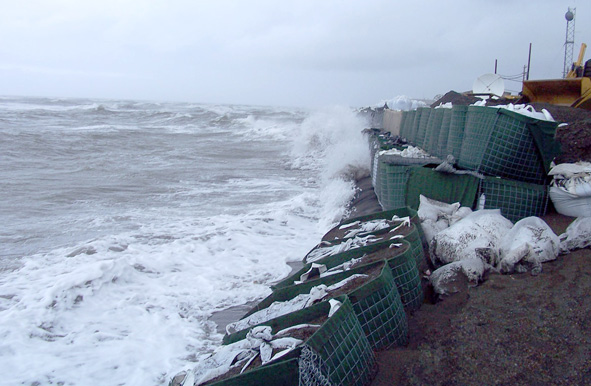
He lets the natives of Kivalina, Alaska, tell the story about their disappearing island community as sea levels rise and storm surges sweep over the land (see image below). This is happening despite the best efforts of the U.S. Army Corps of Engineers, who have built rock berms to hold off the encroaching Pacific. The islanders have been told they have no more than a decade or two before their homes will forever disappear. They are akin to other Pacific Ocean islanders much further south like those on Kiribati, Tuvalu and Vanuatu, who are watching the rising ocean destroy their homelands. But unlike the Pacific Ocean islanders who in 2013 joined other nations in signing the Majuro Declaration for Climate Leadership, the people of Kivalina have no voice other than the launching of lawsuit to express their concern for the future.
Recently a groundswell of concern among private citizens has led to the development of an Arctic Declaration. It presents demands to the leaders of Arctic nations to take action and in its preamble states:
“For the four million people living in the Arctic, warming temperatures are endangering traditional livelihoods, customs, and sources of food. Wildlife is suffering hugely as ecosystems bear the brunt of an increasingly unstable climate.…As the Arctic melts, millions face devastating weather events linked to warmer ocean currents. Coastal cities are already counting the cost of rising sea levels, while island states could disappear entirely. Some of the poorest people on Earth are set to suffer first and most acutely.”
I have reproduced the declaration’s ten points here:
We’ll also look at the impact of these new designs on shipping lanes. With larger ships incapable of using the Panama and Suez Canals, investment in new canals will become a priority.
And finally we’ll look at how climate change will alter existing routes as Arctic ice melts and sea levels rise.
Ships
Today container and bulk carrier ships are fossil-fuel dependent. These include heavy fuel oil, marine gas oil, gas-to-liquid fuel, and liquefied natural gas. Increasingly the marine shipping industry is addressing the issue of marine pollution including emissions. Many ships today use exhaust abatement technology consisting of open-loop scrubbers and catalytic reduction similar to the technology deployed with automobiles running internal combustion engines.
Ship emissions using heavy fuel oil contribute to acid rain while liquid natural gas decreases acidification by as much as 90% not taking into consideration the production processes required to make the fuel. None of the fossil fuels used by marine ships today can be described as carbon neutral with the highest global warming potential connected to gas-to-liquid fuel.
What technologies and strategies are shipbuilders and ship owners deploying in the 21st century to address pollution, particularly CO2?
Going Nuclear – the first nuclear reactors were not built to generate power for mass consumption. They were built to be the power plants for naval ships. The first of these was the USS Nautilus, a submarine completed in 1955. Submarines were ideal test beds for nuclear power. With no need for oxygen to feed fuel-based engine technology, nuclear submarines could remain submerged for days running at very high-speed. Today there are approximately 140 nuclear-powered ships in service operating 180 on board small nuclear reactors. The majority are submarines with a smaller number of aircraft carriers, cruisers and ice breakers. There have been some pioneering merchant ships that used nuclear power plants such as the NS Savannah. But these have proven commercial failures with few exceptions.
What is making nuclear attractive is its carbon footprint which at the power plant level is zero. In addition nuclear-powered ships have demonstrated an excellent safety record. It seems, however, that any nuclear power accident leads to global condemnation of the technology. As a result of the Fukushima post-tsunami disaster in 2011 several projects involving large Chinese shipping companies building nuclear-powered container ships have been put on hold.
Despite Fukushima, Babcock International’s marine division has considered developing a nuclear-powered liquid natural gas tanker. Lloyd’s Register along with a number of major ship builders from European Union countries have also been studying commercial nuclear-powered ships using very small modular reactors intended as power plants for tankers. The most promising projects are in the following ship categories: large, long-distance bulk carriers that travel between dedicated ports with the infrastructure to support them, passenger cruise ships that combine nuclear with diesel back up, large tug boats capable of trans-oceanic hauling of conventional ships, and high-speed bulk carriers.
Hybrid Engine Technology – Companies like Siemens are delivering diesel-electric propulsion systems for large merchant ships, naval vessels and smaller boats. This technology delivers lower fuel and energy consumption and reduced CO2 emissions. Additional advantages over conventional diesel include greater cruising range, higher reliability and less noise pollution. Today new cruise ships combine electrical power with diesel or gas turbine. Advantages include reduced power plant size making for more flexible ship design, lower weight, higher engine efficiency even at low speeds, fuel and cost savings, reduced noise and much lower pollutant emissions.
Some manufacturers are combining solar with conventional power plants on ships. The M/V Auriga Leader is a new class of cargo ship that deploys 328 solar panels to provide energy for the ship’s main electrical grid. The shipbuilder, NYK, has developed prototypes for an even more advanced modular hybrid container ship, the NYK Super Eco Ship. The ship is designed to produce 70% less CO2 emissions than current commercial vessels. Designed as four semi-autonomous modules, the ship upon arrival at a destination port will be capable of splitting into pieces with one part picking up while the other offloads cargo. The power plant includes liquid natural gas fuel cells, solar arrays and eight retractable telescoping masts, each bearing a light-weight airfoil sail. NYK plans to deliver this vessel to market by 2030.
CargoXpress is a small port container ship that combines sail and solar or sail and gas turbine technology.The air foil consists of composite material and opens once at sea like the upper part of a clam shell. Using solar technology the CargoXpress can handle up to 200 containers. Designed for Mediterranean Sea shallow ports the ship includes a cantilevered crane capable of unloading containers onshore without the need for port equipment.
Solar Power – Pure solar-powered ships present many challenges. An experimental vessel, the Tûranor PlanetSolar, features an upper deck covered with almost 500 square meters of photovoltaic solar panels. Operated by a four-person crew the power plant consists of a solar array supplemented by lithium batteries that act as solar energy storage and a power source on cloudy days and nights. The ship can travel about 200 kilometers a day using the power of the sun and at an average speed of 15 knots at night using battery power.
Thermosolar captures the heat from the sun in heat sinks made using salts such as rock salt, sodium nitrate and potassium carbonate. ABENGOA, a Spanish-owned thermal energy company is the developer of a thermosolar land-based plant in Nevada that uses the heat from molten sodium and potassium salts to drive steam turbines. The company is experimenting with a ship-sized thermosolar equivalent for short-distance marine transportation. Land-based solar collectors would generate the heat energy for the onboard molten salt thermal storage systems. Water pumped through the molten salt would convert to steam to drive turbines. Ships using this technology would need the capacity to carry not only cargo but the thermal salt because insufficient volume would not generate enough heat.
Sail and Wind Power – We are not returning to the days of rigged canvas sail. Instead companies like B9, in the U.K., and Fair Transport B.V., in the Netherlands, are building rigless sailing ships designed primarily to work using the wind.
The B9 design includes masts that fully rotate with sails that operate electronically to achieve best wind angles. Each sail is a composite of small sails that can be easily replaced. Loss of a sail does not impact general performance with live test results to-date achieving speeds of almost 25 knots. With B9 sailing ships 60% of the energy used will come from wind supplemented by gas turbines using waste-derived bio-gas only when the winds die down. B9’s market niche is lower volume routes that can maximize the use of wind power. These will include many island ports.
Ecoliner is the 8,000 ton, 120 meter-long cargo ship being developed by Fair Transport B.V. Featuring 3 free-standing sails, the ship is designed using similar technology to that being deployed by B9 with supplementary power coming from diesel-electric engines. Ecoliner is a designed to transport 200 containers using up to 90% less fuel than conventional vessels. Ecoliner should be operating by 2013.
Bigger Ships and Fewer
Maersk, Seaspan and other container shipping companies are focusing on building super-sized container ships with the capacity to hold from 10,000 to 18,000 containers per vessel. These will dwarf current container ships that have capacities of between 3,000 and 8,000.
Maersk, a Danish company, is planning to operate 30 of these super container ships with the first 10 to be delivered in 2013 and 2014. Defined as triple-E, these ships combine economies of scale, energy efficiency and environmental controls. Each ship is 400 meters (1,312 feet) long and requires 50% of the fuel currently consumed by the largest container ships. The ships are also designed to be 35 percent more energy-efficient because engine waste heat is recaptured and used to power the ship.
This new breed of container ship is not capable of using existing canals like the Panama and Suez and will principally operate on trans-oceanic routes between China, the United States and Europe. In consolidating their fleets Seaspan and Maersk will reduce the carbon footprint of their operations. This will help container operators to meet the goals of the Clean Shipping Project, an industry, sea port and government-sponsored initiative started in the North Sea off Europe’s coast and focused on corporate social responsibility related to conservation and environmental concerns.
Lower Emission Fuels
The B9 project described above is using bio-gas, a product of B9’s waste-to-biofuel manufacturing. DNV, a Norwegian company, is building propulsion systems that combine electric drives with diesel, liquid natural gas and fuel cells. The Quantum 9000 is a container ship designed to reduce its environmental footprint while capable of passing through the expanded Panama Canal opening in 2014. More than 330 meters (1,030 feet) in length, this ship reduces CO2 by 30%, nitrous oxide (N2O) by 80%, and sulfur dioxide (SO2) by 95%.
New and Expanded Shipping Lanes
Global warming is changing where merchant ships can operate. Probably the most significant change is the Arctic where the Northeast Passage above Russia, and the Northwest Passage, through Canada’s northern islands, represent short cuts from Asia to Europe and North America. A summer, ice-free Arctic Ocean is a climate change problem that benefits marine shippers looking for safe passage through the Arctic. Shorter routes means lower fuel consumption and less environmental pollution. It also means avoiding waters south of the Suez Canal where piracy near the Horn of Africa has become endemic. Climatologists are predicting passable sea routes through the Canadian Arctic by 2020 as summer sea ice continues to shrink. Russia is already operating ice breakers as a service to marine ships attempting the Northeast Passage.
As more super containers get delivered to major marine shipping companies the Arctic routes may become the preferred method of navigating between Asia, North America and Europe.
]]>