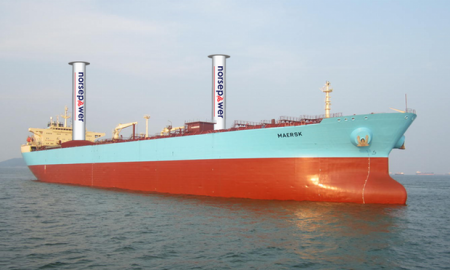
Maersk along with other maritime shipping companies are seeking ways to reduce their carbon footprints. One way has involved reintroducing wind power into maritime transportation. Most of us, however, think of wind power and traditional canvas sails. Norsepower, however, has experimented with an alternative dredged up from the past, a failed 1926 invention, a rotating cylinder that uses its motion to create a push phenomenon similar to the wind hitting sails. In this case, however, the airstream created comes from backspin, just like a spinning baseball released by a pitcher creates lift changing the flight of the ball.
Norsepower, the builder of the rotor sails has installed them on three ships so far. In the Pelican project, they partnered with Maersk Tankers, Energy Technologies Institute (ETI), and Shell International Trading and Shipping Company. Independent oversight and performance analysis was carried out by Lloyd’s Register’s Ship Performance Group. The partners plan to publish detailed results of the one-year pilot project.
Tommy Thomassen, CTO of Maersk Tankers when interviewed described the positive outcome of the one-year test noting optimal usability, safety, and performance under all conditions the Pelican faced. The company is looking for ways to reduce overall greenhouse gas (GHG) emissions and Thomassen sees wind technology as a potential breakthrough. Maersk has set a fleet emission reduction target of 30% by 2021, and 60% reduction from a 2008 baseline by 2030. The plan is to continue operating the Pelican with rotor sails and install the technology on other ships in the fleet.
Shipping is responsible for between 2 and 3% of GHGs, and with 80% of global trade traveling by sea, the industry is working on getting to a state of carbon neutrality by 2050. Maersk wants to be zero-emission in its operations by that date. To get there the company is experimenting with new ship designs, carbon-neutral fuels, rechargeable, and continuous-charge electric propulsion systems, and, of course, wind power. Total investment to achieve carbon neutrality so far has amounted to $1 billion USD. The company has reached out to researchers, academics, technology inventors, investors, cargo owners, and governments seeking co-development and sponsorship of sustainable solutions that eliminate traditional fossil fuels from maritime shipping. The company describes climate change as “one of the most important issues in the world.”

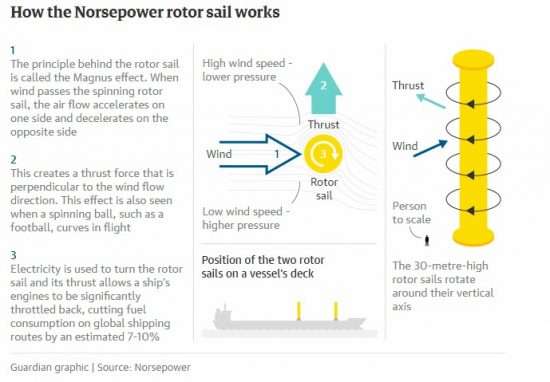
What is that? When spin is applied to object moving through an airstream it creates a propulsive force. If you play tennis and know how to put backspin on a ball then you are using the Magnus Effect to make that ball move in a different way. A pitcher and a baseball bat both use the Magnus Effect. The pitcher throws the ball applying a spin. The bat creates a counteracting spin. In both cases, the Magnus Effect changes the flight of the ball.

When Flettner built his two ships, one, the Barbara, outfitted with 15 meter (50 foot) tall rotors, traveled from Danzig, to South America, and finally to New York City using the technology for propulsion. Keeping the rotor sails spinning consumed too much power when compared to conventional screw propeller driven ships. The result, the technology was abandoned. But times have changed and the technology including materials used to build rotor sails has changed.
That’s why Maersk, the international marine fleet operator, has decided to launch a pilot project, retrofitting a 240-meter (790 foot) oil tanker with two 30-meter (almost 100 foot) rotor sails. These new rotors are the product of a Finnish company, Norsepower. Norsepower describes itself as a clean technology engineering company pioneering in the generation of renewable wind energy for the global maritime industry. It builds three different-sized rotor sails, the smallest 18 meters (60 feet), the intermediate, 24 meters (79 feet), and the tallest, 30 meters (100 feet), the ones being installed for Maersk.
Software controls, wind speed, ship speed and global position sensors help to optimize each sail’s performance. When wind direction changes the rotor spin can be reversed to take full advantage of the power and speed boost gained from the sail’s operation. The rotor sail requires 50 kilowatts of electricity to operate and generates the equivalent of 3 Megawatts of power.
To retrofit an existing ship there should be no obstructing cargo handling equipment on deck surfaces to create turbulence impacting rotor sail performance. Best candidates for rotor sail installation, states Norsepower, are ships traveling routes with constant, prevailing wind conditions over long distances. Cruise ships and tankers seem to best fit the bill.
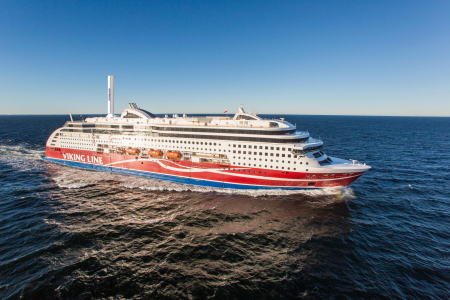
Back in January, Norsepower and the Viking Line announced a rotor sail will be installed on the Viking Grace, a 57,565 ton cruise ship operating in the Baltic Sea and Gulf of Finland. The single rotor sail to be installed is the intermediate height version. Viking hopes to reduce its carbon emissions contribution by 900 tons annually and to save 300 tons in liquid natural gas fuel per year. The Viking Grace with rotor sail on board should be at sea by the end of 2018.
Andrew Scott, at the United Kingdom’s Energy Technologies Institute, when asked about rotor sails, states, “this is one of the few fuel-saving technologies that could offer double-digit percentage improvements” to marine fleet operations. The International Maritime Organization (IMO) recognizes that the burning of bunker oil, is highly polluting and contributes atmospheric aerosols as well as significant greenhouse gasses to the planet’s atmosphere. This Maersk installation will be monitored closely in anticipation that it will produce operational savings of 10% or more, reducing bunker fuel requirements by 1,000 tons, and carbon emissions by an estimated 3,000 tons per year. The Maersk ship with its rotor sails will begin to operate early in 2018.